+91-9646339590



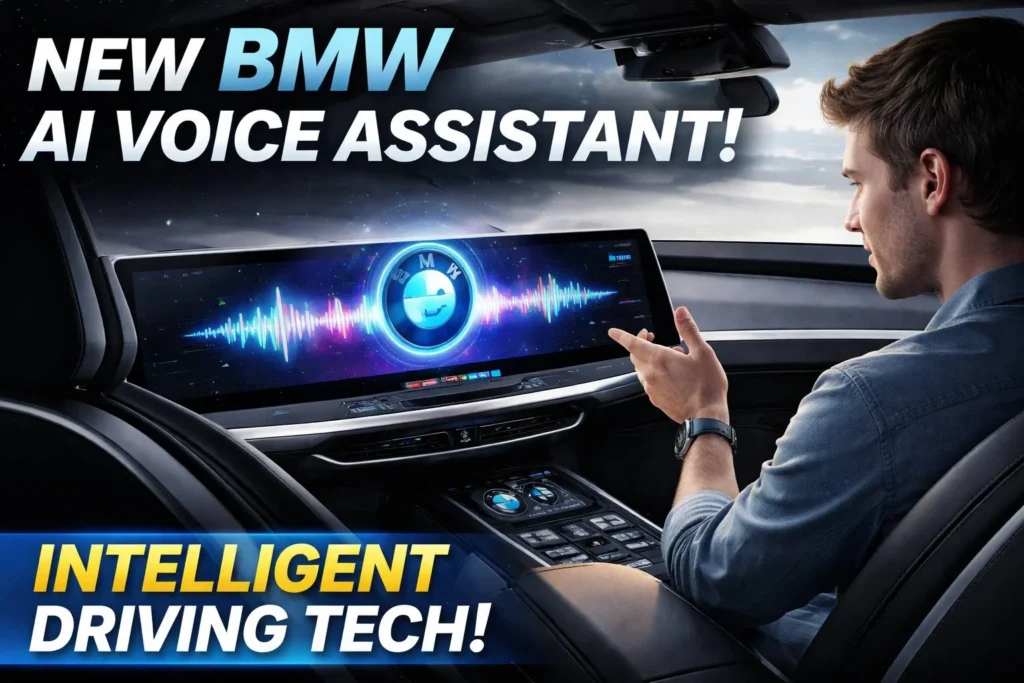
BMW is entering a new era of automotive innovation by integrating advanced artificial intelligence into its newest generation of vehicles. At the center of this transformation is BMW Operating System 9, a modern software architecture designed to enhance voice interaction, navigation intelligence, driver assistance, and vehicle personalization.
This shift reflects the industry’s broader movement toward software-defined vehicles, where capabilities can improve long after a car leaves the showroom. By combining machine learning, cloud connectivity, and deep vehicle sensor integration, BMW is creating a driving environment that becomes smarter and more responsive with every update. The platform expands upon the BMW Intelligent Personal Assistant, enabling natural conversations, contextual responses, and seamless control of multiple vehicle functions.
Instead of relying on rigid voice commands or complex menu navigation, drivers can communicate with the car in a natural way. The result is a more intuitive in-car experience where many routine adjustments happen automatically, allowing drivers to focus more on the road ahead.
What Is BMW’s AI-Driven Driving Experience?
The AI-powered ecosystem introduced with BMW Operating System 9 combines intelligent voice interaction, adaptive driver assistance technologies, and continuous over-the-air software improvements. Together, these technologies create a unified digital platform that functions as the vehicle’s central intelligence hub.
Traditional infotainment systems often felt like standalone screens mounted on the dashboard. In contrast, BMW’s new architecture connects various vehicle systems so they can share data and respond dynamically to real-world driving conditions. The objective is to reduce driver workload while enhancing safety, efficiency, and comfort.
- Conversational Voice Assistant: Advanced speech recognition that understands intent rather than simple keywords.
- Context-Aware Navigation: Intelligent routing suggestions based on traffic patterns, driving history, and environmental data.
- AI-Supported Safety: Driver assistance systems capable of analyzing road conditions in real time.
- Continuous Evolution: Regular feature improvements delivered through over-the-air software updates.
- Deep Personalization: Automatic adjustment of hundreds of cabin preferences tailored to each driver.
Natural Voice Interaction Inside the Cabin
The updated BMW Intelligent Personal Assistant now offers significantly improved conversational abilities. Instead of responding only to specific commands, the system can understand natural language and handle follow-up questions without requiring the driver to repeat a wake phrase.
This improvement is powered by advanced language models capable of analyzing context and intent. Drivers can interact with the vehicle in a more human-like manner, allowing multiple vehicle functions to be controlled through simple voice requests.
- “Find a coffee shop along my route to work that has a drive-through.”
- “Play my morning playlist, lower the cabin temperature, and dim the interior lights.”
- “Do I have enough battery range to reach my destination without charging?”
By enabling voice control for complex actions, BMW reduces the need for drivers to navigate through touchscreen menus while driving. This helps minimize distractions and supports a safer driving experience.
AI Working with Navigation and Driver Assistance
Artificial intelligence also powers BMW’s advanced driver assistance technologies. Through a network of cameras, radar sensors, and ultrasonic detectors, the vehicle constantly monitors its surroundings and interprets road conditions in real time.
The system analyzes this data using onboard algorithms that help anticipate traffic situations, assist with lane positioning, and simplify parking in crowded environments. These technologies provide additional situational awareness while keeping the driver fully in control.
- Assisted Highway Driving: Adaptive cruise control capable of adjusting speed according to traffic flow, curves, and speed limits.
- Intelligent Lane Guidance: Navigation-based lane suggestions that help drivers stay on the correct route.
- Automated Maneuvering: Parking systems capable of memorizing complex parking paths and repeating them automatically.
- 360-Degree Environmental Awareness: AI filtering of sensor data to identify pedestrians, cyclists, and other potential hazards.
Personalization Based on Driver Behavior
One of the most impressive aspects of BMW’s AI platform is its ability to learn from driver behavior over time. By observing everyday usage patterns, the system gradually adapts vehicle settings to match the driver’s personal preferences.
Seat positions, mirror angles, climate control settings, ambient lighting, and media preferences can all be automatically configured when a driver enters the vehicle. These preferences are connected to the driver’s BMW ID and securely stored in the cloud.
If the same driver enters another compatible vehicle—such as the BMW iX or the luxury BMW i7—their personalized profile can be instantly downloaded, recreating a familiar driving environment.
The “Software-Defined Vehicle” and Over-the-Air Updates
BMW is actively transitioning toward a software-defined vehicle architecture. In the past, adding new features typically required purchasing a newer vehicle model. With BMW Operating System 9, the hardware platform is designed to support continuous software expansion.
This means new functionality, improved energy management for electric vehicles, and additional interface features can be introduced through cloud-based updates. These improvements allow vehicles to remain technologically current for longer periods while reducing the need for dealership visits.
Real-World Implementation: BMW iX and i7
These AI-driven capabilities are already available in flagship models such as the BMW iX and the fully electric luxury sedan BMW i7. These vehicles act as technology showcases for BMW’s evolving digital ecosystem.
They also serve as the foundation for the upcoming Neue Klasse platform, which will introduce next-generation computing systems designed to process AI functions locally within the vehicle. This approach reduces response times and improves reliability while minimizing reliance on cloud processing.
How This Helps in Everyday Driving
Beyond advanced technology, BMW’s AI ecosystem delivers practical benefits for everyday drivers.
- Reduced Driving Stress: Intelligent assistance systems help manage heavy traffic and repetitive driving situations.
- Improved Efficiency: Smart navigation can suggest energy-efficient routes for electric vehicles.
- Enhanced Safety: Continuous environmental monitoring provides an additional layer of awareness.
- Greater Convenience: Voice commands eliminate the need to navigate through multiple touchscreen menus.
Technical Comparison: AI Features vs. Traditional Systems
| Feature | Traditional Infotainment | BMW AI (OS 9) |
|---|---|---|
| Voice Control | Fixed phrases and limited commands | Natural language processing with contextual understanding |
| Navigation | Static GPS mapping | Cloud-connected navigation with live traffic intelligence |
| Updates | Manual updates at dealerships | Automatic over-the-air feature updates |
| Parking | Basic sensors and alerts | Automated maneuvering with memory-based parking assistance |
| User Profile | Manual seat memory settings | Cloud-synced BMW ID with full cabin personalization |
AI, Data Security, and User Privacy
As vehicles become more connected, data privacy and cybersecurity are increasingly important. BMW emphasizes strong safeguards to ensure that user data is handled responsibly.
Most AI processing related to voice recognition and driving habits occurs locally within the vehicle, while cloud services use anonymized data whenever possible. Drivers also maintain control over what information can be shared with BMW’s digital services.
Critical driving systems are separated from entertainment software layers to prevent unauthorized access and maintain safety integrity across all vehicle operations.
Conclusion
BMW’s integration of artificial intelligence represents a major step toward the future of intelligent mobility. By combining software innovation, advanced sensor systems, and cloud connectivity, the company is transforming the driving experience into something more adaptive and personalized.
As demonstrated by vehicles such as the BMW iX and the BMW i7, modern vehicles are evolving beyond traditional transportation machines. They are becoming intelligent digital companions capable of learning from their drivers, improving through updates, and delivering a more seamless driving experience with every journey.
About the Author
Ankush Kumar is an automotive content specialist with over 5 years of experience covering global car markets, hybrid technologies, and EV ecosystem developments. His work focuses on translating complex automotive engineering concepts into practical insights for Indian buyers.
He has analyzed vehicle platforms, powertrain systems, and real-world usability trends across multiple brands. His content emphasizes data-backed evaluation, regulatory awareness, and ownership practicality.