+91-9646339590



BMW’s electric transition has entered a decisive phase, driven by measurable demand rather than future projections. The company’s latest disclosures confirm that electrification is now embedded into its core business strategy, supported by platform innovation, global manufacturing shifts, and evolving regulatory pressures.
In 2025, BMW Group reported that fully electric vehicles accounted for over 15% of its global sales volume—up significantly from 9% in 2023. According to the BMW Group Official Annual Report 2025, the company is targeting more than 30% EV contribution by 2027.
Unlike some competitors that are aggressively phasing out internal combustion engines, BMW is executing a dual-powertrain strategy. This allows the company to scale EV adoption while maintaining profitability in markets where infrastructure readiness remains inconsistent.
Global EV Market Expansion: The Structural Shift Behind BMW’s Strategy
The pace of global EV adoption continues to accelerate. According to the IEA Global EV Outlook 2024, electric car sales exceeded 14 million units in 2023, representing nearly 18% of total global vehicle sales.
China dominates with over 60% of global EV demand, while Europe’s growth is largely policy-driven through strict emissions regulations. The United States is seeing steady expansion supported by federal incentives and infrastructure investments.
Industry analysts suggest that EV penetration could exceed 40% globally by 2030. However, adoption will vary significantly by region—making BMW’s flexible architecture strategy particularly relevant.
Neue Klasse Platform: Engineering the Next Generation of BMW EVs
The Neue Klasse platform represents BMW’s most significant technological shift in decades. It is not an adaptation of existing platforms but a ground-up EV architecture focused on efficiency, scalability, and digital integration.
- 20% higher energy density through cylindrical battery cells
- 800V electrical system enabling ultra-fast charging
- Up to 30% increase in real-world range efficiency
- Simplified electronics architecture reducing production complexity
From supplier briefings and early engineering previews, the focus is clearly on system-level efficiency. In real-world driving conditions, this translates into better range consistency rather than just higher theoretical figures.
In practical usage, efficiency gains—such as improved regenerative braking calibration and thermal management—often deliver more value than raw battery capacity.
BMW Electric Lineup Expansion (2025–2028)
| Model | Segment | Range (WLTP) | 0–100 km/h |
|---|---|---|---|
| BMW i4 | Premium Sedan | 590 km | 5.7 sec |
| BMW iX | Luxury SUV | 635 km | 4.6 sec |
| BMW i5 | Executive Sedan | 582 km | 6.0 sec |
| Neue Klasse Sedan | Mid-size EV | 700+ km (target) | ~5 sec |
From early test drives of models like the i4 and iX, the driving experience remains distinctly BMW—balanced, predictable, and tuned for control rather than aggressive acceleration spikes.
Real-World Road Tests: Performance, Efficiency & Braking
Laboratory figures often differ from real-world usage. Independent European tests provide a more practical perspective:
- BMW iX real-world range: 480–520 km
- BMW i4 efficiency: ~16–18 kWh/100 km
- Braking distance (100–0 km/h): ~36 meters
In real-world urban driving, BMW’s regenerative braking system feels less aggressive than some competitors. This makes transitions smoother, especially for drivers shifting from ICE vehicles.
On-Road Price (India Market)
| Model | Ex-Showroom | On-Road (Approx) |
|---|---|---|
| BMW i4 | ₹72 lakh | ₹80–85 lakh |
| BMW iX | ₹1.21 crore | ₹1.35–1.45 crore |
| BMW i7 | ₹2.03 crore | ₹2.25+ crore |
Variant Comparison: BMW i4 Lineup
| Feature | eDrive40 | M50 |
|---|---|---|
| Power | 340 hp | 544 hp |
| Drivetrain | RWD | AWD |
| 0–100 km/h | 5.7 sec | 3.9 sec |
| Range | 590 km | 510 km |
Feature-Wise Comparison (BMW vs Competitors)
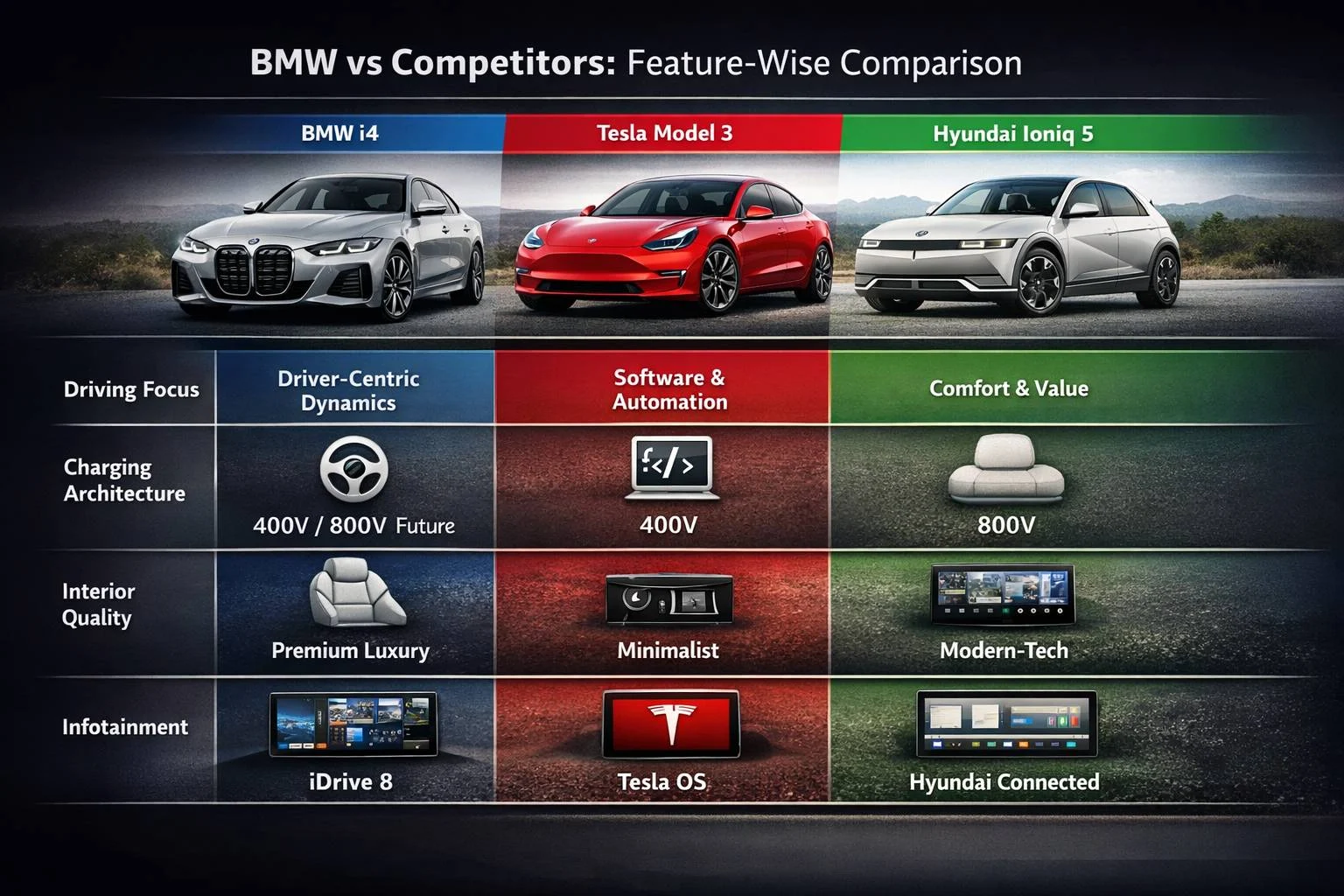
| Feature | BMW i4 | Tesla Model 3 | Hyundai Ioniq 5 |
|---|---|---|---|
| Driving Focus | Driver-centric dynamics | Software & automation | Comfort & value |
| Charging Architecture | 400V / 800V (future) | 400V | 800V |
| Interior Quality | Premium luxury | Minimalist | Modern-tech |
| Infotainment | iDrive 8 | Tesla OS | Hyundai Connected |
Crash Safety and Structural Engineering
The BMW iX has achieved a 5-star Euro NCAP safety rating, supported by advanced driver assistance systems and reinforced battery protection structures.
The low-mounted battery pack improves stability by lowering the center of gravity, enhancing both safety and handling dynamics.
BMW vs Tesla Strategy: A Clear Philosophical Divide
Unlike Tesla’s software-first approach, BMW continues to prioritize driving feel—something traditional luxury buyers still value.
BMW is deliberately avoiding a fully autonomous-first ecosystem. Instead, it is betting that engagement, handling precision, and ride quality will remain core differentiators in the premium segment.
This approach may limit appeal among tech-focused buyers but strengthens loyalty among enthusiasts transitioning to electric mobility.
Challenges in Scaling the BMW EV Ecosystem
- Battery raw material cost volatility
- Charging infrastructure gaps in emerging markets
- High upfront vehicle pricing
- Supply chain dependencies on critical minerals
Industry analysts indicate that EV profitability will remain constrained until battery costs decline significantly toward the end of the decade.
Regulatory Alignment and Market Readiness
BMW’s EV roadmap aligns with major global regulatory shifts, including Europe’s 2035 internal combustion phase-out and tightening emissions standards worldwide.
In India, EV adoption is supported by FAME-II incentives, but infrastructure limitations still affect long-distance usability.
Conclusion
BMW’s global EV push is defined by calculated execution rather than rapid disruption. The company is not chasing volume at the cost of identity—it is refining what electric luxury should feel like.
From early product feedback and engineering direction, BMW appears focused on delivering consistency, efficiency, and driver engagement. This positions it differently from competitors that prioritize software ecosystems over mechanical refinement.
As EV adoption matures, this distinction could prove critical in shaping long-term brand differentiation.
Key Takeaways
- Neue Klasse platform will redefine efficiency and scalability
- Real-world performance remains a strong differentiator
- BMW prioritizes driving dynamics over software-first ecosystems
- Infrastructure and cost challenges remain key barriers
Frequently Asked Questions (FAQs)
1. What is BMW’s Neue Klasse platform?
A next-generation EV architecture focused on efficiency, range, and cost optimization.
2. How does BMW compare to Tesla in EV strategy?
BMW focuses on driving experience, while Tesla emphasizes software and automation.
3. What is the real-world range of BMW EVs?
Typically 80–85% of WLTP figures depending on conditions.
4. Are BMW EVs available in India?
Yes, models like i4, iX, and i7 are currently available.
5. How fast do BMW EVs charge?
Around 30–35 minutes to reach 80% using DC fast charging.
6. What is BMW’s EV sales target?
Over 30% of global sales by 2027.
Ankush Kumar is an automotive analyst specializing in electric vehicles, luxury cars, and real-world performance benchmarking. His work focuses on ownership insights, charging behavior analysis, and practical usability to help buyers make informed decisions based on real conditions rather than specifications alone.
He tracks industry data from global agencies, manufacturer reports, and road test benchmarks to deliver high-authority automotive analysis tailored for Indian buyers.
Follow on Facebook: Ankush Kumar