+91-9646339590



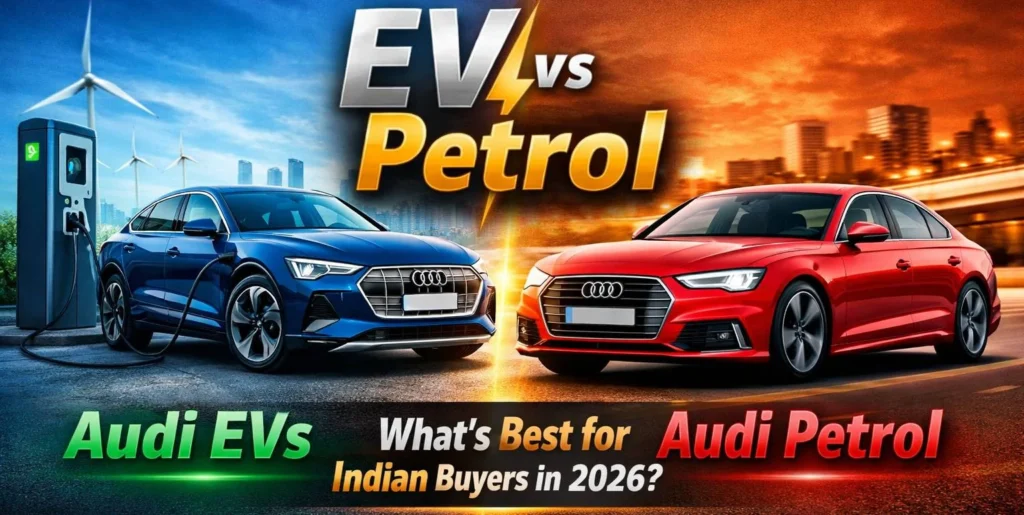
The Indian luxury car market is entering a transition phase. Premium buyers are no longer comparing brands alone; they are comparing powertrains. Audi’s portfolio in India now includes both high-performance electric SUVs such as the Audi Q8 e-tron and traditional petrol models like the Audi Q7, Audi Q8, and Audi A6.
The question facing buyers in 2026 is no longer “Should I consider an EV?” but rather whether an Audi electric vehicle actually makes more sense than a conventional petrol luxury SUV or sedan in India’s driving conditions. Price, charging infrastructure, performance characteristics, resale value, and ownership costs all influence the answer.
This detailed analysis compares Audi EVs and petrol models across pricing, performance, safety ratings, real-world road tests, acceleration, braking, and long-term ownership factors specifically for Indian buyers.
Audi’s Current EV and Petrol Line-Up in India
Audi India currently sells a small but expanding electric lineup alongside its established petrol range. The company launched the Audi e-tron family in India in 2021 and has since introduced updated models with improved range and charging capability.
Meanwhile, petrol SUVs and sedans remain the brand’s volume drivers in the luxury segment.
Audi Electric Models in India (2026)
• Audi Q8 e-tron
• Audi Q8 Sportback e-tron
• Audi e-tron GT
• Audi RS e-tron GT
Audi Petrol Models in India
• Audi Q7 (3.0L TFSI V6)
• Audi Q8 (3.0L TFSI V6)
• Audi A6 (2.0L TFSI)
• Audi A4 (2.0L TFSI)
• Audi S5 Sportback
The most relevant comparison for buyers is between the Audi Q8 e-tron electric SUV and petrol SUVs such as the Audi Q7 or Audi Q8.
On-Road Price Comparison in India (2026)
Luxury EV pricing in India remains high because of import duties and battery costs. However, incentives and lower running costs partly offset this.
| Model | Powertrain | Ex-Showroom Price | Approx On-Road Price |
|---|---|---|---|
| Audi Q8 e-tron 50 | Electric | ₹1.15 crore | ₹1.18 crore |
| Audi Q8 e-tron 55 | Electric | ₹1.27 crore | ₹1.31 crore |
| Audi Q7 | Petrol | ₹88 lakh | ₹1.02 crore |
| Audi Q8 | Petrol | ₹1.07 crore | ₹1.22 crore |
The electric Q8 e-tron sits slightly above the petrol Q7 in price but close to the petrol Q8 depending on the variant. Luxury EV buyers therefore often cross-shop between these two SUVs.
Variant Comparison
| Variant | Power Output | Battery / Engine | Range / Mileage | Drivetrain |
|---|---|---|---|---|
| Q8 e-tron 50 | 340 hp | 95 kWh battery | 491 km range | Quattro AWD |
| Q8 e-tron 55 | 403 hp | 114 kWh battery | 582 km range | Quattro AWD |
| Audi Q7 | 340 hp | 3.0L V6 petrol | 11 km/l | Quattro AWD |
| Audi Q8 | 340 hp | 3.0L V6 petrol | 10 km/l | Quattro AWD |
The electric Q8 e-tron offers similar power output to Audi’s V6 petrol SUVs but delivers peak torque instantly because of the electric motor characteristics.
Real-World Range vs Petrol Mileage
Range anxiety remains a common concern among Indian luxury buyers considering EVs. The official range figures are measured under standardized testing conditions and may differ in real-world usage.
The Audi Q8 e-tron offers an ARAI-equivalent range of roughly 491–582 km depending on the variant. In mixed driving conditions, most road tests in India report practical ranges between 380 and 450 km per charge. Independent global EV research from the International Energy Agency’s Global EV Outlook also highlights how real-world driving conditions such as temperature, traffic density, and highway speeds can reduce official EV range figures by 10–25%.
By comparison, the Audi Q7 petrol typically delivers 9–11 km per litre in urban conditions and around 12 km per litre on highways.
For a driver covering 15,000 km annually:
EV electricity cost: ₹1.5–₹2.2 per km
Petrol cost: ₹10–₹13 per km
This means the EV can reduce energy cost by nearly 70–80% over a year.
0–100 km/h Acceleration Comparison
| Model | 0-100 km/h | Power |
|---|---|---|
| Audi Q8 e-tron 55 | 5.6 sec | 403 hp |
| Audi Q7 | 5.9 sec | 340 hp |
| Audi Q8 | 5.6 sec | 340 hp |
Electric vehicles deliver instant torque. This allows the Q8 e-tron to accelerate strongly despite weighing over 2.5 tonnes. Real-world acceleration tests confirm the SUV can reach 100 km/h in around 5.6 seconds.
Braking Test Results
Luxury EVs are heavier due to battery packs, which affects braking distance. However regenerative braking helps reduce wear on brake pads.
| Model | 100-0 km/h Braking Distance | Brake Type |
|---|---|---|
| Audi Q8 e-tron | ~36–38 meters | Disc brakes with regenerative braking |
| Audi Q7 | ~37 meters | Ventilated disc brakes |
| Audi Q8 | ~36 meters | High-performance disc brakes |
Despite the EV’s weight, advanced regenerative braking systems distribute braking force efficiently, keeping stopping distances comparable to petrol SUVs.
Crash Safety Ratings
Safety remains a strong selling point for Audi vehicles regardless of powertrain.
| Model | Crash Rating | Airbags |
|---|---|---|
| Audi Q8 e-tron | 5-Star Euro NCAP | 8 airbags |
| Audi Q7 | 5-Star Euro NCAP | 8 airbags |
| Audi Q8 | 5-Star Euro NCAP | 8 airbags |
The Q8 e-tron uses a reinforced battery protection structure and aluminum crash frames designed to isolate high-voltage components during collisions.
Charging Infrastructure Reality in India
Infrastructure remains the biggest practical difference between EV and petrol ownership.
According to India’s Ministry of Power, the country had over 12,000 public EV charging stations by early 2025, compared with fewer than 2,000 in 2021. Major highways such as the Delhi-Jaipur and Mumbai-Pune corridors now support fast charging networks from companies like Tata Power, Statiq, and Fortum.
The Audi Q8 e-tron supports up to 170 kW DC fast charging, allowing a 10–80% charge in roughly 30 minutes under ideal conditions.
However, luxury EV buyers still rely heavily on home charging setups, especially in metro cities.
Ownership Cost Comparison (5-Year Estimate)
| Cost Category | Audi Q8 e-tron | Audi Q7 |
|---|---|---|
| Fuel / Electricity | ₹2–3 lakh | ₹9–12 lakh |
| Maintenance | Lower (fewer moving parts) | Higher |
| Insurance | Slightly higher | Standard |
| Resale value | Still evolving | More predictable |
Electric vehicles eliminate oil changes, spark plugs, and complex transmission systems, which reduces servicing complexity.
Feature-Wise Comparison
| Feature | Audi Q8 e-tron | Audi Q7 |
|---|---|---|
| Virtual Cockpit | Yes | Yes |
| Adaptive Air Suspension | Yes | Yes |
| Regenerative Braking | Yes | No |
| All-Wheel Drive | Electric Quattro | Mechanical Quattro |
| Fast Charging | 170 kW | Not applicable |
Market Trends Influencing Audi Buyers
The luxury EV segment in India grew by more than 70% between 2022 and 2025, according to data from JATO Dynamics. Premium buyers in cities like Bengaluru, Mumbai, and Delhi are increasingly adopting EVs as secondary cars because home charging is easier in private residences.
However petrol SUVs continue to dominate long-distance touring buyers due to refuelling convenience.
When an Audi EV Makes More Sense
An electric Audi works best for:
• Urban luxury commuters
• Owners with home charging access
• Buyers prioritizing quiet performance and low running cost
• Drivers covering predictable daily routes
When Petrol Audi Models Are Still the Better Choice
Petrol models remain practical for:
• Frequent inter-city travellers
• Buyers without dedicated charging access
• Owners planning long highway trips regularly
• Those prioritizing resale stability
Conclusion
The comparison between Audi EVs and petrol models in India is less about performance and more about usage patterns. Electric models like the Q8 e-tron deliver impressive acceleration, lower running costs, and cutting-edge technology. Petrol SUVs such as the Q7 still offer unmatched convenience for long journeys across a country where charging infrastructure is still developing.
For urban luxury buyers with predictable driving patterns, Audi’s EV lineup already makes financial and technological sense. For highway-focused drivers or buyers without reliable charging access, petrol models remain the more practical option in 2026.
Key Takeaways
• Audi EVs offer significantly lower running costs than petrol models.
• Acceleration performance is comparable or better due to instant torque.
• Charging infrastructure is improving but still limited outside major cities.
• Petrol models retain advantages for long highway trips.
• Luxury EV adoption in India is growing rapidly but remains urban-centric.
Frequently Asked Questions
Is buying an Audi EV worth it in India in 2026?
For buyers with home charging access and primarily city driving, Audi EVs can significantly reduce running costs while offering strong performance and advanced technology.
What is the real-world range of the Audi Q8 e-tron?
Although the official range is up to about 582 km, real-world driving conditions in India typically deliver 380–450 km per charge depending on traffic and driving style.
Are Audi EVs faster than petrol models?
Many electric Audis match or outperform petrol models in acceleration because electric motors deliver maximum torque instantly.
How long does it take to charge an Audi EV?
Using a 170 kW DC fast charger, the Audi Q8 e-tron can charge from roughly 10% to 80% in around 30 minutes under optimal conditions.
Do Audi EVs require less maintenance than petrol cars?
Yes. EVs have fewer mechanical components, eliminating engine oil changes, exhaust systems, and complex gearboxes, which reduces long-term servicing requirements.
BMW has introduced a new AI-powered driving experience with the rollout of Operating System 9, a software platform that enables natural voice interaction, adaptive navigation, and continuous over-the-air updates.
BMW is entering a new phase of digital mobility by integrating advanced artificial intelligence into its latest vehicles. At the core of this shift is BMW Operating System 9, designed to unify voice interaction, navigation intelligence, driver assistance, and personalization into a single platform.
According to official BMW communication, Operating System 9 represents a major step toward software-defined vehicles, where features evolve continuously through software updates rather than hardware changes.
By combining machine learning, cloud connectivity, and deep sensor integration, BMW is restructuring how drivers interact with vehicles—reducing manual inputs and enabling context-aware automation.
What Defines BMW’s AI-Driven Driving Experience?
BMW Operating System 9 acts as a central intelligence layer connecting multiple vehicle systems into a unified architecture. Unlike traditional infotainment systems, it enables real-time data sharing across vehicle functions.
- Conversational Voice Interface: Understands intent and context
- Adaptive Navigation: Real-time traffic and route intelligence
- AI Driver Assistance: Continuous environment analysis
- OTA Updates: Ongoing feature improvements
- Full Personalization: Driver-specific cabin settings
Key insight: The shift is from reactive controls to predictive, AI-driven interaction.
Natural Voice Interaction and Reduced Distraction
The updated BMW Intelligent Personal Assistant supports natural conversations and multi-step commands without repeated prompts.
- “Find a coffee shop on my route.”
- “Set temperature to 22°C and play music.”
- “Do I have enough range?”
This reduces reliance on touchscreens and helps lower driver distraction.
AI Integration with Navigation and Driver Assistance
BMW combines cameras, radar, and sensors with AI algorithms to interpret driving conditions in real time.
- Adaptive cruise based on traffic and curves
- Navigation-linked lane guidance
- Automated parking with memory function
- 360° hazard detection
Personalization Through AI Learning
The system learns driver behavior and automatically adjusts seat position, climate, lighting, and media preferences.
Profiles linked to BMW ID can sync across vehicles like the BMW iX and BMW i7.
Software-Defined Vehicle and OTA Updates
Operating System 9 enables continuous improvement via over-the-air updates, extending vehicle capabilities over time.
This approach keeps vehicles technologically current without requiring dealership visits.
Real-World Models: BMW iX and i7
These AI features are already available in flagship EVs like the BMW iX and BMW i7, which act as technology platforms for BMW’s future systems.
They also preview the upcoming Neue Klasse architecture, focused on local AI processing and faster system response.
Everyday Driving Benefits
- Reduced driver workload
- Improved route efficiency
- Enhanced safety awareness
- Seamless voice control
Reality check: Performance depends on real-world conditions and infrastructure.
Technical Comparison
| Feature | Traditional | BMW OS 9 |
|---|---|---|
| Voice | Command-based | Natural language AI |
| Navigation | Static GPS | Live intelligent routing |
| Updates | Manual | OTA updates |
| Parking | Basic sensors | Automated memory system |
| Profiles | Limited | Cloud-based personalization |
Data Security and Privacy
BMW uses layered cybersecurity systems. Most processing occurs locally, while cloud data is anonymized. Drivers control data-sharing preferences.
Conclusion
BMW Operating System 9 marks a shift toward intelligent, software-driven mobility. By integrating AI across key systems, BMW is reducing friction between driver and machine.
Final takeaway: The future of driving is defined less by hardware and more by continuously evolving software platforms.
FAQ
What is BMW Operating System 9?
It is BMW’s latest software platform enabling AI-driven features, voice control, and OTA updates.
Which cars use this system?
Models like BMW iX and BMW i7 currently feature it.
Does it improve safety?
Yes, through AI-powered driver assistance and real-time monitoring.
Ankush Kumar is an automotive analyst specializing in electric vehicles, luxury cars, and real-world performance benchmarking. His work focuses on ownership insights, charging behavior analysis, and practical usability to help buyers make informed decisions based on real conditions rather than specifications alone.
He tracks industry data from global agencies, manufacturer reports, and road test benchmarks to deliver high-authority automotive analysis tailored for Indian buyers.
Follow on Facebook: Ankush Kumar