+91-9646339590



Introduction
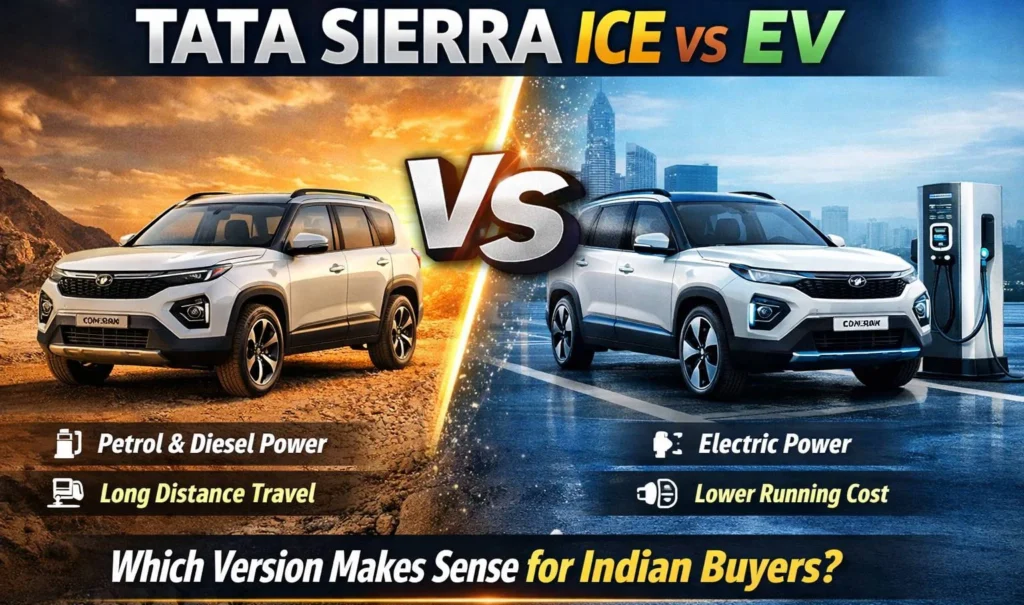
The Tata Sierra’s comeback is not just a nostalgic revival—it represents a structural shift in how SUVs are being offered in India. By launching both ICE and EV versions of the same product, Tata Motors is effectively asking buyers to choose between two different mobility ecosystems.
This comparison goes beyond specifications. It evaluates how each version behaves in Indian conditions—traffic density, highway usage, climate impact, charging realities, and long-term ownership economics.
Market Context: Why Sierra ICE vs EV Matters
India’s EV market crossed approximately 2.3% passenger vehicle penetration in 2024, with Tata Motors accounting for over 70% of EV sales. However, ICE vehicles still dominate due to infrastructure gaps and purchase cost sensitivity.
This makes the Sierra an important test case: can a premium SUV succeed equally in both ICE and EV formats, or will one clearly outperform the other in real-world usage?
Estimated On-Road Price Comparison (India)
Pricing estimates are derived from Tata’s current lineup positioning (Nexon, Harrier, Curvv EV) and expected feature packaging.
| Variant | Expected Ex-Showroom | Expected On-Road (Delhi) |
|---|---|---|
| Sierra ICE Base | ₹15–16 lakh | ₹17–19 lakh |
| Sierra ICE Top | ₹20–22 lakh | ₹23–26 lakh |
| Sierra EV Base | ₹22–24 lakh | ₹24–26 lakh |
| Sierra EV Top | ₹26–28 lakh | ₹28–31 lakh |
The EV premium (~₹8–10 lakh) aligns with Tata’s current strategy seen in Nexon EV vs Nexon ICE. However, state subsidies and road tax exemptions can reduce this gap by ₹1–2 lakh depending on location.
Powertrain Architecture & Engineering Differences
ICE Version (Harrier-Derived Platform Behavior)
The Sierra ICE is based on Tata’s current architecture and uses the 2.0L Kryotec diesel engine (licensed from Stellantis), along with a possible 1.5L TGDi petrol option.
- Power: 150–170 PS
- Torque: 250–350 Nm
- Transmission: 6MT / 6AT
This engine is already proven in the Harrier and Safari, delivering strong mid-range torque but showing some turbo lag under 1,500 rpm in city conditions.
EV Version (Gen-2 Acti.EV Platform)
The Sierra EV is built on Tata’s Gen-2 Acti.EV architecture, designed to enhance structural rigidity while enabling more efficient battery integration and improved cabin space utilization.
- Battery: 55–60 kWh (likely LFP chemistry)
- Power: ~160–180 PS equivalent
- Torque: ~280–320 Nm (instant delivery)
LFP batteries are less energy-dense than NMC but are more stable under high temperatures—an important factor in Indian conditions where summer temperatures often exceed 45°C.
Acceleration, Weight & Braking Analysis
| Metric | Sierra ICE | Sierra EV |
|---|---|---|
| 0–100 km/h | 10–11 sec | 8–9 sec |
| Kerb Weight | ~1,650–1,750 kg | ~1,900–2,050 kg |
| Braking (100–0 km/h) | 38–40 m | 36–38 m |
Despite being heavier, the EV benefits from a lower center of gravity due to battery placement, improving stability and braking consistency. Regenerative braking also reduces dependency on mechanical brakes in daily driving.
Real-World Performance: City vs Highway
Urban Driving Behavior
The Sierra EV will have a clear advantage in cities. Instant torque eliminates lag, and single-pedal driving reduces fatigue in stop-go traffic. Real-world efficiency is expected to be around 6–7 km/kWh, translating to ~350–420 km usable range.
In contrast, the ICE version’s real-world mileage will likely fall between 12–16 km/l, dropping significantly in dense traffic conditions.
Highway Driving & Range Confidence
On highways, the ICE version remains more practical. Refueling takes under 5 minutes, and range exceeds 700 km per tank.
The EV, while capable, depends on charging infrastructure. India had over 12,000 public charging stations as of 2025, but highway reliability varies. Detailed government data can be accessed through the Ministry of Power official website, which provides updates on EV charging infrastructure and policy initiatives.
DC fast charging is designed to support approximately 10–80% charge in around 40 minutes under optimal conditions. However, real-world charging availability remains uneven, particularly outside major highways and metro regions.
Running Cost & 5-Year Ownership Analysis
Let’s break down realistic ownership costs assuming 15,000 km/year usage:
| Factor | Sierra ICE | Sierra EV |
|---|---|---|
| Fuel/Energy Cost | ₹7–9/km | ₹1–1.5/km |
| Annual Running Cost | ₹1.1–1.3 lakh | ₹20,000–30,000 |
| 5-Year Cost | ₹5.5–6.5 lakh | ₹1–1.5 lakh |
The EV can recover a large portion of its price premium over 5 years, especially for high-mileage users. However, battery replacement (post 8 years) remains a long-term consideration, though costs are steadily declining.
Feature & Technology Comparison
| Feature | Sierra ICE | Sierra EV |
|---|---|---|
| ADAS Level 2 | Yes | Yes (better integration) |
| Infotainment | 12–13 inch | 12–13 inch + EV UI |
| Drive Modes | Eco/Sport | Eco/City/Sport + Regen levels |
| OTA Updates | Limited | Full-stack OTA |
| Connected Tech | Standard | Advanced battery analytics |
The EV variant will be more software-centric, offering features like charging scheduling, energy consumption tracking, and remote diagnostics.
Safety & Crash Rating
Tata Motors has established a strong safety track record, with models like the Nexon and Punch securing 5-star ratings in Global NCAP assessments. As of now, the Tata Sierra does not have an officially published Bharat NCAP crash test rating in the public domain.
Buyers can refer to standardized crash test protocols and verified results through the Global NCAP website, which evaluates vehicle safety performance across multiple markets, including India.
Key safety features include:
- 6 airbags standard
- Electronic Stability Control (ESC)
- ADAS (adaptive cruise, lane assist)
The EV’s battery pack will also act as a structural reinforcement element, improving crash energy distribution.
Thermal Management & Indian Conditions
Battery performance in Indian climates is a critical factor. Tata’s newer EVs use liquid-cooled battery systems to maintain optimal temperature ranges.
In high heat conditions (40–45°C), EV efficiency can drop by 5–10%, but LFP chemistry offers better thermal stability compared to NMC batteries.
ICE vehicles, on the other hand, experience efficiency drops due to AC load and engine heat but remain operationally consistent.
Resale Value & Market Reality
ICE vehicles still have stronger resale predictability due to established demand. However, EV resale values are improving, particularly for Tata models, due to growing acceptance and lower operating costs.
Data from used car platforms in 2024 shows EV resale values stabilizing at 60–70% after 3 years, compared to ~70–75% for ICE SUVs in the same segment.
Who Should Buy What?
Sierra ICE Makes Sense If:
- You frequently drive long distances (300+ km trips)
- You live in regions with limited charging access
- You prioritize lower upfront cost
Sierra EV Makes Sense If:
- Your daily driving is under 100 km
- You have access to home charging
- You want significantly lower running costs
- You prefer refined, silent driving
Conclusion
The Tata Sierra ICE vs EV decision is ultimately shaped by usage, not specifications. The EV delivers superior refinement, lower operating cost, and stronger city performance. The ICE variant remains unmatched in flexibility, especially for long-distance travel.
As charging infrastructure expands and battery costs decline, the balance will gradually shift toward EVs. But in current Indian conditions, both versions have clear, valid use cases.
Key Takeaways
- EV offers ~70–80% lower running cost than ICE
- ICE remains more practical for highway and rural usage
- EV delivers better acceleration and city drivability
- Charging infrastructure is improving but uneven
- Usage pattern is the most important decision factor
FAQs
1. Is Tata Sierra EV suitable for long-distance travel?
Yes, but requires careful planning around charging stations. ICE is still more convenient for highways.
2. What is the real-world range of Sierra EV?
Expected to be around 350–420 km depending on driving conditions.
3. Will Sierra ICE have diesel option?
Highly likely, based on Tata’s current engine lineup.
4. Which version is cheaper to maintain?
The EV, due to fewer moving parts and lower service requirements.
5. How long does EV battery last?
Typically 8 years or more, with gradual degradation rather than sudden failure.
6. Is EV resale a concern in India?
It is improving rapidly as EV adoption increases and market confidence grows.
About the Author
Ankush Kumar is an automotive content specialist with over 5 years of experience covering global car markets, hybrid technologies, and EV ecosystem developments. His work focuses on translating complex automotive engineering concepts into practical insights for Indian buyers.
He has analyzed vehicle platforms, powertrain systems, and real-world usability trends across multiple brands. His content emphasizes data-backed evaluation, regulatory awareness, and ownership practicality.