+91-9646339590



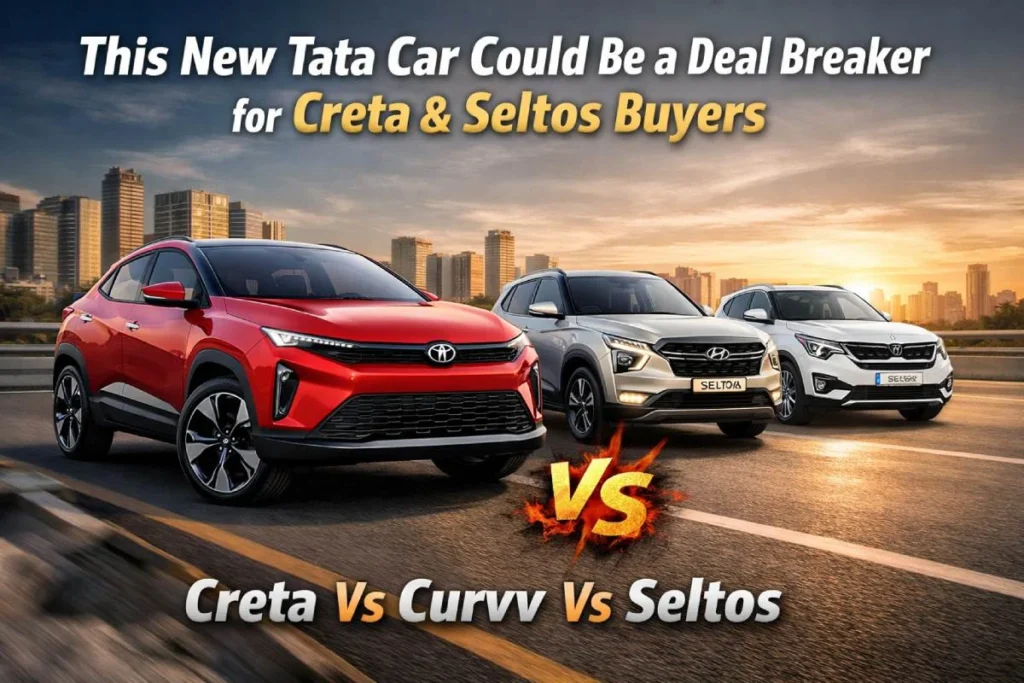
The mid-size SUV segment in India has long been dominated by two key players—the Hyundai Creta and Kia Seltos. Together, they command a major share of monthly sales, with the Creta alone often crossing 13,000–15,000 units, according to SIAM industry data. Their success is built on a proven formula: feature-rich interiors, refined powertrains, and strong brand appeal that continues to attract a wide range of buyers.
The Tata Curvv, however, is not built to follow that formula. It represents a shift in product strategy—one that prioritizes design differentiation, structural safety, and electrification readiness. Instead of competing feature-for-feature, Tata Motors is repositioning what value means in this segment.
Platform & Engineering: The Real Differentiator
The Curvv is underpinned by Tata’s ATLAS-based architecture, engineered to support both internal combustion and electric powertrains from inception. This is a key structural difference from rivals like the Creta and Seltos, which continue to rely on ICE-derived platforms.
This flexible architecture enables:
- Optimized structural rigidity for improved crash protection
- Better packaging efficiency for battery placement in EV variants
- Reduced long-term development cost across multiple powertrains
From an industry standpoint, this aligns with Tata’s broader strategy to scale electrification without developing entirely separate product lines—an approach already visible in its Nexon EV lineup.
Powertrain Strategy: Balancing Efficiency, Performance, and Electrification
The Curvv is expected to introduce Tata’s next-generation 1.2L turbocharged petrol engine with direct injection (GDI). Compared to conventional MPFI systems, GDI improves combustion efficiency, leading to better fuel economy and torque delivery.
- 1.2L Turbo Petrol (GDI): ~125 hp, ~225 Nm
- 1.5L Diesel: ~115 hp, ~260 Nm
- EV Variant: 400–500 km (MIDC cycle)
While the Creta and Seltos offer more powerful turbo-petrol options (~160 hp), Tata’s tuning philosophy is expected to prioritize real-world drivability over outright acceleration—an important distinction for urban Indian usage.
0–100 km/h Performance (Segment Benchmark Context)
- Curvv Petrol DCT: ~10.0–10.5 seconds
- Creta 1.5 Turbo: ~9.0 seconds
- Seltos 1.5 Turbo: ~9.2 seconds
- Curvv EV: ~8.5–9.0 seconds
The EV variant is likely to feel quicker in real-world driving due to instant torque delivery, particularly in city conditions.
Braking & Dynamic Behaviour
Based on Tata’s recent chassis developments, the Curvv is expected to deliver balanced ride quality with improved high-speed stability. Estimated braking performance aligns with segment benchmarks:
- 100–0 km/h: ~38–40 meters
- All-wheel disc brakes (top variants)
- Enhanced ESC calibration
This suggests a focus on predictable and confidence-inspiring dynamics rather than sporty handling.
Crash Safety: Structural Advantage
Tata Motors has established a strong safety reputation, with multiple models achieving high ratings under Global NCAP testing protocols. While the Curvv is yet to be officially rated, its platform and structural philosophy indicate a high probability of strong performance.
- Expected: 5-star crash rating
- 6 airbags standard (expected)
- Level 2 ADAS (lane assist, adaptive cruise, AEB)
This remains a critical differentiator, especially as safety awareness among Indian buyers continues to rise.
Design Strategy: Coupe SUV Trade-Offs
The Curvv introduces a coupe-SUV silhouette—a first in this segment. While this enhances visual appeal and perceived premium positioning, it introduces practical compromises:
- Slight reduction in rear headroom
- Narrower rear glass area impacting visibility
- Potentially less usable boot opening
For urban buyers prioritizing design, these trade-offs may be acceptable. For family buyers, practicality remains a key consideration.
On-Road Price Positioning
- Base Variant: ₹13.5 – ₹14.5 lakh
- Mid Variant: ₹15.5 – ₹17 lakh
- Top Variant: ₹18.5 – ₹20 lakh
This positions the Curvv strategically below the top-end variants of Creta and Seltos, while offering additional differentiation through design and EV availability.
Feature-Wise Comparison
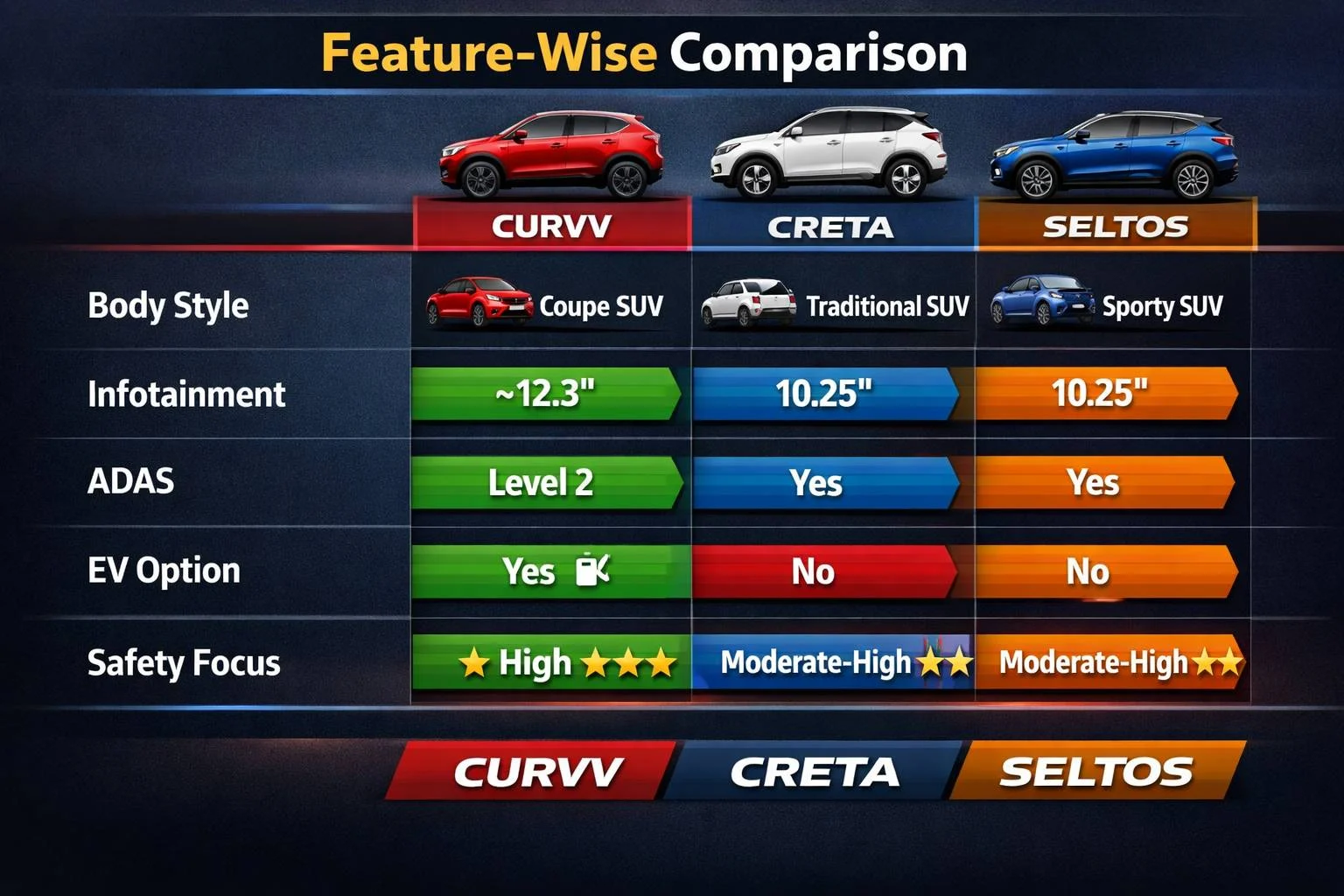
| Feature | Curvv | Creta | Seltos |
|---|---|---|---|
| Body Style | Coupe SUV | Traditional SUV | Sporty SUV |
| Infotainment | ~12.3-inch | 10.25-inch | 10.25-inch |
| ADAS | Level 2 | Yes | Yes |
| EV Option | Yes | No | No |
| Safety Focus | High | Moderate–High | Moderate–High |
Ownership Economics: Real-World Cost Analysis
Ownership cost is increasingly becoming a deciding factor. Based on current fuel and electricity pricing trends in India:
- Petrol Running Cost: ₹7–9 per km
- Diesel Running Cost: ₹5–6.5 per km
- EV Running Cost: ₹1–1.5 per km (home charging)
EV variants offer significantly lower running costs, but higher upfront pricing. Over a 5-year ownership period (15,000 km/year), EV users can potentially save ₹3–4 lakh in fuel expenses compared to petrol variants.
However, resale value and battery degradation perception remain factors influencing long-term ownership decisions.
Charging & EV Practicality
The Curvv EV is expected to support fast charging:
- DC Fast Charging: 10–80% in ~50 minutes
- AC Home Charging: 6–8 hours
India’s public charging infrastructure is expanding, with over 12,000 public charging stations installed as of 2024 (government and private combined). Still, EV usability is highest in metro and Tier-1 cities.
Buyer Persona Analysis: Who Should Choose What?
- Choose Curvv: If you value design, safety, and future EV flexibility
- Choose Creta: If you want refined petrol engines and strong resale
- Choose Seltos: If you prefer performance-oriented turbo variants and sporty styling
The Curvv is particularly appealing to younger, urban buyers and early adopters of electrification.
Strategic Insight: Internal Competition Risk
An important industry angle is internal cannibalization. The Curvv could overlap with Tata’s own Nexon EV and even entry-level Harrier buyers. However, its coupe positioning may help differentiate it enough to minimize direct overlap.
Conclusion
The Tata Curvv is less about beating the Creta and Seltos at their own game and more about changing the rules of comparison. By combining a distinctive design, safety-first engineering, and EV readiness, Tata is targeting a shift in buyer mindset rather than incremental gains.
If executed with consistent quality and service support, the Curvv has the potential to influence not just sales figures, but also how future SUVs in this segment are designed and engineered.
Key Takeaways
- Curvv introduces coupe SUV styling to a mass-market segment
- Built on a multi-powertrain-ready architecture
- Strong focus on safety and structural integrity
- EV variant offers significant running cost advantage
- Targets evolving buyer preferences, not just feature comparison
FAQs
1. Is Tata Curvv better than Creta and Seltos?
It depends on priorities. Curvv leads in safety, design, and EV readiness, while rivals offer stronger refinement and brand perception.
2. What is the expected price of Tata Curvv?
₹13.5 lakh to ₹20 lakh (on-road range).
3. What is the real-world running cost of Curvv EV?
Approximately ₹1–1.5 per km with home charging.
4. Does Curvv compromise practicality?
Slightly, due to coupe design—mainly rear headroom and boot access.
5. Is Curvv suitable for long-term ownership?
Yes, especially if Tata maintains service consistency and resale improves.
6. Should you wait for Tata Curvv?
If safety, design, and EV flexibility matter, it is a strong alternative to consider.
Ankush Kumar is an automotive analyst specializing in electric vehicles, luxury cars, and real-world performance benchmarking. His work focuses on ownership insights, charging behavior analysis, and practical usability to help buyers make informed decisions based on real conditions rather than specifications alone.
He tracks industry data from global agencies, manufacturer reports, and road test benchmarks to deliver high-authority automotive analysis tailored for Indian buyers.
Follow on Facebook: Ankush Kumar