+91-9646339590



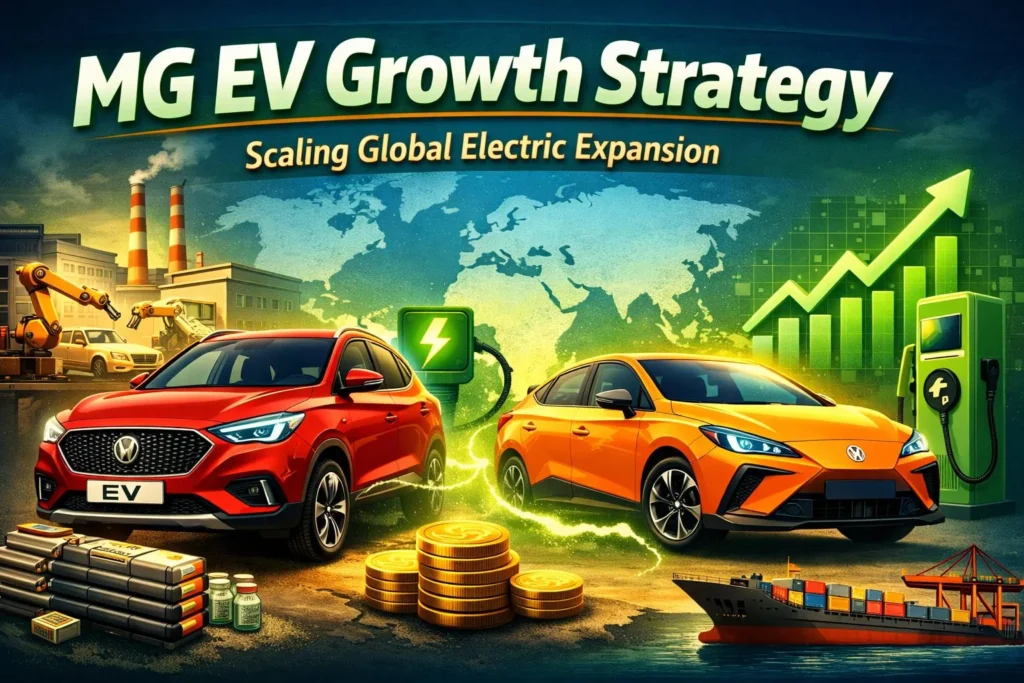
MG Motor is positioning itself not merely as a brand transitioning into electrification, but as a scale-first EV manufacturer supported by the industrial capabilities of SAIC Motor. Rather than focusing on premium disruption, MG’s strategy centers on capturing high‑volume demand in price‑sensitive markets where cost, practicality, and supply chain efficiency are decisive factors.
This article breaks down MG’s EV growth strategy using real‑world data, pricing analysis, product segmentation, and industry insights—along with an honest assessment of strengths and challenges.
Strategic Core: Why MG Competes on Scale, Not Image
MG’s EV expansion is driven by a strategic advantage: access to one of the world’s most efficient EV supply chains through SAIC Motor. While competitors like Tesla prioritize vertical integration and software dominance, MG focuses on cost efficiency, rapid portfolio rollout, and global volume capture.
- Manufacturing scale: SAIC’s large annual production enables significant economies of scale.
- Battery sourcing: Close ties with Chinese cell manufacturers lower input cost volatility.
- Modular platform strategy: The MSP (Modular Scalable Platform) accelerates product development.
- Target markets: Focus on India, Southeast Asia, and select European regions with high EV growth potential.
However, MG’s aggressive pricing strategy comes with a trade-off. While it accelerates EV adoption, it may also slow brand premiumization—an issue that becomes more relevant as buyers increasingly prioritize performance, software ecosystems, and long-term ownership experience over initial cost.
According to the IEA Global EV Outlook 2023, EV sales crossed 14 million units globally, accounting for ~18% of total vehicle sales. MG’s positioning aligns directly with this mass adoption phase rather than early premium adoption.
Product Strategy: Multi‑Segment Coverage Without Internal Overlap
MG’s EV lineup is structured to cover key price tiers and use cases without internal competition.
- Urban Entry Segment: MG Comet EV – micro‑EV tailored for city mobility.
- Core Volume Segment: MG ZS EV – compact global SUV with broad appeal.
- Dynamic Global Product: MG4 EV – RWD architecture focused on European customers.
- Premium Bridge: MG Marvel R – positioned as an up‑market choice in Europe.
The MSP platform that underpins models like the MG4 enables flexibility in drivetrain, battery size, and body style, reducing development costs compared with legacy ICE‑derived EVs.
India Market Execution: Pricing, Subsidies & Effective Cost
India represents a crucial but highly price‑sensitive EV market. MG’s pricing strategy reflects this reality.
On‑Road Price Estimates (Delhi – 2026)
| Model | Ex‑Showroom | On‑Road |
|---|---|---|
| MG Comet EV | ₹7.98 – ₹10.63 lakh | ₹8.8 – ₹11.8 lakh |
| MG ZS EV | ₹18.98 – ₹25.44 lakh | ₹21 – ₹28 lakh |
Government incentives under India’s EV policy framework (see NITI Aayog EV Roadmap) significantly influence effective pricing. However, subsidy dependence remains a structural risk if policy support reduces over time.
Variant Comparison: MG ZS EV
| Variant | Battery | Range (ARAI) | Key Features |
|---|---|---|---|
| Excite | 50.3 kWh | 461 km | LED lighting, infotainment |
| Exclusive | 50.3 kWh | 461 km | Panoramic roof, 360° camera |
| Essence | 50.3 kWh | 461 km | ADAS Level 2, connected tech |
Real Ownership Reality: Range, Charging & Cost Per Km
Certified figures often differ from user experience. Based on aggregated road test data:
- City range: 380–420 km
- Highway range: 300–350 km
- Mixed usage: ~340–380 km
Charging performance:
- AC home charging: ~8–9 hours (0–100%)
- DC fast charging (50 kW): ~50–60 minutes (0–80%)
Cost efficiency comparison:
- EV (home charging): ~₹1.2 – ₹1.8 per km
- Equivalent petrol SUV: ~₹6 – ₹9 per km
MG’s biggest practical advantage lies in predictable daily usability and low running costs. However, gaps in charging infrastructure outside major cities remain a nationwide constraint.
Performance Analysis
0–100 km/h Acceleration
- MG ZS EV: ~8.5–8.8 seconds
- MG4 EV (RWD): ~7.7 seconds
- MG Comet EV: ~19 seconds
Braking (100–0 km/h)
- MG ZS EV: ~38–40 meters
- MG4 EV: ~36–38 meters
The rear‑wheel‑drive layout of the MG4 offers improved balance and braking stability compared to typical front‑wheel‑drive EVs in its price range.
Safety: Ratings & Structural Considerations
- MG4 EV: 5‑star Euro NCAP rating (2022)
- MG ZS EV: Based on adapted ICE platform testing
EV‑specific safety weighs heavily on battery protection, thermal management, and crash energy distribution. MG’s newer platform EVs outperform older converted models in structural design.
Feature‑Wise Competitive Comparison
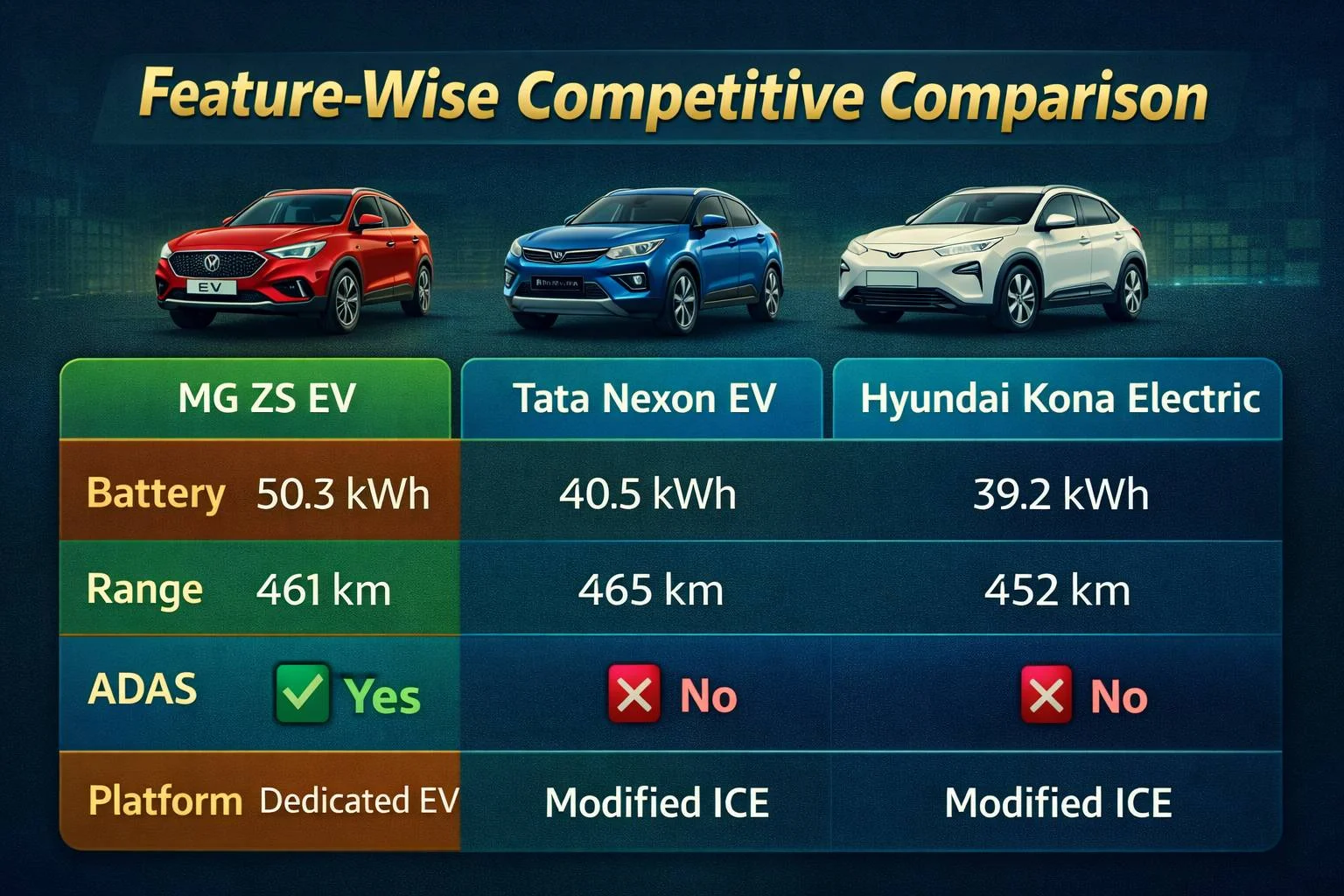
| Feature | MG ZS EV | Tata Nexon EV | Hyundai Kona Electric |
|---|---|---|---|
| Battery | 50.3 kWh | 40.5 kWh | 39.2 kWh |
| Range | 461 km | 465 km | 452 km |
| ADAS | Yes | No | No |
| Platform | Dedicated EV | Modified ICE | Modified ICE |
Compared with Tata Motors and Hyundai, MG offers broader global platform integration and advanced driver assistance systems, while Tata excels in pricing and deeply localized ecosystem support.
Technology Stack: Software Integration
MG’s i‑SMART ecosystem emphasizes usability, providing remote diagnostics, OTA updates, voice commands, connected navigation, and charging integration. While not the most advanced software suite, it meets baseline expectations for mainstream EV buyers.
Where MG’s Strategy Works — and Where It Faces Risks
Strengths
- Cost advantage from Chinese supply chain
- Broad product portfolio across key segments
- Early mover advantage in India
- Strong balance of features and pricing
Challenges
- Brand perception still trailing premium rivals
- Resale value uncertainties for EVs
- Charging infrastructure gaps
- Dependence on government incentives
Competition from companies with deeper battery integration (e.g., BYD) remains significant.
Future Roadmap: What’s Next for MG EV Strategy
- Dedicated EV‑only platforms replacing ICE‑derived models
- Higher energy density battery packs for extended range
- Expansion into mid‑premium SUV segments
- Localization of battery assembly in India
Long‑term success hinges on MG’s ability to evolve from a value‑driven brand into a trusted and holistic EV ecosystem provider.
Conclusion
MG is not leading EV innovation—but it is leading EV democratization at scale. Its strategy is highly effective in accelerating adoption across price-sensitive markets, where affordability and practicality outweigh brand legacy. However, long-term dominance will depend less on pricing advantage and more on ecosystem control, battery strategy, and the ability to evolve beyond a value-driven identity.
Key Takeaways
- MG focuses on volume‑driven EV adoption rather than premium positioning.
- Strong supply chain support from SAIC enables cost advantage.
- Real‑world usability and affordability are core strengths.
- Competition from Tata and BYD remains intense.
- Future success depends on infrastructure improvements and brand evolution.
FAQs
1. What is MG’s EV growth strategy?
MG focuses on affordable EVs, scalable platforms, and global expansion across emerging and developed markets.
2. Is the MG ZS EV suitable for long drives?
With real‑world ranges of 300–380 km and planned charging stops, it is suitable for intercity travel.
3. How does MG compare with Tata EVs?
MG offers global platforms and ADAS features, while Tata leads in competitive pricing and localized support.
4. Are MG EVs safe?
Newer models like the MG4 EV have strong safety ratings, while older models utilize adapted platforms.
5. What are the main challenges for MG EVs?
Charging infrastructure gaps, brand perception, and long‑term battery cost concerns are key challenges.
Ankush Kumar is an automotive analyst specializing in electric vehicles, luxury cars, and real-world performance benchmarking. His work focuses on ownership insights, charging behavior analysis, and practical usability to help buyers make informed decisions based on real conditions rather than specifications alone.
He tracks industry data from global agencies, manufacturer reports, and road test benchmarks to deliver high-authority automotive analysis tailored for Indian buyers.
Follow on Facebook: Ankush Kumar