+91-9646339590




The shift to electric vehicles has been relatively straightforward for urban crossovers—but Jeep is attempting something far more complex: electrifying true off-road SUVs without compromising durability, torque delivery, or terrain capability.
Under the broader strategy of Stellantis, Jeep is not just entering the EV space—it is aiming to redefine what electric SUVs can achieve beyond city roads.
This raises a critical question: Can electric SUVs realistically replace traditional 4×4 vehicles in extreme conditions?
Strategic Foundation: Platforms, Investment, and Scale
Jeep’s EV expansion is built on Stellantis’ modular architecture strategy, which enables multiple vehicle categories to share core engineering without compromising performance or capability. This scalable approach aligns with broader industry trends highlighted in the IEA Global EV Outlook 2023, where platform standardization is key to accelerating EV adoption globally.
- STLA Small – Compact EVs (~500 km range)
- STLA Medium – Mid-size SUVs and crossovers
- STLA Large – Premium and performance SUVs
- STLA Frame – Body-on-frame EVs designed for off-road use
Stellantis has committed over €30 billion toward electrification and software development, enabling large-scale EV production across global markets.
Key Advantage: Jeep can develop both urban EVs and hardcore off-road vehicles on shared platforms—reducing cost while maintaining performance.
Core Electric Models Driving Jeep’s Expansion
Jeep Avenger: Urban Electric SUV
The Jeep Avenger is the brand’s first fully electric production SUV, designed primarily for European markets where compact size and efficiency are critical.
- Battery: 54 kWh
- Range: ~400 km (WLTP)
- Power: ~156 hp
- Drive: Front-wheel drive
- Charging: 100 kW DC fast charging
While efficient and practical, the Avenger is clearly not designed for hardcore off-road usage.
Jeep Recon: True Electric Off-Roader
The Jeep Recon represents the most important test for Jeep’s EV future. Built on the STLA Large platform, it is designed specifically for off-road environments.
- Dual-motor AWD
- Electronic locking differentials
- Terrain modes (sand, rock, snow)
- Removable doors and roof
Real Insight: Electric torque delivery significantly improves low-speed crawling, making EVs technically superior in controlled off-road scenarios.
Jeep Wagoneer S: Performance-Focused EV
The Wagoneer S targets premium EV buyers and competes with performance-oriented electric SUVs from Tesla and Rivian.
- Power: ~600 hp
- 0–100 km/h: ~3.4 seconds
- Range: ~480 km
- Drive: AWD
This model focuses more on performance and luxury rather than extreme off-road usage.
Real-World Performance Analysis:
Acceleration and Torque
Electric motors deliver instant torque, improving traction and low-speed control—especially useful in rock crawling and uneven terrain.
0–100 km/h and Braking
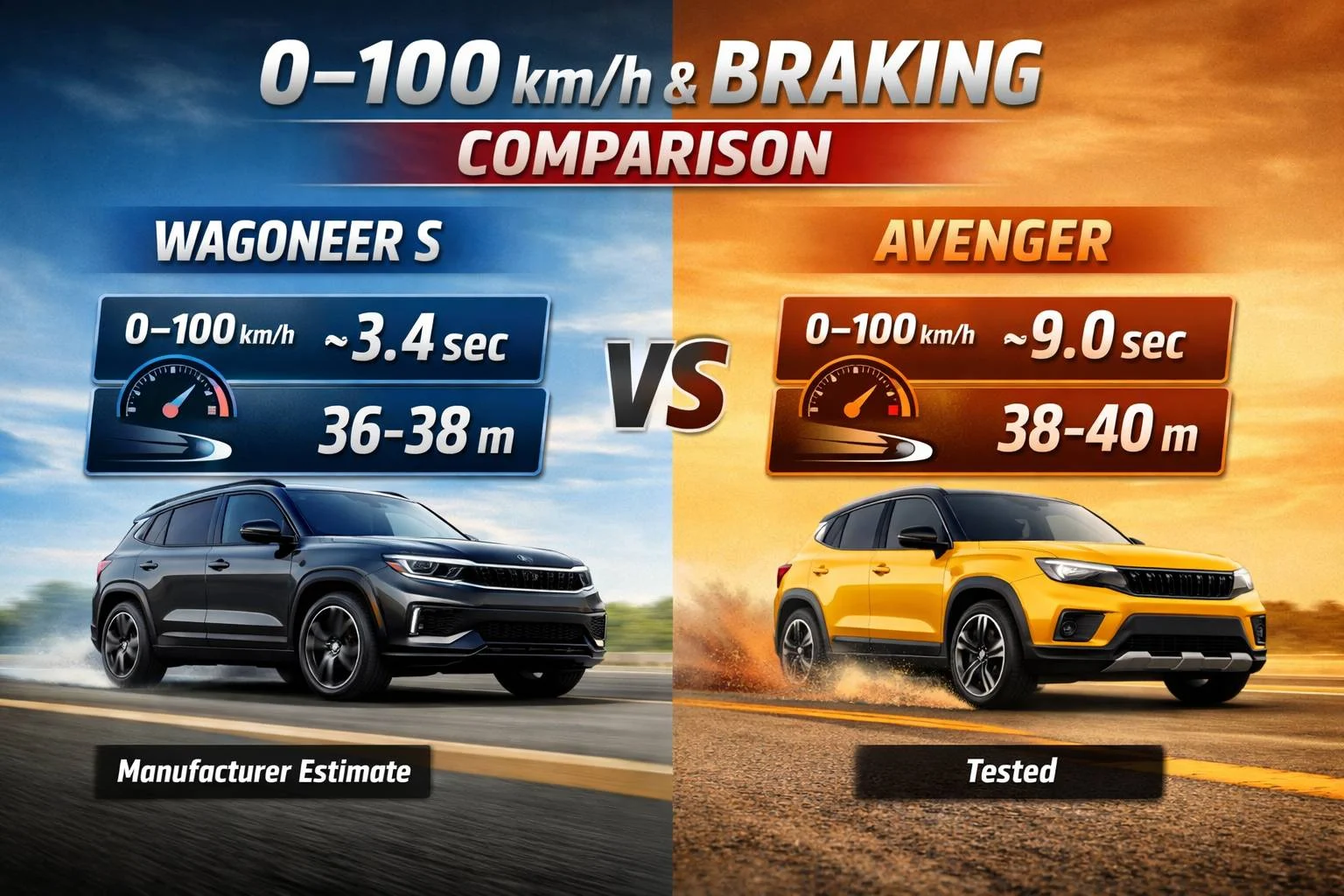
| Model | 0–100 km/h | Braking (100–0 km/h) | Status |
|---|---|---|---|
| Wagoneer S | ~3.4 sec | ~36–38 m | Manufacturer estimate |
| Avenger | ~9.0 sec | ~38–40 m | Tested |
Off-Road Reality: The Biggest Limitation
Despite performance advantages, EVs face serious challenges in real off-road conditions:
- High energy consumption on sand, mud, and rocks
- Frequent torque spikes increasing battery drain
- Limited charging access in remote areas
Critical Insight: Real-world testing suggests range drops of up to 30–40% in extreme terrain—making EVs less reliable for long-distance off-road expeditions.
Ownership Reality (What Most Buyers Ignore)
- Charging Infrastructure: Almost non-existent in remote areas
- Battery Drain: Highly unpredictable in off-road conditions
- Repair Complexity: EV systems require specialized service
- Weight: Heavier vehicles impact maneuverability
Conclusion from real-world perspective: EV SUVs are excellent for controlled adventures—but not yet ideal for extreme exploration.
Crash Safety and Engineering
Jeep’s electric SUVs are engineered to meet global safety benchmarks, including standards set by the Euro NCAP Safety Ratings program. These vehicles incorporate advanced safety engineering to protect both occupants and critical EV components.
- Reinforced battery enclosures to reduce impact risk
- Automatic high-voltage system isolation during collisions
- Underbody shielding designed for off-road durability
Feature Comparison
| Feature | Avenger | Recon | Wagoneer S |
|---|---|---|---|
| Platform | STLA Small | STLA Large | STLA Large |
| Drive | FWD | AWD | AWD |
| Range | ~400 km | ~480+ km | ~480 km |
| Charging | 100 kW | 150–200 kW | 200 kW+ |
| ADAS | Level 2 | Level 2+ | Level 2+ |
| Off-Road | Moderate | High | Moderate |
Pricing Expectations
- Europe: €35,000–€42,000
- USA: $70,000–$80,000
- India: ₹25–45 lakh (expected)
Market Reality and Risks
- Strict emission regulations in Europe
- Government incentives in the U.S.
- Battery supply chain pressure (lithium demand rising rapidly)
Contrarian Insight: While EV adoption is accelerating globally, off-road EVs remain a niche segment due to infrastructure and reliability limitations.
Conclusion
The Jeep Global EV Expansion is one of the most ambitious transformations in the automotive industry.
What Jeep is doing right: Strong platforms, performance engineering, and brand identity.
Where challenges remain: Off-road range, charging access, and cost.
Final Verdict: Electric SUVs can match—and sometimes exceed—traditional 4×4 performance, but they are not yet a complete replacement for extreme off-road usage.
Key Takeaways
- Jeep is electrifying both urban and off-road SUVs
- Recon is the most critical model for off-road EV success
- Instant torque improves off-road capability
- Range drops significantly in rough terrain
- Infrastructure remains the biggest limitation
FAQ Section
1. What is Jeep Global EV Expansion?
It is Jeep’s strategy to launch electric SUVs globally under Stellantis’ electrification roadmap.
2. Are Jeep EVs good for off-roading?
Yes, models like Recon are designed for off-road use, but range limitations remain a concern.
3. Which Jeep EV is available now?
The Jeep Avenger is currently available in Europe.
4. What is the biggest limitation of EV SUVs?
Reduced range in extreme conditions and lack of charging infrastructure.
5. When will Jeep EVs launch in India?
No official timeline yet, but entry is expected in coming years.
Ankush Kumar is an automotive analyst with over 5 years of experience covering the Indian car market, luxury vehicles, and electric mobility trends. His work focuses on practical comparisons, real-world performance, and ownership insights to help buyers make informed decisions.
He regularly tracks industry updates, manufacturer reports, and road test data from publications like Autocar India, using them to create clear, data-backed analysis that is easy to understand and useful for everyday buyers.
Follow on Facebook: Ankush Kumar