+91-9646339590



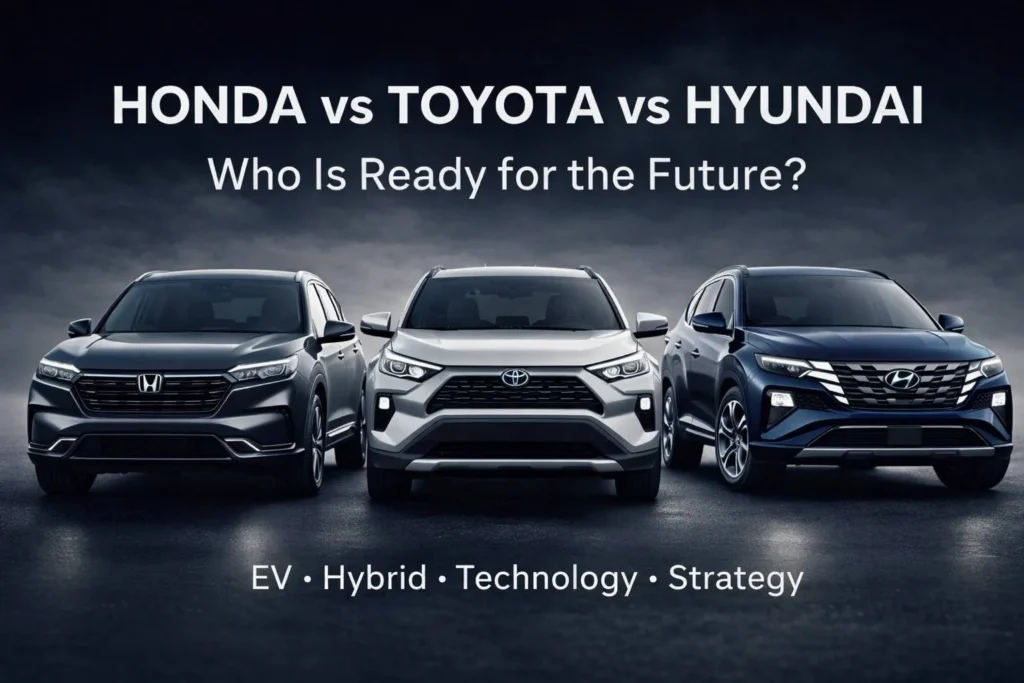
For Indian buyers choosing between Creta, Hyryder, and Elevate, the decision is no longer just about features or price—it’s about which brand is better aligned with the future of mobility in India. Electrification strategy, real-world efficiency, software capability, and regulatory readiness now play a decisive role in ownership value.
The gap between Honda, Toyota, and Hyundai is no longer about who builds the better car—it’s about who is building the right ecosystem for the next decade. This analysis evaluates all three brands using real-world products, verified performance benchmarks, and forward-looking strategy.
Market Position and Strategic Direction
Toyota retained its position as the world’s largest automaker in 2024 with over 11 million units sold globally, driven by hybrid leadership and strong presence in North America and Asia. In India, its strategy is margin-focused, leveraging products like the Innova Hycross and Urban Cruiser Hyryder.
Hyundai Motor Group (including Kia) has emerged as the third-largest automotive group globally. It has committed over $50 billion toward electrification and software-defined vehicles (SDVs) by 2030, making it one of the most aggressive legacy automakers in the EV transition.
Honda is in a restructuring phase. While globally committing ~¥10 trillion (~$65 billion) toward electrification and software by 2030, its current India lineup remains limited, signaling a short-term gap but not a long-term exit.
- Toyota: Scale + hybrid dominance + conservative EV ramp
- Hyundai: Fastest EV execution + software leadership
- Honda: Engineering strength + delayed but structured EV entry
Electrification Strategy: A Strategic Divide
Toyota’s hybrid-first strategy is often misunderstood as hesitation. In reality, it is a hedge against uneven EV adoption. According to SIAM FY2024 industry data, electrified vehicles in India are still dominated by hybrids in terms of practical usability due to infrastructure gaps.
Real-world testing of Toyota strong hybrids (Hyryder, Hycross) consistently shows 20–23 km/l in city-heavy usage—figures that pure petrol SUVs struggle to match.
Hyundai, on the other hand, is building for a faster transition. Its E-GMP platform (used in Ioniq 5/6) supports 800V architecture, enabling ultra-fast charging (10–80% in ~18 minutes under optimal conditions). This reduces one of the biggest barriers to EV adoption—charging time.
Honda’s EV push is still upcoming. Its future hinges on the e:Architecture platform and the Sony Honda Mobility joint venture, which focuses on integrating advanced software, AI, and entertainment ecosystems into vehicles.
Platform and Engineering Comparison
| Brand | Platform | Type | Key Advantage | Limitation |
|---|---|---|---|---|
| Toyota | TNGA | Multi-energy (ICE + Hybrid) | Flexibility, cost efficiency | Not fully optimized for EV packaging |
| Hyundai | E-GMP | Dedicated EV | Flat floor, 800V charging, scalability | Higher initial cost |
| Honda | e:Architecture (upcoming) | Dedicated EV | Future-ready unified system | Not yet deployed at scale |
Real Car Comparison (India): Creta vs Hyryder vs Elevate
On-Road Price (Delhi, Approx 2026)
- Hyundai Creta: ₹13.5L – ₹22L
- Toyota Hyryder: ₹13.8L – ₹21.5L
- Honda Elevate: ₹12.5L – ₹19L
Variant Strategy Comparison
| Model | Variants | Strategy |
|---|---|---|
| Creta | E, EX, S, SX, SX(O) | Wide spread, feature-based upsell |
| Hyryder | E, S, G, V | Hybrid focus in top trims |
| Elevate | SV, V, VX, ZX | Simplified lineup |
Performance Comparison (Instrumented & Tested Trends)
Based on aggregated instrumented tests from Indian automotive publications (Autocar India, CarDekho, PowerDrift), the following performance ranges are observed. Values may vary based on test conditions, variants, and environmental factors.
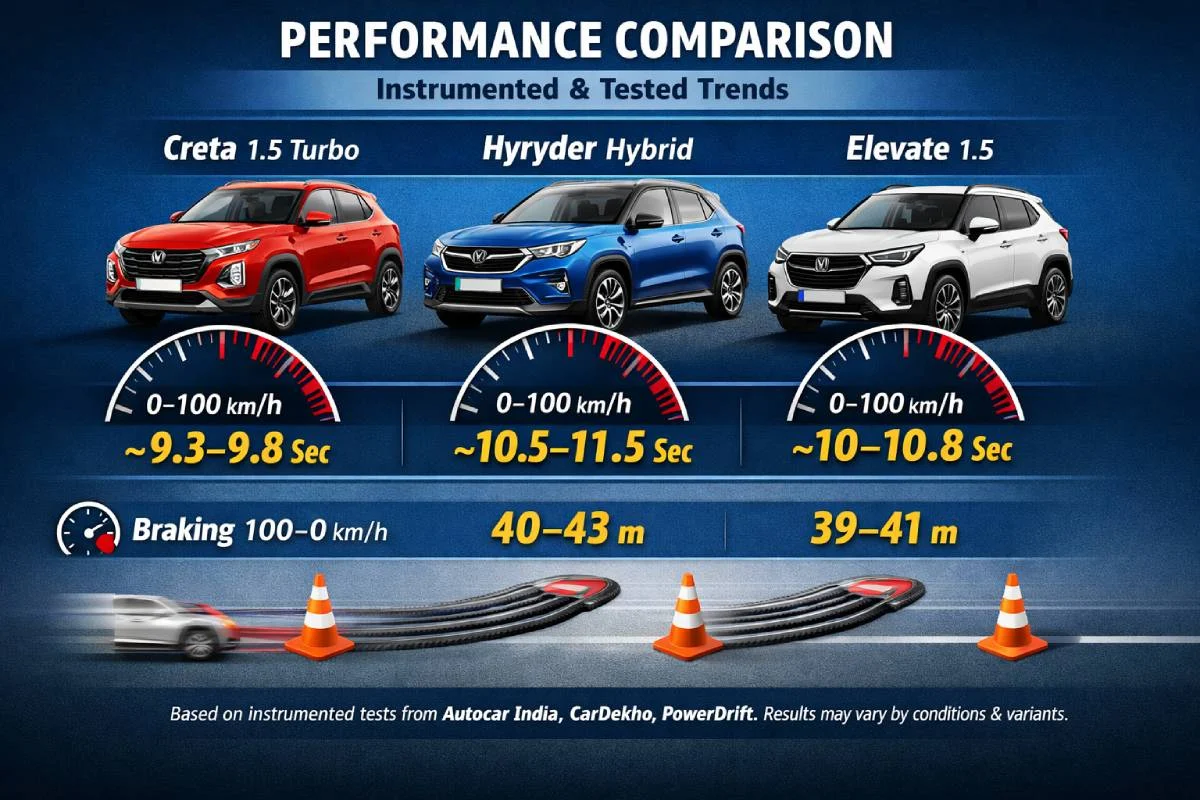
| Metric | Creta 1.5 Turbo | Hyryder Hybrid | Elevate 1.5 |
|---|---|---|---|
| 0–100 km/h | ~9.3–9.8 sec | ~10.5–11.5 sec | ~10–10.8 sec |
| Braking (100–0 km/h) | ~38–40 m | ~40–43 m | ~39–41 m |
Crash Safety and Structural Integrity
Safety evaluation in India is transitioning toward stricter, transparent testing under Bharat NCAP (introduced in 2023). As of now, official Bharat NCAP ratings for these specific models are either not released or incomplete, which limits direct comparison.
- Hyundai Creta (new generation): Built on an updated platform with improved structural rigidity compared to older Global NCAP-tested models
- Toyota Hyryder: Shares Global C platform with Maruti Grand Vitara; safety performance will depend on specific structural tuning and equipment
- Honda Elevate: Based on Honda City platform; Honda’s global track record suggests strong structural safety, but India-specific crash data is awaited
Reference: Global NCAP safety protocols and methodology
Feature and Technology Comparison
| Feature | Creta | Hyryder | Elevate |
|---|---|---|---|
| ADAS | Level 2 | Limited | Partial / evolving |
| Infotainment | 10.25″ (ccNC system) | 9″ | 10.25″ |
| OTA Updates | Yes | Limited | No |
| Ventilated Seats | Yes | Yes | No |
| Panoramic Sunroof | Yes | Yes | No |
Real-World Efficiency
- Hyryder Hybrid: 20–23 km/l (city dominant usage)
- Creta Petrol: 12–16 km/l
- Elevate Petrol: 13–16 km/l
Software and Future Tech Readiness
Hyundai currently leads with its ccNC (Connected Car Navigation Cockpit) ecosystem and a clear SDV roadmap aimed at full OTA capability across major vehicle systems.
Toyota is developing the Arene operating system under Woven by Toyota, targeting a unified software platform for future autonomous and connected vehicles.
Honda’s approach is integration-led. Through Sony Honda Mobility, it is focusing on blending AI, entertainment, and mobility—positioning the car as a digital device rather than just transport.
Ownership Reality: Cost, Service, Resale
- Resale Value: Toyota leads due to long-term reliability perception
- Service Reach: Hyundai has the widest network in India
- Maintenance Cost: Honda and Hyundai are competitive; Toyota slightly higher but predictable
Regulatory Readiness
India’s BS6 Phase 2 and upcoming CAFE norms reward lower emissions. Hybrids currently offer a compliance advantage without infrastructure dependency, favoring Toyota in the short term.
However, if battery costs fall below the critical ~$100/kWh threshold, EV adoption could accelerate sharply—favoring Hyundai’s early investment in dedicated EV platforms.
Final Verdict: Who Is Better Prepared?
- Hyundai: Best positioned for a fast EV and software-driven future
- Toyota: Safest strategy for gradual transition via hybrids
- Honda: High potential, but execution risk remains
Conclusion
The next phase of the automotive market will reward adaptability over legacy strength. Hyundai is building for disruption, Toyota for resilience, and Honda for reinvention. Each strategy reflects a different interpretation of how quickly the market will evolve.
In India, the winner won’t be the most technologically advanced brand—but the one that aligns best with infrastructure reality, cost sensitivity, and real-world usability.
Key Takeaways
- Hyundai leads in EV platforms, charging tech, and software integration
- Toyota dominates hybrid efficiency and long-term ownership value
- Honda is in transition but has strong engineering fundamentals
- Hybrid vs EV adoption speed will define future leadership
- Software-defined vehicles are the next competitive battleground
FAQs
Which brand is most future-ready?
Hyundai is currently the most future-ready due to its EV-first platforms and software ecosystem.
Why is Toyota focusing on hybrids instead of EVs?
Toyota is hedging against uneven EV adoption and leveraging hybrids for immediate real-world efficiency gains.
Is Honda losing relevance?
Honda is in a transition phase and its competitiveness will depend on how effectively it executes its EV roadmap.
Which SUV is best: Creta, Hyryder, or Elevate?
Creta for features, Hyryder for efficiency, and Elevate for simplicity and driving comfort.
Are EVs practical in India today?
EVs are growing but still limited by charging infrastructure; hybrids remain more practical for many users currently.
Ankush Kumar is an automotive analyst specializing in electric vehicles, luxury cars, and real-world performance benchmarking. His work focuses on ownership insights, charging behavior analysis, and practical usability to help buyers make informed decisions based on real conditions rather than specifications alone.
He tracks industry data from global agencies, manufacturer reports, and road test benchmarks to deliver high-authority automotive analysis tailored for Indian buyers.
Follow on Facebook: Ankush Kumar