+91-9646339590



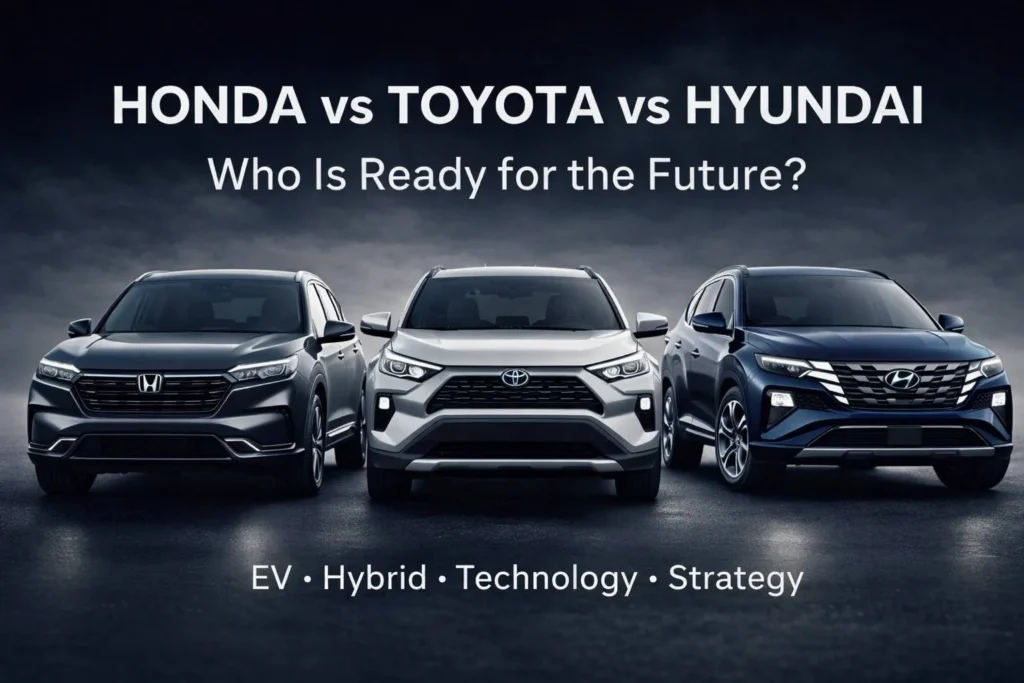
Honda, Toyota, and Hyundai are three of the most influential carmakers shaping the future of the global automotive industry. As the market moves toward electrification, software-driven vehicles, and stricter regulations, each brand is taking a different path to stay competitive.
Rather than chasing the same strategy, Honda, Toyota, and Hyundai are prioritising different strengths. This comparison looks at how prepared each brand is for the future, based on technology focus, product planning, and long-term adaptability.
Different Approaches to the Future
The future of mobility is not only electric. It includes hybrids, software integration, safety systems, and flexible manufacturing. How well a brand balances these elements will determine its success over the next decade.
Honda is known for engineering discipline, Toyota for hybrid leadership and scale, and Hyundai for fast execution and design-driven innovation.
Honda’s Strategy: Cautious and Engineering-Led
Honda has chosen a measured approach to future mobility. Instead of rushing into full electrification, the brand is focusing on gradual transition while improving efficiency, safety, and reliability.
This strategy reduces risk but also means Honda is moving slower than some rivals in launching mass-market electric vehicles.
Toyota’s Strategy: Scale, Hybrids, and Stability
Toyota is arguably the most diversified of the three. Its long-standing leadership in hybrid technology gives it a strong advantage during the transition phase.
By spreading investments across hybrids, EVs, and alternative fuels, Toyota aims to stay resilient regardless of how quickly markets change.
Hyundai’s Strategy: Speed and Aggressive Expansion
Hyundai has emerged as one of the most aggressive players in recent years. The brand is moving quickly in EVs, design, and digital features.
Its willingness to experiment and launch new technologies faster has helped Hyundai gain market share in multiple regions.
Key Strengths of Each Brand
- Honda: Strong engineering quality, dependable powertrains, long-term reliability
- Toyota: Hybrid dominance, massive scale, cost efficiency
- Hyundai: Rapid innovation, modern design, strong EV push
Technology and Electrification Readiness
Electrification is a major factor in future preparedness. However, readiness is not just about EV launches. It includes battery strategy, charging compatibility, and software integration.
Each brand is investing heavily, but with different timelines and priorities.
| Brand | Primary Focus | Future Advantage |
|---|---|---|
| Honda | Gradual electrification, core engineering | Lower risk, strong reliability |
| Toyota | Hybrids, diversified powertrains | Flexibility and global scale |
| Hyundai | EVs, design, software | Speed and innovation |
Market Adaptability and Speed
The pace of change varies across regions. Brands that can adapt quickly without sacrificing quality will have an edge.
Hyundai leads in speed, Toyota excels in scale-based adaptation, and Honda focuses on controlled evolution.
Challenges Each Brand Faces
- Honda needs to accelerate EV presence without harming reliability
- Toyota must ensure EV competitiveness matches its hybrid success
- Hyundai needs to maintain quality while expanding rapidly
Who Is Better Prepared for the Future?
The answer depends on how the future unfolds. If the transition remains gradual, Toyota’s hybrid-heavy strategy may prove the most resilient.
If EV adoption accelerates rapidly, Hyundai’s aggressive push and design-first approach could deliver the biggest gains.
Honda’s strength lies in long-term durability and engineering trust, which may appeal to buyers who prioritise reliability over rapid change.
Final Thoughts
Honda, Toyota, and Hyundai are all preparing for the future—but in very different ways. There is no single winning formula yet.
The brand best prepared will be the one that adapts fastest without losing customer trust. For now, Toyota offers stability, Hyundai offers momentum, and Honda offers caution backed by engineering confidence.