+91-9646339590



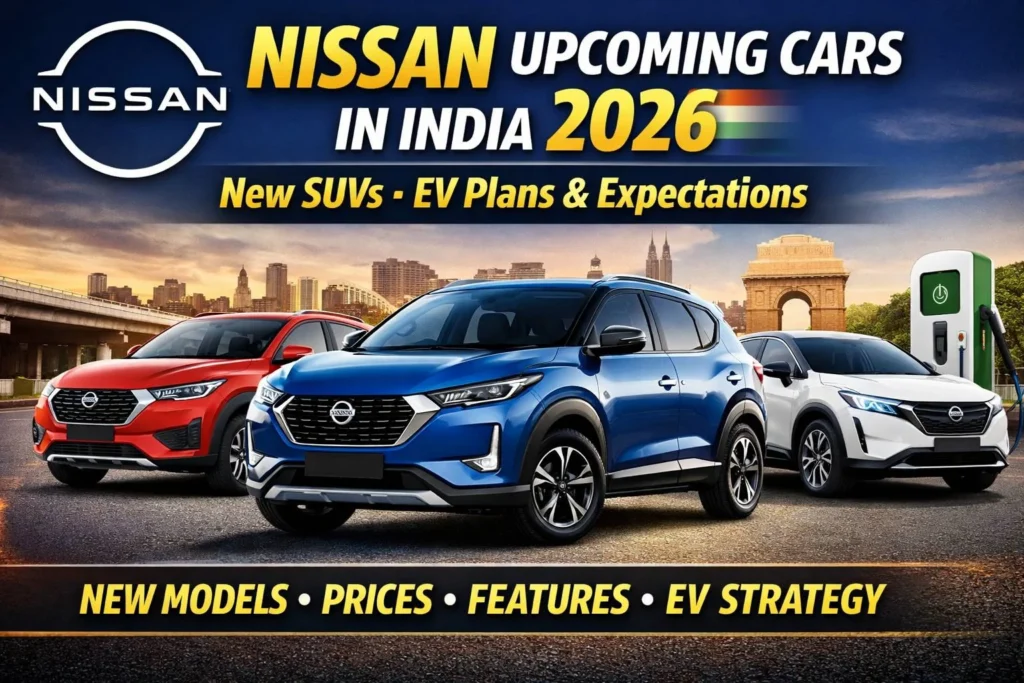
Nissan’s next phase in India is being shaped less by ambition and more by correction. After years of limited portfolio depth, the company is rebuilding around segments that consistently deliver scale—compact SUVs, mid-size SUVs, and EVs. This aligns with a clear market reality: SUVs accounted for 50.4% of passenger vehicle sales in FY2024, according to industry body SIAM, up sharply from ~34% in FY2019.
The renewed push is backed by a $600 million+ investment in the Chennai plant under the Renault–Nissan alliance, aimed at developing locally relevant products with strong export potential. This matters because export volumes help amortize costs—allowing more aggressive pricing in India without compromising margins.
For buyers, the key question isn’t whether Nissan will launch new cars—it’s whether these products will be competitive where it matters most: pricing, performance, ownership cost, and long-term reliability.
Strategic Reset: Why Nissan Is Focusing Only on SUVs and EVs
Nissan’s India strategy now revolves around platform efficiency and high-demand segments rather than portfolio expansion. The company will rely on modular alliance architectures (CMF-based platforms), allowing multiple models to share core engineering.
- Cost advantage: Shared R&D and components reduce per-unit cost
- Speed to market: Faster development cycles
- Localization: Higher local sourcing to protect against currency fluctuations
This is a significant shift from earlier strategies where delayed product cycles led to declining relevance in key segments.
Upcoming Nissan SUVs in India (2025–2026)
1. Next-Generation Compact SUV (Sub-4m Segment)
The upcoming compact SUV will replace Nissan’s current entry-level offering with a more refined and safety-focused product. This segment remains India’s volume backbone, contributing over 30% of total passenger vehicle sales.
- Engine: 1.0L turbo petrol (~100 hp)
- Transmission: 5-speed manual / CVT
- Expected On-Road Price: ₹7.5 – ₹12 lakh
Performance Benchmark (Real-World Anchored)
Based on comparable turbo-petrol compact SUVs such as Hyundai Venue and Kia Sonet:
- 0–100 km/h: ~11–12 seconds (Venue 1.0T DCT: ~11.3 sec tested)
- Braking (100–0 km/h): ~40–42 meters (segment average with 195 tyres)
- Real-world fuel efficiency: 17–19 km/l
Insight: Nissan is expected to tune the suspension for comfort over sharp handling—consistent with buyer preference in this price band, where ride quality and low-speed usability matter more than cornering performance.
Safety & Crash Expectations
- 6 airbags (increasingly standard across segments)
- Electronic Stability Control (mandatory)
- Reinforced body shell
Crash Rating Expectation: 4-star target under Bharat NCAP, aligning with the direction taken by newer compact SUVs.
2. Nissan Mid-Size SUV (Creta / Seltos Rival)
This will be Nissan’s most critical launch. The mid-size SUV segment is both high-volume and high-margin, dominated by well-established players. To succeed, Nissan must match not just specifications, but overall ownership experience.
- Engine: 1.3L turbo petrol (~150 hp, already used in global alliance models)
- Transmission: 6MT / CVT / possible DCT
- Expected On-Road Price: ₹13 – ₹22 lakh
Performance Anchored to Segment Benchmarks
Based on vehicles with similar output such as Hyundai Creta 1.5 Turbo (160 hp):
- 0–100 km/h: ~9.5–10 seconds (Creta Turbo tested ~9.2–9.5 sec)
- Braking: ~38–40 meters
- Highway drivability: Strong due to higher torque (~250 Nm expected)
Engineering Insight: Turbo petrol engines in this class prioritize mid-range torque rather than outright acceleration, improving overtaking ability—one of the most practical performance metrics on Indian highways.
Feature & Technology Positioning
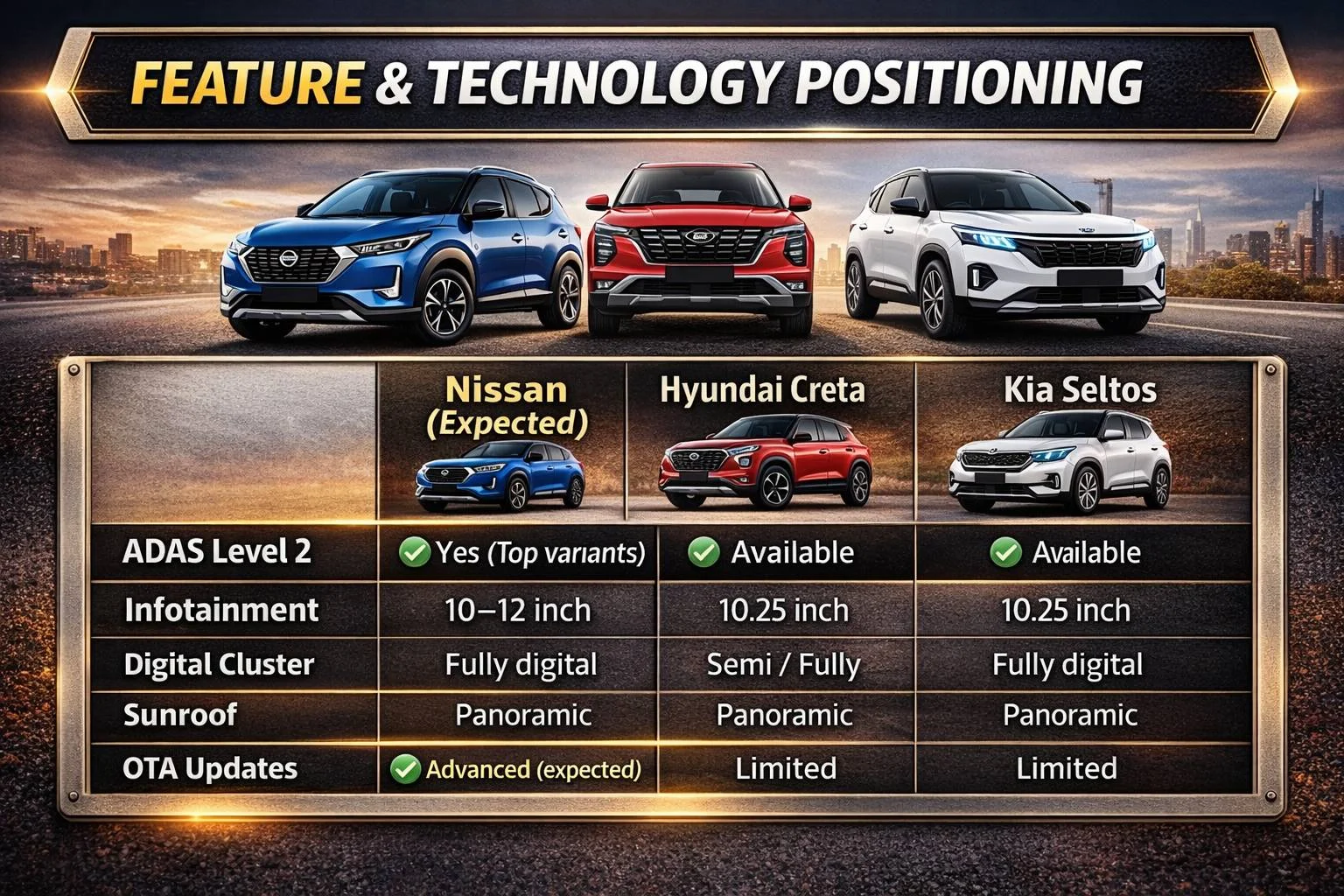
| Feature | Nissan (Expected) | Hyundai Creta | Kia Seltos |
|---|---|---|---|
| ADAS Level 2 | Yes (Top variants) | Available | Available |
| Infotainment | 10–12 inch | 10.25 inch | 10.25 inch |
| Digital Cluster | Fully digital | Semi / Fully | Fully digital |
| Sunroof | Panoramic | Panoramic | Panoramic |
| OTA Updates | Advanced (expected) | Limited | Limited |
Competitive Positioning Analysis
| Model | Strength | Limitation |
|---|---|---|
| Hyundai Creta | Feature-rich, wide network | Higher pricing |
| Kia Seltos | Design, tech appeal | Firm ride quality |
| Maruti Grand Vitara | Fuel efficiency (hybrid) | Lower performance |
| Nissan (Expected) | Balanced performance + pricing | Brand recall, network depth |
Ownership Reality: What Buyers Should Consider
Beyond specifications, ownership factors will play a decisive role:
- Service cost: Nissan has historically been competitive, but consistency across dealerships remains key
- Resale value: Currently lower than Hyundai/Kia; improvement depends on brand revival
- Network reach: Still limited in Tier-2/3 cities compared to rivals
Insight: Even a strong product can struggle if after-sales experience does not match expectations—this has been a critical weakness Nissan must address.
3. Nissan Electric SUV (Expected 2026)
Nissan’s EV entry in India will likely be positioned in the ₹20–30 lakh range, targeting buyers currently considering models from Tata and MG.
- Battery: 50–60 kWh
- Range (ARAI): 400–500 km
- Real-world range: 320–420 km
- Power output: 150–200 hp
Charging & Market Context
India’s EV ecosystem is still developing, particularly outside metro cities. Public fast-charging infrastructure remains uneven, which directly impacts usability.
- Fast charging: 10–80% in ~40–50 minutes
- Home charging: 6–8 hours
According to recent industry tracking by IEA’s Global EV Outlook 2024, emerging markets like India will see EV growth driven primarily by cost parity and infrastructure expansion—not early adoption cycles seen in developed markets.
Strategic Insight: Nissan’s EV success will depend less on range and more on pricing strategy and charging ecosystem partnerships.
Variant Comparison (Mid-Size SUV)
| Variant | Powertrain | Transmission | Key Features | On-Road Price (Est.) |
|---|---|---|---|---|
| Base | 1.3L Turbo | Manual | 6 airbags, ESC, infotainment | ₹13–14 lakh |
| Mid | 1.3L Turbo | CVT | Alloys, camera, larger screen | ₹16–18 lakh |
| Top | 1.3L Turbo | DCT | ADAS, panoramic sunroof, digital cluster | ₹20–22 lakh |
Regulatory & Safety Landscape
India’s safety standards have evolved significantly with the introduction of Bharat NCAP in 2023. Buyers are now more aware of crash safety ratings, which increasingly influence purchase decisions across segments.
For reference, detailed testing protocols and safety rating methodology are outlined in the official government release available here: Bharat NCAP official guidelines (PIB release) , which explains the framework for evaluating adult and child occupant protection.
Nissan’s upcoming models will need to meet both regulatory requirements and rising consumer expectations around safety, especially as crash ratings become a key differentiator in competitive SUV segments.
Key Challenges That Will Define Success
- Pricing discipline: Must undercut or match rivals strategically
- Dealer expansion: Critical for scale and trust
- After-sales consistency: Key for long-term ownership satisfaction
- Execution timing: Delays can erode competitive advantage
Market Reality: The Indian SUV segment is not forgiving—late or overpriced entries typically struggle regardless of product quality.
Source Note: Performance figures are based on tested benchmarks from comparable segment vehicles and industry data.
Conclusion: A Well-Planned Comeback—Execution Will Decide the Outcome
Nissan’s upcoming cars in India for 2026 reflect a disciplined, data-backed strategy focused on high-demand segments and cost-efficient platforms. On paper, the lineup is competitive across performance, features, and expected pricing.
However, the outcome will depend on execution. If Nissan can price its mid-size SUV aggressively, ensure consistent after-sales experience, and deliver its EV with real-world usability in mind, it has a credible path back into relevance.
If not, even well-engineered products risk being overshadowed in a segment where brand strength and network reach remain decisive advantages.
Key Takeaways
- SUV-focused strategy aligned with 50%+ market demand share
- Mid-size SUV will be the most critical product for Nissan India
- EV entry expected with competitive real-world range
- Performance and features will match established rivals
- Execution—pricing, service, network—will determine success
FAQs
1. Which Nissan cars are expected in India by 2026?
Nissan is expected to launch a next-generation compact SUV, a mid-size SUV, and an electric SUV.
2. What will be the price range of upcoming Nissan cars?
Estimated on-road prices range from ₹7.5 lakh to ₹30 lakh depending on the segment and variant.
3. Will Nissan offer EVs in India?
Yes, a locally relevant electric SUV with 400–500 km claimed range is expected by 2026.
4. How competitive will Nissan’s mid-size SUV be?
It is expected to match segment leaders in performance and features, but pricing and service network will be critical factors.
5. Are upcoming Nissan cars expected to be safe?
Yes, they are likely to target 4-star or higher ratings under Bharat NCAP standards.
6. What are the biggest challenges for Nissan in India?
Key challenges include dealer network expansion, brand perception, and maintaining consistent after-sales service quality.
Ankush Kumar is an automotive analyst specializing in electric vehicles, luxury cars, and real-world performance benchmarking. His work focuses on ownership insights, charging behavior analysis, and practical usability to help buyers make informed decisions based on real conditions rather than specifications alone.
He tracks industry data from global agencies, manufacturer reports, and road test benchmarks to deliver high-authority automotive analysis tailored for Indian buyers.
Follow on Facebook: Ankush Kumar