+91-9646339590



Introduction: Why Audi’s 2026 Formula One Entry Matters
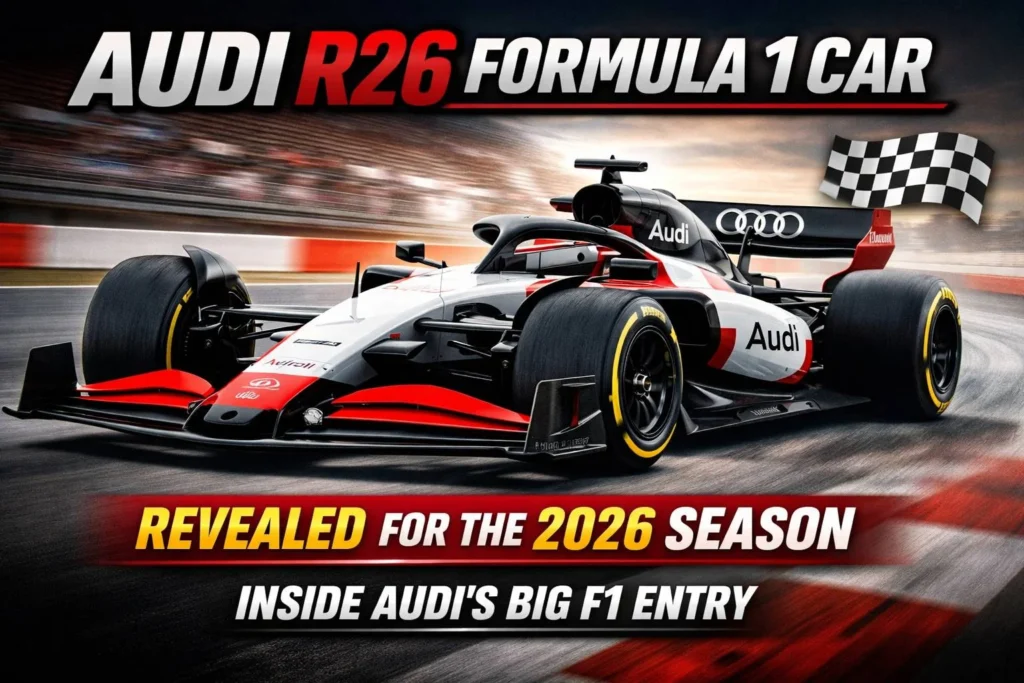
The arrival of the Audi R26 marks one of the most significant manufacturer entries in modern Formula One. Beginning with the 2026 FIA Formula One World Championship, Audi will compete as a full works team after acquiring a controlling stake in the Sauber organization. This transition transforms Sauber into the factory-backed Audi Formula One Team, combining race operations in Hinwil, Switzerland with advanced hybrid power-unit development at Audi’s Neuburg an der Donau motorsport facility in Germany.
The timing of Audi’s entry is highly strategic. The 2026 Formula One regulations introduce the most substantial power-unit overhaul since the hybrid era began in 2014. These new rules dramatically increase the role of electrification, with hybrid systems expected to generate nearly 50 percent of the total power output. In addition, all teams will run on 100% sustainable synthetic fuels, reflecting the sport’s commitment to carbon-neutral racing technologies.
For Audi, Formula One represents far more than a marketing platform. The championship functions as a high-intensity engineering laboratory where innovations in hybrid systems, battery efficiency, energy recovery, and lightweight materials can be tested under extreme conditions. Insights gained from the Audi R26 development program are expected to influence the company’s future high-performance RS models and electrified road vehicles.
Within this context, the Audi R26 is not simply a race car—it is the foundation of a long-term motorsport engineering strategy designed to position Audi as a major technological force in Formula One’s next regulatory era.
Audi’s Transformation of the Sauber Formula One Team
Audi’s Formula One entry builds upon the infrastructure of the historic Sauber organization, one of the sport’s most respected independent teams. Founded by Peter Sauber in 1970, the Swiss operation entered Formula One in 1993 and has remained a consistent presence on the grid for more than three decades.
Sauber previously operated as the works team for BMW between 2006 and 2009, achieving multiple podium finishes and a race victory during the 2008 season. The partnership with Audi represents a similar transition—transforming the team from an independent constructor into a fully integrated factory program.
Following Audi’s 2022 announcement to enter Formula One, the company began gradually increasing its ownership stake in Sauber while simultaneously expanding engineering capabilities across both facilities. Major investments have been directed toward:
- Advanced aerodynamic simulation systems
- Next-generation driver-in-the-loop simulators
- Expanded computational fluid dynamics infrastructure
- Hybrid power-unit development laboratories
The Sauber headquarters in Hinwil houses one of the most advanced wind tunnels in Formula One, which continues to support aerodynamic research and car development. Meanwhile, Audi’s Neuburg facility in Germany has been upgraded to support full hybrid power-unit design, testing, and calibration.
According to official Audi Motorsport disclosures, the Neuburg development center now operates more than 20 high-performance engine dynamometer test benches capable of simulating complete race conditions and validating hybrid power-unit reliability under extreme loads.
Audi R26 Technical Overview
The Audi R26 has been engineered specifically around the new 2026 Formula One technical regulations. These rules significantly reshape both the hybrid power-unit architecture and the aerodynamic philosophy of modern Formula One cars.
Although teams rarely reveal the full technical specifications of their race cars, regulatory constraints and available engineering information allow a clear overview of the R26’s expected design architecture.
| Specification | Technical Details |
|---|---|
| Power Unit | Audi 2026 Hybrid Power Unit |
| Engine Configuration | 1.6-liter turbocharged V6 internal combustion engine |
| Electric Motor | MGU-K kinetic energy recovery system |
| Total Power Output | Approximately 950–1000 horsepower combined |
| Fuel | 100% sustainable synthetic racing fuel |
| Chassis | Carbon-fiber composite monocoque |
| Transmission | 8-speed semi-automatic gearbox |
| Tyres | Pirelli 18-inch Formula One specification tyres |
One of the most important regulatory changes affecting the Audi R26 is the removal of the MGU-H system. This component previously recovered energy from exhaust heat but significantly increased power-unit complexity and development costs. Eliminating the MGU-H simplifies engine architecture while shifting greater emphasis toward electrical energy recovery through the drivetrain.
Hybrid Power Unit Engineering
The hybrid system powering the Audi R26 represents one of the most advanced energy recovery platforms ever developed in Formula One. Under the 2026 regulations, the electric motor component—known as the MGU-K—will deliver up to 350 kW of electrical output, equivalent to roughly 470 horsepower.
This dramatic increase in electric contribution fundamentally changes the balance between internal combustion and electrical power within the hybrid power unit.
The system integrates several advanced technologies:
- High-density lithium-ion battery energy storage
- Next-generation regenerative braking systems
- Real-time energy deployment management software
- AI-assisted race simulation and strategy modeling
Managing hybrid energy effectively is one of the most complex engineering challenges in modern Formula One. Engineers must carefully distribute electrical deployment across each lap—maximizing acceleration out of slow corners while preserving sufficient battery charge for overtaking opportunities on long straights.
For a new manufacturer like Audi, optimizing hybrid system efficiency will be a critical factor in achieving competitive performance during the team’s early seasons.
Aerodynamic Development Strategy
Aerodynamic efficiency remains the single most important performance factor in modern Formula One. The Audi R26 is expected to focus heavily on underfloor airflow management, which generates the majority of a car’s downforce through ground-effect aerodynamics.
The 2026 regulations introduce several aerodynamic adjustments designed to reduce drag and improve overtaking. These changes require teams to carefully balance downforce generation with energy efficiency, particularly given the increased importance of electrical energy deployment.
Audi’s aerodynamic development program relies on three primary research tools:
- Wind tunnel testing at Sauber’s Hinwil facility
- High-resolution computational fluid dynamics simulations
- Track-side aerodynamic correlation using real telemetry data
These technologies allow engineers to validate theoretical airflow models against real-world track performance, ensuring that simulation data accurately reflects on-track behavior.
Track Testing and Development Process
The Audi R26 is expected to make its first full track appearance during official pre-season testing ahead of the 2026 championship. At this stage of development, teams focus primarily on reliability and system validation rather than outright lap-time performance.
Early testing programs typically examine several critical engineering systems:
- Thermal management of hybrid components
- Battery charging and discharge efficiency
- Aerodynamic stability at high speed
- Telemetry calibration and sensor validation
Modern Formula One cars generate enormous volumes of performance data. During a typical race weekend, engineers can collect more than 1 terabyte of telemetry data per car, covering thousands of sensor inputs ranging from suspension movement and brake temperatures to aerodynamic pressure distribution and hybrid energy deployment.
Estimated Performance Characteristics
Although Formula One teams rarely publish official acceleration figures, performance estimates based on comparable hybrid cars provide a realistic picture of the Audi R26’s expected capabilities.
| Performance Metric | Estimated Range |
|---|---|
| 0–100 km/h | Approximately 2.6 seconds |
| 0–200 km/h | Approximately 4.5–5.0 seconds |
| Top Speed | 330–350 km/h depending on aerodynamic setup |
| Braking Distance (100–0 km/h) | Approximately 17 meters |
Formula One braking systems utilize carbon-carbon composite discs capable of operating at temperatures exceeding 1,000°C. Under maximum braking conditions, drivers can experience deceleration forces greater than five times the force of gravity.
Safety and Crash Protection
Formula One maintains some of the most demanding safety standards in global motorsport. Every chassis must pass a series of FIA crash tests before receiving homologation approval to compete in the championship.
These tests include:
- High-energy frontal impact crash testing
- Side-impact intrusion protection tests
- Roll-hoop structural strength validation
- Survival cell integrity testing
The carbon-fiber monocoque structure of the Audi R26 is engineered to absorb large amounts of crash energy while maintaining a reinforced survival cell around the driver. The halo cockpit protection device, introduced in 2018, further enhances safety by protecting drivers from debris and high-energy impacts.
Feature Comparison: Audi R26 vs Typical 2026 F1 Competitors
| Feature | Audi R26 | Typical 2026 F1 Car |
|---|---|---|
| Power Unit Manufacturer | Audi | Ferrari / Mercedes / Red Bull Powertrains |
| Hybrid Electrical Output | Up to 350 kW | 300–350 kW |
| Fuel Type | 100% sustainable fuel | 100% sustainable fuel |
| Energy Recovery | MGU-K system | MGU-K system |
| Battery Technology | Advanced lithium-ion energy store | FIA-regulated hybrid battery systems |
Estimated Development Cost
Formula One race cars are not commercial vehicles and therefore do not have a conventional market price. However, industry engineering estimates suggest that a modern hybrid Formula One chassis—combined with power-unit development—can cost between $12 million and $18 million per car.
Since 2021, teams have operated under financial regulations introduced by the
FIA Formula One Financial Regulations, which established a cost cap designed to control spending and improve competitive balance across the grid.
The current base spending limit is approximately $135 million per season, although certain categories such as driver salaries, marketing expenses, and some infrastructure investments are excluded from the cap.
Drivers and Team Leadership
Audi’s early driver lineup blends experience with emerging talent. German driver Nico Hülkenberg brings extensive Formula One race experience and technical feedback capabilities, while Brazilian driver Gabriel Bortoleto enters the championship after winning the 2024 Formula 2 title.
The leadership structure of the Audi Formula One project includes several highly experienced figures within the motorsport industry. Among them is former McLaren team principal Andreas Seidl, who played a central role in organizing Audi’s entry strategy and overseeing the integration of Sauber into the new factory team.
Industry Impact of Audi’s Entry
Audi’s decision to enter Formula One reflects a broader industry trend in which major automotive manufacturers are returning to motorsport as the sport transitions toward electrification and sustainable fuels.
Technological innovations developed in Formula One frequently influence high-performance production vehicles. Notable examples include:
- The Mercedes-AMG One hypercar derived from Formula One hybrid technology
- The Porsche 918 Spyder developed using Le Mans hybrid racing systems
- McLaren’s P1 hypercar utilizing advanced energy recovery technology
Similarly, Audi’s Formula One program is expected to contribute valuable engineering insights that may shape the company’s future high-performance electric and hybrid RS models.
Conclusion
The Audi R26 represents the beginning of a new chapter in both Audi’s motorsport history and Formula One’s evolving hybrid era. By entering the championship during a major regulatory reset, Audi gains the opportunity to build competitive foundations alongside other manufacturers adapting to the same technological transition.
While immediate championship success is rare for new entrants, Audi’s extensive investment in engineering infrastructure, hybrid power-unit research, and aerodynamic development suggests a carefully structured long-term strategy.
Ultimately, the R26 should be viewed not as a finished product but as the starting point of a multi-year development program designed to establish Audi as a major competitive force in Formula One.
Key Takeaways
- Audi will debut as a full Formula One works team starting in the 2026 season.
- The Audi R26 is designed around new hybrid regulations emphasizing electrification and sustainable fuel.
- The hybrid power unit can deliver up to 350 kW of electrical power.
- Audi combines Sauber’s race infrastructure with its own hybrid power-unit development center.
- Technologies developed in Formula One frequently influence high-performance production vehicles.
Frequently Asked Questions
When will Audi start racing in Formula One?
Audi will officially enter the FIA Formula One World Championship as a full works team beginning in the 2026 season.
What engine does the Audi R26 use?
The Audi R26 uses a 1.6-liter turbocharged V6 hybrid power unit combined with a high-output MGU-K energy recovery system.
How powerful are 2026 Formula One power units?
The combined output of the internal combustion engine and electric motor is expected to approach 1,000 horsepower depending on hybrid deployment strategy.
Who will drive for Audi in 2026?
The early driver lineup includes Nico Hülkenberg and Brazilian Formula 2 champion Gabriel Bortoleto.
Why is Audi entering Formula One?
Audi views Formula One as a platform for developing advanced hybrid technologies, sustainable fuels, and high-performance engineering innovations that may influence future road vehicles.
BMW has introduced a new AI-powered driving experience with the rollout of Operating System 9, a software platform that enables natural voice interaction, adaptive navigation, and continuous over-the-air updates.
BMW is entering a new phase of digital mobility by integrating advanced artificial intelligence into its latest vehicles. At the core of this shift is BMW Operating System 9, designed to unify voice interaction, navigation intelligence, driver assistance, and personalization into a single platform.
According to official BMW communication, Operating System 9 represents a major step toward software-defined vehicles, where features evolve continuously through software updates rather than hardware changes.
By combining machine learning, cloud connectivity, and deep sensor integration, BMW is restructuring how drivers interact with vehicles—reducing manual inputs and enabling context-aware automation.
What Defines BMW’s AI-Driven Driving Experience?
BMW Operating System 9 acts as a central intelligence layer connecting multiple vehicle systems into a unified architecture. Unlike traditional infotainment systems, it enables real-time data sharing across vehicle functions.
- Conversational Voice Interface: Understands intent and context
- Adaptive Navigation: Real-time traffic and route intelligence
- AI Driver Assistance: Continuous environment analysis
- OTA Updates: Ongoing feature improvements
- Full Personalization: Driver-specific cabin settings
Key insight: The shift is from reactive controls to predictive, AI-driven interaction.
Natural Voice Interaction and Reduced Distraction
The updated BMW Intelligent Personal Assistant supports natural conversations and multi-step commands without repeated prompts.
- “Find a coffee shop on my route.”
- “Set temperature to 22°C and play music.”
- “Do I have enough range?”
This reduces reliance on touchscreens and helps lower driver distraction.
AI Integration with Navigation and Driver Assistance
BMW combines cameras, radar, and sensors with AI algorithms to interpret driving conditions in real time.
- Adaptive cruise based on traffic and curves
- Navigation-linked lane guidance
- Automated parking with memory function
- 360° hazard detection
Personalization Through AI Learning
The system learns driver behavior and automatically adjusts seat position, climate, lighting, and media preferences.
Profiles linked to BMW ID can sync across vehicles like the BMW iX and BMW i7.
Software-Defined Vehicle and OTA Updates
Operating System 9 enables continuous improvement via over-the-air updates, extending vehicle capabilities over time.
This approach keeps vehicles technologically current without requiring dealership visits.
Real-World Models: BMW iX and i7
These AI features are already available in flagship EVs like the BMW iX and BMW i7, which act as technology platforms for BMW’s future systems.
They also preview the upcoming Neue Klasse architecture, focused on local AI processing and faster system response.
Everyday Driving Benefits
- Reduced driver workload
- Improved route efficiency
- Enhanced safety awareness
- Seamless voice control
Reality check: Performance depends on real-world conditions and infrastructure.
Technical Comparison
| Feature | Traditional | BMW OS 9 |
|---|---|---|
| Voice | Command-based | Natural language AI |
| Navigation | Static GPS | Live intelligent routing |
| Updates | Manual | OTA updates |
| Parking | Basic sensors | Automated memory system |
| Profiles | Limited | Cloud-based personalization |
Data Security and Privacy
BMW uses layered cybersecurity systems. Most processing occurs locally, while cloud data is anonymized. Drivers control data-sharing preferences.
Conclusion
BMW Operating System 9 marks a shift toward intelligent, software-driven mobility. By integrating AI across key systems, BMW is reducing friction between driver and machine.
Final takeaway: The future of driving is defined less by hardware and more by continuously evolving software platforms.
FAQ
What is BMW Operating System 9?
It is BMW’s latest software platform enabling AI-driven features, voice control, and OTA updates.
Which cars use this system?
Models like BMW iX and BMW i7 currently feature it.
Does it improve safety?
Yes, through AI-powered driver assistance and real-time monitoring.
Ankush Kumar is an automotive analyst specializing in electric vehicles, luxury cars, and real-world performance benchmarking. His work focuses on ownership insights, charging behavior analysis, and practical usability to help buyers make informed decisions based on real conditions rather than specifications alone.
He tracks industry data from global agencies, manufacturer reports, and road test benchmarks to deliver high-authority automotive analysis tailored for Indian buyers.
Follow on Facebook: Ankush Kumar