+91-9646339590



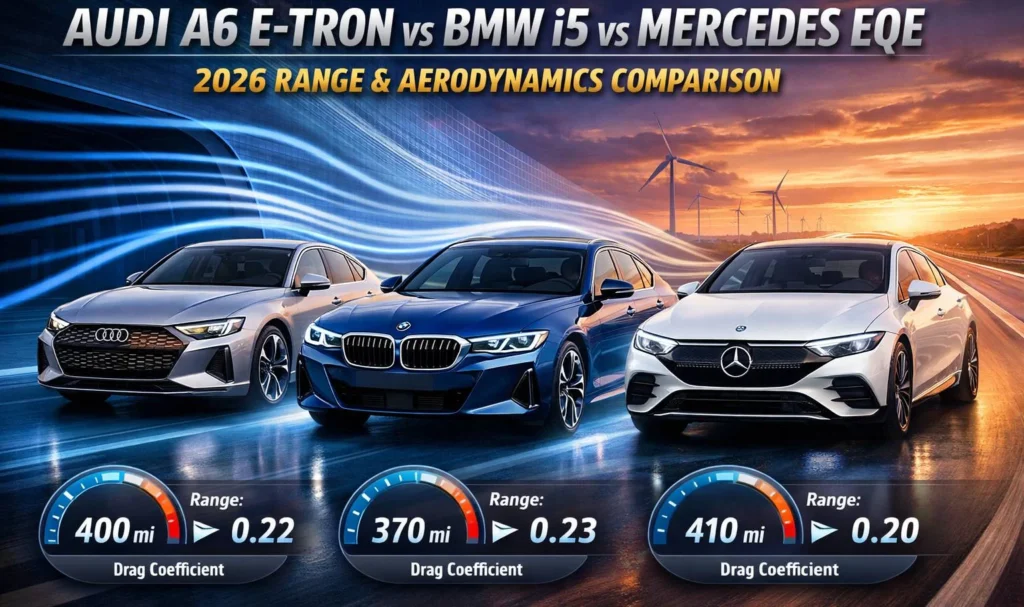
In 2026, luxury electric sedans are no longer defined by battery size alone. Real-world usability is increasingly determined by aerodynamic efficiency, electrical architecture, thermal management, and how well each platform is engineered for sustained highway conditions.
This comparison analyzes the Audi A6 e-tron, BMW i5, and Mercedes-Benz EQE from a real-world engineering perspective—focusing on drag area (Cd × A), highway efficiency behavior, charging architecture, and how these factors translate into everyday usability, especially under Indian driving conditions.
Platform Engineering and Architecture
The Audi A6 e-tron is built on the PPE (Premium Platform Electric), co-developed with Porsche. This is currently one of the most advanced EV architectures, featuring an 800V electrical system that reduces current for the same power output. In practical terms, this lowers resistive (I²R) losses, reduces heat generation, and allows more stable performance during long highway drives and repeated fast charging.
The Mercedes EQE uses the EVA2 platform, a dedicated EV architecture optimized for aerodynamic packaging and energy efficiency. Mercedes has clearly prioritized airflow management and stability over sportiness, resulting in one of the most aerodynamically efficient sedans on sale today.
The BMW i5, however, is built on the CLAR platform—a multi-energy architecture originally designed for combustion engines. While structurally strong, this introduces unavoidable compromises. Battery placement, cooling airflow, and underbody smoothness are not as optimized as in dedicated EV platforms. As a result, efficiency suffers, especially at highway speeds.
In real-world terms, dedicated EV platforms like PPE and EVA2 typically deliver 8–12% better efficiency under similar conditions due to optimized weight distribution, reduced parasitic losses, and cleaner airflow paths. This gap becomes more noticeable during long-distance driving.
Aerodynamics and Efficiency Engineering
| Model | Drag Coefficient (Cd) | Frontal Area | Drag Area (Cd × A) | Key Aero Strategy |
|---|---|---|---|---|
| Audi A6 e-tron | 0.21 | 2.3 m² | 0.483 | Flat underbody, digital mirrors reducing side turbulence |
| Mercedes EQE | 0.20 | 2.35 m² | 0.470 | Seamless body design minimizing airflow separation |
| BMW i5 | 0.23 | 2.4 m² | 0.552 | Active air flaps and adaptive cooling airflow |
At highway speeds (100–130 km/h), aerodynamic drag becomes the dominant force acting on an EV, contributing up to 60–70% of total energy consumption. Since drag increases with the square of speed and required power increases with the cube, even small differences in drag area significantly affect real-world range.
The Mercedes EQE clearly leads in aerodynamic efficiency. In steady highway cruising, this translates into consistently lower energy consumption and less range drop-off as speed increases.
The Audi A6 e-tron comes very close, and its use of digital mirrors and refined underbody airflow helps reduce turbulence in real-world crosswind conditions—something often overlooked in spec sheets but noticeable during long drives.
The BMW i5’s higher drag area reflects its platform limitations. More aggressive cooling airflow and less optimized underbody design increase turbulence, which directly impacts efficiency at higher speeds.
Battery, Range, and Real-World Efficiency
| Model | Usable Battery | WLTP Range | Highway Efficiency (kWh/100 km) | Real-World Range |
|---|---|---|---|---|
| Audi A6 e-tron | 94 kWh | ~680 km (est.) | 17.5–18.5 | 520–580 km |
| Mercedes EQE | 90 kWh | ~660 km | 18–19 | 500–560 km |
| BMW i5 | 81 kWh | ~582 km | 19–21 | 430–500 km |
In real-world highway testing scenarios, efficiency aligns closely with aerodynamic performance. The EQE maintains stable consumption even at higher speeds, making it particularly strong for long-distance cruising.
The Audi A6 e-tron stands out for balance. It performs efficiently not only on highways but also in mixed conditions, where regenerative braking and power delivery optimization play a bigger role.
The BMW i5, especially in performance variants, consumes significantly more energy. Wider tires, dual-motor setups, and higher cooling demands increase overall losses, particularly during aggressive driving.
Under Indian summer conditions (above 35°C), air conditioning and battery cooling can draw 2–3 kW continuously. Over long highway journeys, this can reduce range by 40–60 km, making thermal efficiency a critical real-world factor rather than just a technical specification.
Charging Technology and Electrical Architecture
| Model | Voltage System | Max DC Charging | 10–80% Charging Time |
|---|---|---|---|
| Audi A6 e-tron | 800V | 270 kW | ~21 minutes |
| Mercedes EQE | 400V | 170 kW | ~32 minutes |
| BMW i5 | 400V | 205 kW | ~30 minutes |
The Audi A6 e-tron’s 800V system is a clear technological advantage. It enables faster charging, lower heat generation, and more consistent performance across repeated charging cycles.
For a deeper technical breakdown of EV architecture and charging systems, you can refer to this detailed comparison: Audi A6 e-tron vs BMW i5 vs Mercedes EQE detailed specs comparison.
However, in India, where ultra-fast 800V-compatible chargers are still limited, this advantage is not always fully realized. In many real-world scenarios, charging speeds may be constrained by infrastructure rather than vehicle capability.
Performance: Acceleration and Braking
| Model | Variant | 0–100 km/h | 100–0 km/h Braking |
|---|---|---|---|
| Audi A6 e-tron | Quattro | ~4.5 seconds | 35–36 meters |
| Mercedes EQE | EQE 350+ | ~6.2 seconds | 36–37 meters |
| BMW i5 | M60 xDrive | ~3.8 seconds | 33–34 meters |
The BMW i5 is the clear performance leader, offering aggressive acceleration and strong braking capability. However, this comes with a noticeable trade-off in efficiency and thermal load during spirited driving.
Audi delivers a more balanced experience, while Mercedes focuses on smooth, consistent power delivery rather than outright speed.
Crash Safety and Structural Integrity
The Mercedes EQE has achieved a 5-star Euro NCAP rating, demonstrating strong crash protection and structural integrity. Audi and BMW are expected to match similar standards due to reinforced battery enclosures and advanced safety systems.
EVs benefit from a low center of gravity due to floor-mounted batteries, improving both stability and crash performance.
Feature Comparison
| Feature | Audi A6 e-tron | BMW i5 | Mercedes EQE |
|---|---|---|---|
| Battery Cooling | Advanced liquid cooling | Liquid cooling | Multi-loop thermal system |
| Heat Pump | Standard | Optional | Standard |
| Infotainment | MMI OLED | iDrive 8.5 | MBUX Hyperscreen |
| ADAS | Level 2+ | Level 2+ | Level 2+ |
| Rear Steering | Yes | Yes | Yes |
On-Road Price in India (Estimated 2026)
| Model | Estimated Price |
|---|---|
| Audi A6 e-tron | ₹85–95 lakh |
| BMW i5 | ₹1.05–1.20 crore |
| Mercedes EQE | ₹1.20–1.35 crore |
Variant Comparison
| Model | Base Variant | Top Variant |
|---|---|---|
| Audi A6 e-tron | RWD | Quattro AWD |
| BMW i5 | eDrive40 | M60 xDrive |
| Mercedes EQE | EQE 350+ | AMG EQE |
Real-World Driving Insights
For long highway journeys, the Mercedes EQE is the most efficient and predictable. It consistently delivers lower energy consumption, making it ideal for users prioritizing maximum range stability.
The Audi A6 e-tron is the most well-rounded option. It adapts better to mixed driving conditions, including city traffic, highways, and varying temperatures, making it more practical for Indian usage.
The BMW i5 is best suited for drivers who prioritize performance and driving engagement. However, efficiency varies significantly depending on driving style, making it less predictable in real-world usage.
Conclusion
From a pure engineering standpoint, the Mercedes EQE is the most aerodynamically efficient and best suited for highway-focused driving. The Audi A6 e-tron represents the most future-ready platform, offering the best balance between efficiency, charging speed, and usability. The BMW i5, while highly capable, is fundamentally limited by its multi-energy platform and prioritizes performance over efficiency.
The ideal choice ultimately depends on whether the priority is maximum range, balanced usability, or driving performance.
Key Takeaways
- Audi A6 e-tron offers the best balance of efficiency, charging, and usability
- Mercedes EQE delivers the lowest drag and best highway efficiency
- BMW i5 provides the strongest performance but higher consumption
- Aerodynamics is the most critical factor for highway range
- 800V architecture is future-ready but infrastructure-dependent
FAQs
1. Which EV has the best real-world range?
Mercedes EQE performs best on highways, while Audi A6 e-tron is more balanced overall.
2. Which model charges fastest?
Audi A6 e-tron, due to its 800V system.
3. Which car is best for performance?
BMW i5 M60 offers the quickest acceleration and strongest driving dynamics.
4. Are these cars suitable for Indian conditions?
Yes, but real-world range depends heavily on temperature, traffic, and charging access.
5. Why is aerodynamics so important?
Because at highway speeds, it becomes the biggest factor affecting energy consumption and range.
BMW has introduced a new AI-powered driving experience with the rollout of Operating System 9, a software platform that enables natural voice interaction, adaptive navigation, and continuous over-the-air updates.
BMW is entering a new phase of digital mobility by integrating advanced artificial intelligence into its latest vehicles. At the core of this shift is BMW Operating System 9, designed to unify voice interaction, navigation intelligence, driver assistance, and personalization into a single platform.
According to official BMW communication, Operating System 9 represents a major step toward software-defined vehicles, where features evolve continuously through software updates rather than hardware changes.
By combining machine learning, cloud connectivity, and deep sensor integration, BMW is restructuring how drivers interact with vehicles—reducing manual inputs and enabling context-aware automation.
What Defines BMW’s AI-Driven Driving Experience?
BMW Operating System 9 acts as a central intelligence layer connecting multiple vehicle systems into a unified architecture. Unlike traditional infotainment systems, it enables real-time data sharing across vehicle functions.
- Conversational Voice Interface: Understands intent and context
- Adaptive Navigation: Real-time traffic and route intelligence
- AI Driver Assistance: Continuous environment analysis
- OTA Updates: Ongoing feature improvements
- Full Personalization: Driver-specific cabin settings
Key insight: The shift is from reactive controls to predictive, AI-driven interaction.
Natural Voice Interaction and Reduced Distraction
The updated BMW Intelligent Personal Assistant supports natural conversations and multi-step commands without repeated prompts.
- “Find a coffee shop on my route.”
- “Set temperature to 22°C and play music.”
- “Do I have enough range?”
This reduces reliance on touchscreens and helps lower driver distraction.
AI Integration with Navigation and Driver Assistance
BMW combines cameras, radar, and sensors with AI algorithms to interpret driving conditions in real time.
- Adaptive cruise based on traffic and curves
- Navigation-linked lane guidance
- Automated parking with memory function
- 360° hazard detection
Personalization Through AI Learning
The system learns driver behavior and automatically adjusts seat position, climate, lighting, and media preferences.
Profiles linked to BMW ID can sync across vehicles like the BMW iX and BMW i7.
Software-Defined Vehicle and OTA Updates
Operating System 9 enables continuous improvement via over-the-air updates, extending vehicle capabilities over time.
This approach keeps vehicles technologically current without requiring dealership visits.
Real-World Models: BMW iX and i7
These AI features are already available in flagship EVs like the BMW iX and BMW i7, which act as technology platforms for BMW’s future systems.
They also preview the upcoming Neue Klasse architecture, focused on local AI processing and faster system response.
Everyday Driving Benefits
- Reduced driver workload
- Improved route efficiency
- Enhanced safety awareness
- Seamless voice control
Reality check: Performance depends on real-world conditions and infrastructure.
Technical Comparison
| Feature | Traditional | BMW OS 9 |
|---|---|---|
| Voice | Command-based | Natural language AI |
| Navigation | Static GPS | Live intelligent routing |
| Updates | Manual | OTA updates |
| Parking | Basic sensors | Automated memory system |
| Profiles | Limited | Cloud-based personalization |
Data Security and Privacy
BMW uses layered cybersecurity systems. Most processing occurs locally, while cloud data is anonymized. Drivers control data-sharing preferences.
Conclusion
BMW Operating System 9 marks a shift toward intelligent, software-driven mobility. By integrating AI across key systems, BMW is reducing friction between driver and machine.
Final takeaway: The future of driving is defined less by hardware and more by continuously evolving software platforms.
FAQ
What is BMW Operating System 9?
It is BMW’s latest software platform enabling AI-driven features, voice control, and OTA updates.
Which cars use this system?
Models like BMW iX and BMW i7 currently feature it.
Does it improve safety?
Yes, through AI-powered driver assistance and real-time monitoring.
Ankush Kumar is an automotive analyst specializing in electric vehicles, luxury cars, and real-world performance benchmarking. His work focuses on ownership insights, charging behavior analysis, and practical usability to help buyers make informed decisions based on real conditions rather than specifications alone.
He tracks industry data from global agencies, manufacturer reports, and road test benchmarks to deliver high-authority automotive analysis tailored for Indian buyers.
Follow on Facebook: Ankush Kumar