+91-9646339590



Introduction
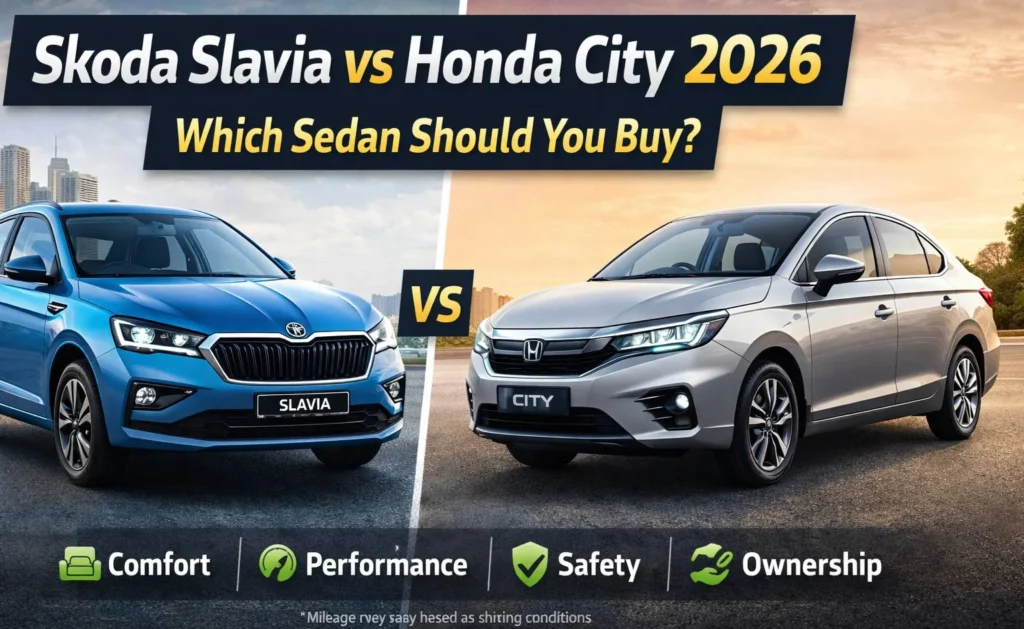
Despite SUVs dominating Indian roads, the Skoda Slavia and Honda City continue to hold ground for buyers who value precision, comfort, and efficiency over bulk.
In 2026, choosing between these two sedans isn’t about features alone—it’s about how they perform in real-world conditions like city traffic, highway overtakes, fuel efficiency, and long-term ownership.
This comparison breaks down not just specifications, but how each car actually fits into daily Indian driving.
This comparison goes beyond specifications. It evaluates how these cars behave in real-world Indian conditions—traffic, highways, fuel costs, service ecosystems, and long-term ownership risks.
On-Road Price Comparison (2026)
On-road pricing varies by state, but realistic metro estimates (Delhi/Chandigarh) are as follows:
| Variant | Skoda Slavia (₹ On-road) | Honda City (₹ On-road) |
|---|---|---|
| Base | ₹13.5 – ₹14.2 lakh | ₹13.8 – ₹14.5 lakh |
| Mid Variant | ₹16 – ₹17.5 lakh | ₹16.5 – ₹18 lakh |
| Top Variant | ₹20 – ₹21.5 lakh | ₹19.5 – ₹21 lakh |
Insight: Pricing overlap is significant, but value differs based on usage. Slavia delivers stronger performance per rupee, while City offsets cost with lower ownership risk and higher resale predictability.
Platform & Engineering Philosophy
The Skoda Slavia is built on Volkswagen Group’s MQB-A0-IN platform, a localized version of the global MQB architecture engineered specifically to reduce costs by up to 95% localization under the India 2.0 strategy. This platform prioritizes structural rigidity, high-speed stability, and driving precision.
The Honda City is based on Honda’s Global Small Car platform, refined over multiple generations. Its focus is less on outright performance and more on durability, ride comfort, and consistent behavior across varied road conditions.
Real-world implication: The Slavia feels more “European” in its driving manners, while the City feels more predictable and forgiving in everyday usage.
Variant & Powertrain Comparison
| Specification | Skoda Slavia | Honda City |
|---|---|---|
| Engine Options | 1.0 TSI (115 PS), 1.5 TSI (150 PS) | 1.5 i-VTEC Petrol (121 PS) |
| Torque | 178 Nm / 250 Nm | 145 Nm |
| Gearbox | Manual, Torque Converter, DSG | Manual, CVT |
| Hybrid Option | No | Yes (e:HEV strong hybrid) |
The Slavia’s 1.5 TSI uses active cylinder technology (ACT), shutting down two cylinders under light load to improve efficiency—technology typically seen in higher segments.
Performance: Real Road Tests
0–100 km/h Acceleration
- Skoda Slavia 1.5 TSI DSG: ~8.6–9.0 seconds (Autocar India instrumented test)
- Skoda Slavia 1.0 TSI AT: ~11.5 seconds
- Honda City 1.5 CVT: ~10.5–11.2 seconds
The Slavia 1.5 is among the quickest sedans under ₹25 lakh. More importantly, its mid-range acceleration (40–100 km/h) is significantly stronger, which directly impacts overtaking confidence on highways.
Braking Performance (100–0 km/h)
- Skoda Slavia: ~39–41 meters
- Honda City: ~41–43 meters
The difference is small but noticeable during emergency braking scenarios. The Slavia’s braking system feels sharper and more progressive under repeated use.
Real-World Driving Behavior
In dense city traffic, the Honda City’s CVT offers smoother, jerk-free operation. The Slavia DSG, while quick, can feel slightly abrupt at low speeds and requires careful modulation in stop-go traffic.
On highways, the situation reverses. The Slavia’s turbocharged torque and chassis stability make it more effortless above 80 km/h, whereas the City requires more throttle input for overtakes.
Fuel Efficiency (Real-World Conditions)
| Condition | Skoda Slavia | Honda City |
|---|---|---|
| City Driving | 12–15 km/l | 13–16 km/l |
| Highway | 17–20 km/l | 18–21 km/l |
| Hybrid (City e:HEV) | — | 22–26 km/l |
The City hybrid’s efficiency advantage becomes significant in urban usage, where regenerative braking and EV-only driving reduce fuel consumption.
Crash Safety & Structural Integrity
Safety evaluation should consider both structural strength and active safety systems.
- Skoda Slavia: Shares its platform with the Volkswagen Virtus, which scored a 5-star rating in Global NCAP (2023), indicating strong structural safety.
- Honda City: Achieved a 5-star rating in ASEAN NCAP, with consistent performance across frontal and side impact tests.
For detailed crash testing protocols and safety ratings, refer to the Global NCAP official website, which has evaluated multiple India-market vehicles under standardized conditions.
Safety Feature Comparison
| Feature | Skoda Slavia | Honda City |
|---|---|---|
| Airbags | Up to 6 | Up to 6 |
| ADAS | No | Yes (Honda Sensing) |
| Adaptive Cruise Control | No | Yes |
| Lane Keep Assist | No | Yes |
Important context: While ADAS gives Honda City an edge on paper, its effectiveness in India depends on road markings and traffic discipline. In inconsistent lane conditions, systems like lane keep assist may not function optimally.
Interior, Space & Comfort
The Honda City continues to set benchmarks for rear-seat comfort. Its longer wheelbase translates into superior legroom, making it better suited for chauffeur-driven use or family travel.
The Slavia offers a more driver-focused cabin with better seat bolstering and a lower seating position, enhancing control during spirited driving.
Feature Comparison
| Feature | Skoda Slavia | Honda City |
|---|---|---|
| Infotainment | 10-inch touchscreen | 8-inch touchscreen |
| Digital Instrument Cluster | Yes | No |
| Sunroof | Yes | Yes |
| Wireless Connectivity | Yes | Yes |
The Slavia feels more modern in terms of interface and layout, while the City emphasizes usability and ergonomics.
Ride Quality & Handling
The Slavia uses a firmer suspension setup, which improves stability at high speeds but can feel slightly stiff over broken roads.
The City’s softer suspension absorbs road imperfections more effectively, making it more comfortable for daily commuting and uneven surfaces.
Ownership Cost, Service & Reliability
According to SIAM and independent ownership surveys (2024–2025)
- Honda consistently ranks among the most reliable brands in India.
- Skoda has reduced service costs significantly under its India 2.0 program, improving parts availability and maintenance transparency.
Annual Maintenance Cost:
- Skoda Slavia: ₹8,000 – ₹12,000
- Honda City: ₹6,000 – ₹10,000
Service Network: Honda has a wider network (~350+ touchpoints), while Skoda is expanding but still comparatively limited in smaller towns.
Resale Value: Honda City maintains stronger resale due to long-standing brand trust and lower perceived ownership risk.
Which Sedan Makes More Sense in 2026?
Choose Skoda Slavia if:
- You prioritize performance and driving engagement
- You frequently drive on highways
- You prefer sharper handling and braking
Choose Honda City if:
- You want predictable long-term ownership
- You prioritize comfort and rear seat space
- You want maximum fuel efficiency (hybrid advantage)
Conclusion
The Skoda Slavia and Honda City are not direct substitutes—they represent two different interpretations of what a sedan should deliver in modern India.
The Slavia is engineered for drivers who value responsiveness, high-speed stability, and mechanical sophistication. The City focuses on consistency, efficiency, and long-term usability.
In 2026, the better choice depends less on specifications and more on how the car fits into your daily life. Buyers prioritizing driving pleasure will gravitate toward the Slavia, while those seeking reliability and comfort will find the City more aligned with their needs.
Key Takeaways
- Skoda Slavia delivers superior performance and highway dynamics
- Honda City offers better comfort, reliability, and resale value
- City hybrid provides unmatched efficiency for urban driving
- Slavia has stronger braking and handling characteristics
- ADAS gives City an edge in active safety, with real-world limitations
FAQs
1. Which sedan is better for long-term ownership?
Honda City is generally the safer choice due to its proven reliability, lower maintenance variability, and stronger resale value.
2. Is Skoda Slavia reliable in 2026?
Reliability has improved significantly under the India 2.0 program, though long-term perception still trails Honda.
3. Which car performs better on highways?
Skoda Slavia, especially the 1.5 TSI, offers stronger mid-range performance and better stability at high speeds.
4. Is Honda City hybrid worth buying?
Yes, particularly for city users, where fuel savings and smooth driving can offset the higher initial cost.
5. Which sedan is safer overall?
Both offer strong structural safety, but Honda City includes ADAS features, giving it an advantage in active safety.
About the Author
Ankush Kumar is an automotive content specialist with over 5 years of experience covering global car markets, hybrid technologies, and EV ecosystem developments. His work focuses on translating complex automotive engineering concepts into practical insights for Indian buyers.
He has analyzed vehicle platforms, powertrain systems, and real-world usability trends across multiple brands. His content emphasizes data-backed evaluation, regulatory awareness, and ownership practicality.
Ankush Kumar is an automotive analyst specializing in electric vehicles, luxury cars, and real-world performance benchmarking. His work focuses on ownership insights, charging behavior analysis, and practical usability to help buyers make informed decisions based on real conditions rather than specifications alone.
He tracks industry data from global agencies, manufacturer reports, and road test benchmarks to deliver high-authority automotive analysis tailored for Indian buyers.
Follow on Facebook: Ankush Kumar