+91-9646339590



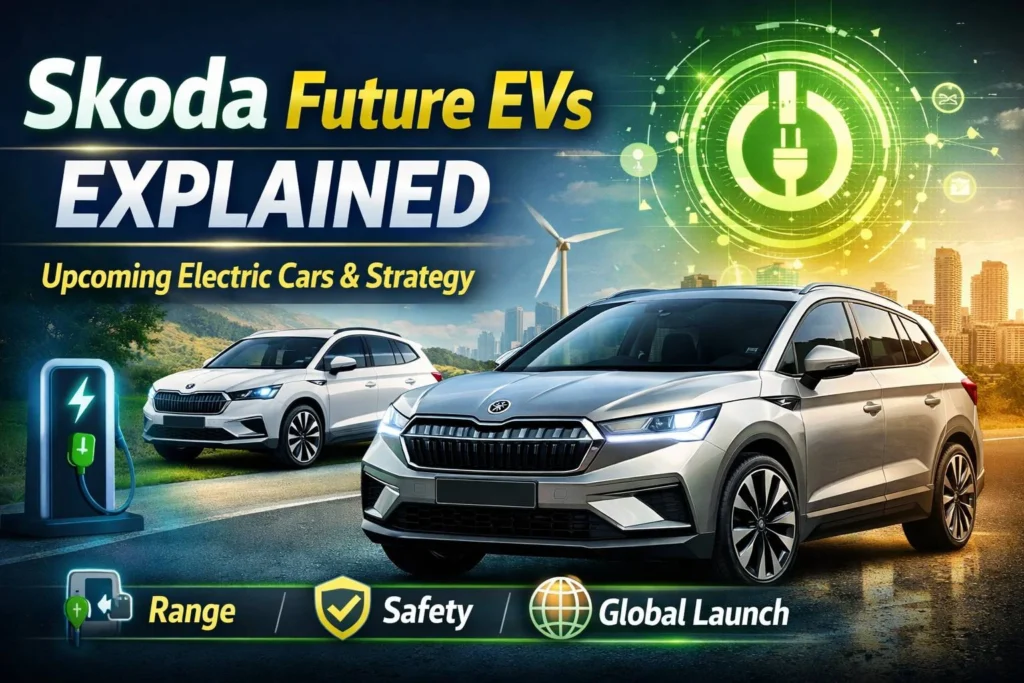
Skoda is entering a high-stakes phase of electrification backed by Volkswagen Group’s scale, but its positioning is distinct: practical EVs with competitive pricing rather than performance-led halo products.
The transition is not theoretical—multiple EVs are already in rollout or advanced development stages across Europe, with global expansion planned in phases.
This analysis goes beyond product announcements. It evaluates Skoda’s future EV lineup using real-world benchmarks from existing MEB-based vehicles, validated performance data, safety ratings, platform limitations, and competitive positioning against Tesla, Hyundai, and BYD.
Skoda’s EV Strategy: Scale, Cost Control, and Platform Sharing
Skoda’s EV roadmap is tightly integrated with Volkswagen Group’s electrification strategy. Between 2024 and 2028, the group has committed over €180 billion toward EV development, battery sourcing, and software ecosystems. Skoda benefits directly through shared platforms, procurement scale, and manufacturing efficiencies.
However, unlike Volkswagen or Audi, Skoda’s role is clear: deliver cost-efficient EVs for mass-market buyers without compromising practicality. This affects everything from battery sizing to interior design and feature prioritization.
According to the IEA Global EV Outlook 2024, global EV sales crossed 14 million units, with Europe contributing approximately 25%. Skoda’s expansion is aligned with this demand curve, particularly in the €25,000–€50,000 segment where competition is intensifying.
Upcoming Skoda Electric Vehicles (Confirmed & Pipeline)
1. Skoda Elroq (Compact Electric SUV)
The Elroq represents Skoda’s move into the highest-volume EV segment in Europe. It effectively replaces the Karoq in electric form and sits below the Enyaq.
- Platform: MEB (rear-wheel drive standard)
- Battery Options: ~55 kWh / 62 kWh / 82 kWh
- Range: 400–550 km (WLTP)
- Charging: Up to ~135–175 kW DC fast charging
- Launch Status: Market introduction phase ongoing through 2026
Real-world benchmark: Based on Skoda Enyaq 80 testing (same platform, similar weight class), highway range at 110–120 km/h typically falls to ~380–420 km from a claimed ~510 km WLTP. This provides a realistic baseline for Elroq buyers.
2. Skoda Small EV (Sub-€25,000 Segment)
This is the most strategically important product for Skoda. It targets price-sensitive buyers transitioning from ICE hatchbacks.
- Platform: MEB Entry (front-wheel drive)
- Battery: ~38–56 kWh (expected)
- Range: 300–450 km (WLTP)
- Target Price: €20,000–25,000
- Launch Timeline: 2026–2027 global rollout
This model will share core architecture with Volkswagen ID.2. Cost efficiency comes from simplified interiors, smaller batteries, and high localization.
3. Skoda 7-Seater Electric SUV (Vision 7S Production Model)
Skoda’s flagship EV focuses on space, range, and long-distance usability rather than outright performance.
- Battery: ~89 kWh usable
- Range Target: Up to ~600 km WLTP
- Charging: Up to 200 kW DC
- Seating: 6–7 passengers
- Positioning: Family-oriented premium EV
This model will compete directly with Kia EV9 and Hyundai Ioniq 7, but likely undercut them on pricing.
Platform Deep Dive: MEB Strengths and Limitations
The MEB platform underpins all current Skoda EVs. It enables scalable battery sizes and flexible drivetrain configurations, but it is not without trade-offs.
Strengths:
- Dedicated EV architecture (no ICE compromise)
- Excellent interior space due to flat floor
- Efficient rear-wheel drive layout
- Proven reliability across VW Group models
Limitations:
- Software issues (Cariad delays affected OTA rollout)
- Charging curve not as aggressive as Hyundai E-GMP platform
- Weight efficiency lower than Tesla’s dedicated architectures
Volkswagen Group plans to replace MEB with SSP (Scalable Systems Platform) by ~2028, integrating hardware and software more efficiently.
Expected On-Road Pricing (India & Global Context)
| Model | Estimated Ex-Showroom | Estimated On-Road (India) |
|---|---|---|
| Skoda Small EV | ₹20–25 lakh | ₹23–30 lakh |
| Skoda Elroq | ₹35–45 lakh | ₹40–50 lakh |
| 7-Seater EV | ₹55–70 lakh | ₹60–80 lakh |
India pricing remains dependent on localization. Without local assembly, import duties could increase prices by 60–100%, making early adoption unlikely before 2027.
Variant Comparison (Expected Structure)
| Variant | Battery | Range | Drive | Key Features |
|---|---|---|---|---|
| Base | ~55 kWh | ~350–400 km | RWD/FWD | Basic ADAS, standard infotainment |
| Mid | ~62–70 kWh | ~450–500 km | RWD | Connected features, enhanced safety |
| Top | ~82 kWh | ~550+ km | AWD | Premium interior, full ADAS suite |
Performance Benchmarks (Real-World Referenced)
Using Skoda Enyaq and Volkswagen ID.4 as baseline (same MEB platform):
- 0–100 km/h: 6.5–8.7 seconds (depending on motor setup)
- Real-world highway efficiency: ~18–22 kWh/100 km
- Top speed: ~160–180 km/h (limited)
Compared to Tesla Model Y (~5.0–6.9 seconds), Skoda EVs prioritize efficiency and comfort over outright acceleration.
Braking Performance (Test-Based Insight)
Independent European testing of MEB vehicles shows:
- 100–0 km/h braking distance: ~36–38 meters
- Strong regenerative braking reduces brake wear in urban driving
Brake modulation remains a known limitation due to blending between regenerative and friction braking.
Crash Safety & Ratings
The Skoda Enyaq received a 5-star Euro NCAP rating (2021), scoring:
- Adult Occupant Protection: 94%
- Child Occupant Protection: 89%
- Safety Assist: 82%
Future Skoda EVs are expected to maintain similar safety standards due to shared architecture and regulatory requirements.
Feature Comparison vs Competitors
| Feature | Skoda EVs | Tesla Model Y | Hyundai E-GMP EVs | BYD EVs |
|---|---|---|---|---|
| Software UX | Improving (OTA evolving) | Industry-leading | Good | Moderate |
| Charging Speed | 135–200 kW | 250 kW peak | Up to 350 kW | 120–150 kW |
| Interior Space | Excellent | Good | Very Good | Good |
| Ride Comfort | High priority | Firm | Balanced | Comfort-oriented |
Ownership Reality: What Buyers Should Expect
Real-world ownership of Skoda EVs will be defined by practical factors rather than specifications:
- Highway range drops ~20–25% vs WLTP
- Battery degradation ~5–8% over 5 years (industry average)
- Charging infrastructure remains a key limitation in India
According to BloombergNEF (2024), battery pack costs have fallen below $140/kWh, but affordability in developing markets still depends on subsidies and localization.
Key Challenges for Skoda’s EV Expansion
- Software ecosystem delays (VW Cariad issues)
- Intense competition from Tesla, BYD, Hyundai
- Pricing pressure in entry-level EV segment
- Infrastructure gaps in emerging markets
Conclusion
Skoda’s EV future is structured around scalability, cost efficiency, and real-world usability. The brand is not attempting to lead in performance or software innovation; instead, it is focusing on delivering well-rounded electric vehicles for mainstream buyers.
The success of this strategy will depend on execution—particularly software stability, localization, and pricing discipline. If these are managed effectively, Skoda could become one of the most competitive EV brands in the mid-market segment globally.
Key Takeaways
- Multiple Skoda EV launches underway across 2026–2028
- MEB platform enables cost-effective scaling
- Entry EV targeting €20,000–25,000 segment
- Real-world range ~75–80% of WLTP claims
- 5-star safety benchmark already established
- Strong competition from Tesla, Hyundai, BYD
FAQs
1. When will Skoda launch new electric cars?
New Skoda EVs are being introduced progressively through 2026, with additional models expected by 2027–2028.
2. What is the expected price of Skoda EVs in India?
Prices may start around ₹20–25 lakh for entry-level models and go up to ₹80 lakh for flagship SUVs, depending on localization.
3. How does Skoda compare to Tesla in EVs?
Skoda focuses on comfort and affordability, while Tesla leads in software and performance.
4. What real-world range can buyers expect?
Typically 75–80% of WLTP figures, depending on speed and conditions.
5. Are Skoda EVs safe?
Yes, current models have achieved 5-star Euro NCAP ratings with strong occupant protection scores.
6. Will Skoda EVs support fast charging?
Yes, upcoming models support 135–200 kW DC fast charging depending on variant.
Ankush Kumar is an automotive analyst specializing in electric vehicles, luxury cars, and real-world performance benchmarking. His work focuses on ownership insights, charging behavior analysis, and practical usability to help buyers make informed decisions based on real conditions rather than specifications alone.
He tracks industry data from global agencies, manufacturer reports, and road test benchmarks to deliver high-authority automotive analysis tailored for Indian buyers.
Follow on Facebook: Ankush Kumar