+91-9646339590



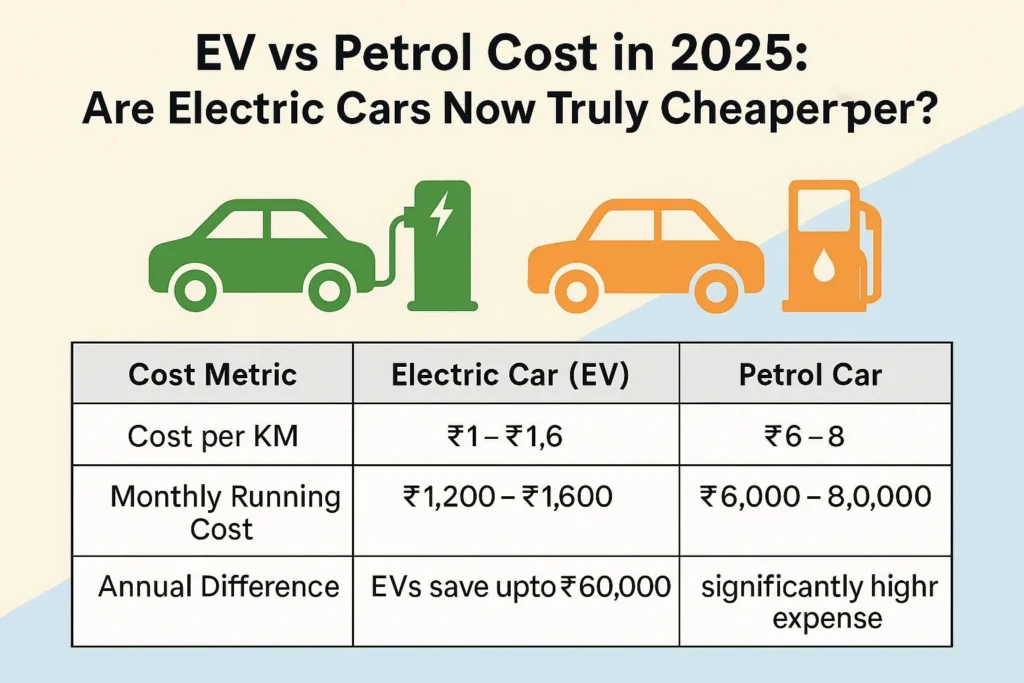
Electric cars are cheaper in the long run due to significantly lower running and maintenance costs, but they still have a higher upfront price. Most Indian buyers recover this price difference within 3–5 years depending on usage.
The EV vs petrol debate in India has shifted from theory to real ownership economics. Rising fuel costs, improved battery efficiency, and better charging infrastructure have made EVs a financially viable option—but not for everyone.
This analysis evaluates actual costs, real-world performance, and ownership practicality using current Indian market data.
On-Road Price Comparison in 2025
Upfront cost remains the biggest difference between EVs and petrol vehicles.
| Segment | EV Model | Petrol Model | Price Difference |
|---|---|---|---|
| Entry Hatchback | Tata Nexon EV electric SUV platform (₹16–19 lakh) | Hyundai Creta petrol SUV India (₹12–20 lakh) | ₹4–5 lakh |
| Premium EV | MG ZS EV long-range electric SUV (₹25–28 lakh) | Hyundai Creta petrol SUV India | ₹6–8 lakh |
EVs benefit from lower GST (5%) compared to petrol vehicles (28%), along with state-level incentives. According to the Ministry of Heavy Industries (2024), subsidies under FAME schemes have reduced effective EV pricing by up to ₹1.5 lakh in some cases.
Real-World Running Cost (With Practical Calculation)
EV running cost depends on electricity rate, driving conditions, and charging losses.
Typical EV usage scenario:
– Efficiency: 130 Wh/km (city driving with AC)
– Electricity cost: ₹8/unit
– Charging loss: ~10%
Effective EV cost: ~₹1.5–₹2.0 per km
Petrol usage scenario:
– Mileage: 15 km/l
– Fuel price: ₹100/litre
Effective petrol cost: ~₹6.5–₹7 per km
| Annual Usage (15,000 km) | EV | Petrol |
|---|---|---|
| Running Cost | ₹22,500 – ₹30,000 | ₹97,000 – ₹1.05 lakh |
India had over 12,000 public EV charging stations as of 2024, according to Ministry of Power data, improving usability in urban areas.
Total Cost of Ownership (5-Year Real Scenario)
For a typical Indian user driving 15,000 km annually:
- EV Total Cost: ₹13–16 lakh
- Petrol Total Cost: ₹15–19 lakh
This includes purchase price, running cost, and maintenance. EVs become financially beneficial after ~4 years in most urban scenarios.
Maintenance and Battery Reality
EVs eliminate several traditional maintenance components:
- No engine oil or gearbox servicing
- Lower brake wear due to regenerative braking
- Fewer mechanical failures
Annual maintenance:
- EV: ₹5,000 – ₹8,000
- Petrol: ₹9,000 – ₹15,000
Battery warranties offered by manufacturers like Tata Motors and MG Motor typically cover 8 years or 1.6 lakh km. However, replacement cost post warranty can range between ₹4–7 lakh depending on battery size.
Variant Comparison: Nexon EV vs Petrol Nexon
| Specification | Nexon EV | Nexon Petrol |
|---|---|---|
| Power | 127–143 PS | 120 PS |
| Torque | 215–250 Nm | 170 Nm |
| Range / Mileage | 325–465 km | 16–17 km/l |
The EV delivers stronger acceleration in city traffic due to instant torque, especially useful in stop-go conditions.
Real Road Test Insights
0–100 km/h Acceleration
Nexon EV: ~9.2 seconds
Petrol Nexon: ~11.5 seconds
Braking (100–0 km/h)
EV: ~38–40 meters
Petrol: ~40–42 meters
EVs also benefit from regenerative braking, which reduces brake wear and improves efficiency during urban driving.
Driving Experience: Real Usage Differences
EV Experience:
- Instant acceleration in traffic
- Silent cabin, ideal for city commuting
- One-pedal driving reduces fatigue
Petrol Experience:
- Better suited for long-distance travel
- No dependency on charging infrastructure
- Consistent high-speed performance
For users planning long trips, EV charging availability becomes a key factor (see our EV Charging Guide in India for practical planning tips).
Charging vs Refueling
Petrol refueling: 3–5 minutes
EV home charging: 6–8 hours
Fast charging: 40–60 minutes (0–80%)
For daily commuters with home charging, EVs integrate seamlessly into routine usage.
Resale Value Trends
Petrol cars still have stronger resale value due to market maturity. However, EV resale is improving with better battery durability data and increased demand.
Factors influencing EV resale:
- Battery health
- Charging cycles
- Service history
Feature-Wise Comparison
| Feature | EV | Petrol |
|---|---|---|
| Running Cost | Very Low | High |
| City Performance | Excellent | Moderate |
| Highway Range | Moderate | High |
| Maintenance | Low | Higher |
| Refueling Time | Slow | Fast |
Who Should Buy an EV in 2025?
Best suited for:
- Urban commuters driving 12,000+ km/year
- Users with home charging access
- Daily office or city usage
Petrol is better for:
- Low annual usage (<8,000 km)
- Frequent highway driving
- Areas with limited EV infrastructure
Suggested External References
- Ministry of Power India – EV Charging Data
- SIAM India – Automotive Industry Statistics
- Tata Motors Official EV Product Information
Conclusion: Practical Cost Reality in 2025
EVs are no longer just an environmental choice—they are a financially practical option for a large segment of Indian buyers. For city users with consistent driving patterns, lower running cost offsets the higher purchase price within a few years.
However, petrol cars continue to offer flexibility, especially for long-distance travel and lower initial investment. The decision depends less on technology and more on usage pattern.
Key Takeaways
- EVs cost ~70% less per km compared to petrol cars
- Break-even point occurs within 3–5 years
- Battery warranty reduces long-term ownership risk
- Charging infrastructure is improving rapidly in cities
- Petrol cars remain practical for low-usage buyers
FAQs
1. Are EVs cheaper than petrol cars in India in 2025?
Yes, especially for users with higher annual driving. EVs offer lower running and maintenance costs.
2. What is EV cost per km in real conditions?
Approximately ₹1.5–₹2.0 per km depending on electricity rate and driving conditions.
3. How long does EV battery last?
Most EV batteries last 8–10 years and come with manufacturer warranties.
4. Is EV charging difficult in India?
In cities, charging is becoming easier with growing infrastructure, but rural areas still face limitations.
5. Should I buy EV or petrol car?
If your usage is mostly city-based and above 12,000 km/year, EV is financially beneficial. Otherwise, petrol remains practical.
About the Author
Ankush Kumar is an automotive content specialist with over 5 years of experience covering global car markets, hybrid technologies, and EV ecosystem developments. His work focuses on translating complex automotive engineering concepts into practical insights for Indian buyers.
He has analyzed vehicle platforms, powertrain systems, and real-world usability trends across multiple brands. His content emphasizes data-backed evaluation, regulatory awareness, and ownership practicality.
Ankush Kumar is an automotive analyst specializing in electric vehicles, luxury cars, and real-world performance benchmarking. His work focuses on ownership insights, charging behavior analysis, and practical usability to help buyers make informed decisions based on real conditions rather than specifications alone.
He tracks industry data from global agencies, manufacturer reports, and road test benchmarks to deliver high-authority automotive analysis tailored for Indian buyers.
Follow on Facebook: Ankush Kumar