+91-9646339590



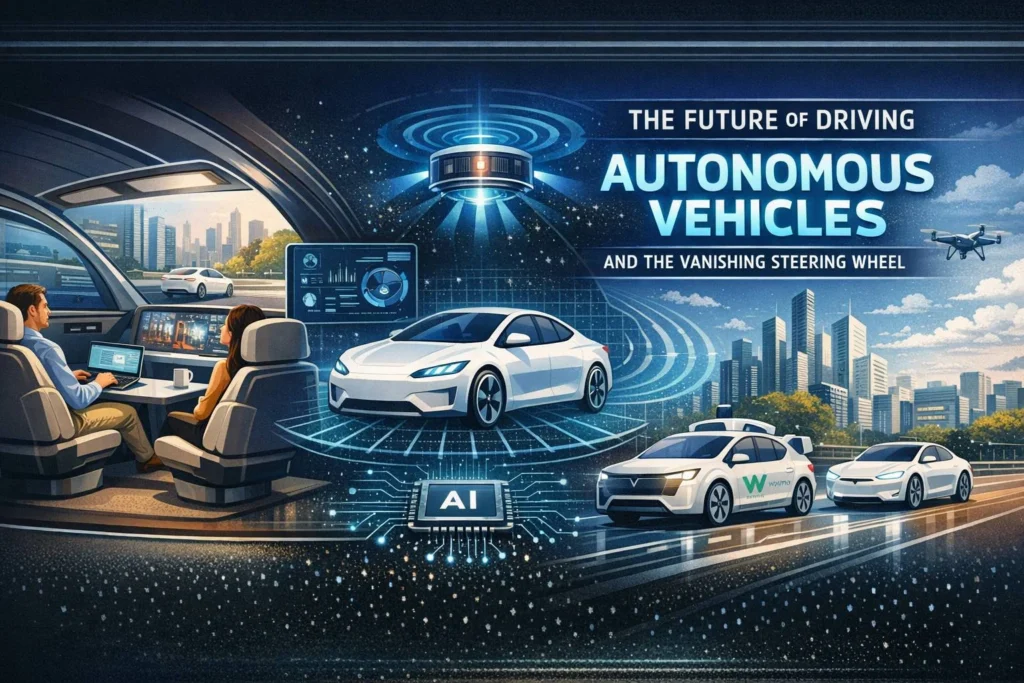
For over 100 years, every car has relied on one thing—the steering wheel. That relationship is now being challenged by autonomous driving systems that no longer require human control.
The shift is not theoretical. It is already visible in robotaxi fleets, regulatory changes, and next-generation vehicle platforms designed without traditional controls.
What’s emerging is a structural transition: cars are evolving from driver-operated machines into self-operating systems. In that context, the steering wheel becomes optional rather than essential.
What Is Required for Steering Wheels to Disappear?
Level 4 autonomous driving is required for steering wheels to disappear. At this level, vehicles can operate entirely without human intervention within defined environments, eliminating the need for manual controls.
Unlike Level 2 or Level 3 systems, where drivers must remain engaged or available as backup, Level 4 systems handle all driving tasks independently.
As of 2025:
- Over 50 million vehicles globally are equipped with Level 2 ADAS (Statista, 2025)
- Level 3 systems like Mercedes-Benz Drive Pilot allow conditional hands-free driving
- Level 4 vehicles are already operating in controlled urban deployments
Autonomous Driving Levels Comparison
| Level | Control | Steering Wheel Needed |
|---|---|---|
| L2 | Human supervises | Yes |
| L3 | Conditional automation | Yes |
| L4 | Fully autonomous (limited areas) | No |
| L5 | Fully autonomous (all conditions) | No |
Why Steering Wheels Become a Liability in Level 4 Vehicles
In fully autonomous environments, retaining a steering wheel creates more problems than benefits.
- Delayed human response: Expecting drivers to suddenly take control introduces risk
- System duplication: Vehicles must support both manual and autonomous systems
- Cabin inefficiency: Steering hardware limits interior flexibility
For this reason, purpose-built autonomous vehicles are increasingly eliminating manual controls entirely.
Real Vehicles Already Operating Without Steering Wheels
Several companies have developed production-intent vehicles without steering systems:
- Cruise Origin (General Motors autonomous platform): No steering wheel or pedals
- Zoox robotaxi system (Amazon-owned): Symmetrical cabin, no driver seat
- Nuro autonomous delivery vehicles: Designed purely for logistics
These are not experimental concepts—they are operational in real-world testing environments.
Regulatory Shift: Steering Wheels Are No Longer Mandatory
Government policy is evolving alongside technology.
- U.S. NHTSA updated rules in 2022 to allow vehicles without steering wheels
- Japan legalized Level 4 deployment in 2023
- EU is actively developing unified AV regulations
Official reference: NHTSA Automated Vehicle Guidelines
EV Platforms Accelerating Steering-Free Design
Modern electric vehicle platforms are structurally compatible with autonomous design.
Examples include:
- Tesla autonomous systems: Software-centric vehicle architecture
- Hyundai E-GMP platform: Flat-floor EV design enabling flexible interiors
- Volkswagen MEB architecture: Modular EV platform supporting drive-by-wire
Additionally, steer-by-wire systems—already seen in production models like the Lexus RZ (2023)—remove the mechanical link between steering input and wheel movement, making physical steering components unnecessary.
The Hidden Cost of Keeping Steering Wheels
Retaining manual controls increases complexity and cost.
- Dual system validation increases engineering effort
- More components increase failure points
- Liability becomes unclear between driver and system
Early autonomous hardware stacks cost between $5,000–$10,000 per vehicle (2018–2020). While costs are decreasing, maintaining redundant systems still affects profitability—especially for fleets.
Fleet Economics: Where Steering Wheels Disappear First
Autonomous fleets prioritize efficiency over driver interaction.
According to McKinsey (2024), autonomous mobility could generate $300–$400 billion annually by 2035.
Fleet vehicles benefit from:
- Higher utilization rates
- Optimized cabin space
- Lower maintenance complexity
Safety Performance: Progress and Challenges
Safety remains the deciding factor.
Waymo reported approximately 85% fewer injury crashes per million miles compared to human drivers in 2024.
Source: Waymo Safety Report
However, challenges remain:
- Edge-case scenarios
- Weather-related sensor limitations
- Urban unpredictability
Consumer Trust Still Lags Behind Technology
Deloitte (2024) reports that over 50% of consumers remain skeptical about fully autonomous vehicles.
Key concerns include:
- Lack of control
- System reliability
- Cybersecurity risks
India and Emerging Markets: Slower Adoption Curve
Markets like India present unique challenges:
- Mixed traffic conditions
- Variable infrastructure
- Limited HD mapping
However, controlled environments such as airports or smart city zones could see early adoption.
Timeline: When Will Steering Wheels Disappear?
- 2025–2030: Robotaxi expansion
- 2030–2035: Commercial fleet adoption
- Post-2035: Gradual shift in private vehicles
Conclusion: A Functional Shift in Mobility
The disappearance of the steering wheel is not a design trend—it is a functional outcome of autonomous capability.
Its removal will begin in controlled environments, scale through fleets, and eventually influence private ownership.
What do you think?
Would you trust a car without a steering wheel?
Key Takeaways
- Level 4 autonomy enables steering-free vehicles
- Companies like Waymo, Zoox, and Cruise already operate such systems
- Regulations are adapting globally
- EV platforms make these designs possible
- Fleet economics accelerate adoption
- Safety and trust remain the biggest barriers
Frequently Asked Questions (FAQ)
Will cars without steering wheels be legal?
Yes, in regions like the U.S. and Japan under specific regulatory frameworks.
Are there real cars without steering wheels?
Yes, including Cruise Origin and Zoox robotaxis.
Is autonomous driving safer than human driving?
Early data suggests improved safety, but broader validation is ongoing.
When will steering wheels disappear?
Likely after 2035 for widespread adoption.
Why remove steering wheels?
To reduce complexity, cost, and improve autonomous efficiency.
About the Author
Ankush Kumar is an automotive content specialist with over 5 years of experience covering global car markets, hybrid technologies, and EV ecosystem developments. His work focuses on translating complex automotive engineering concepts into practical insights for Indian buyers.
He has analyzed vehicle platforms, powertrain systems, and real-world usability trends across multiple brands. His content emphasizes data-backed evaluation, regulatory awareness, and ownership practicality.