+91-9646339590



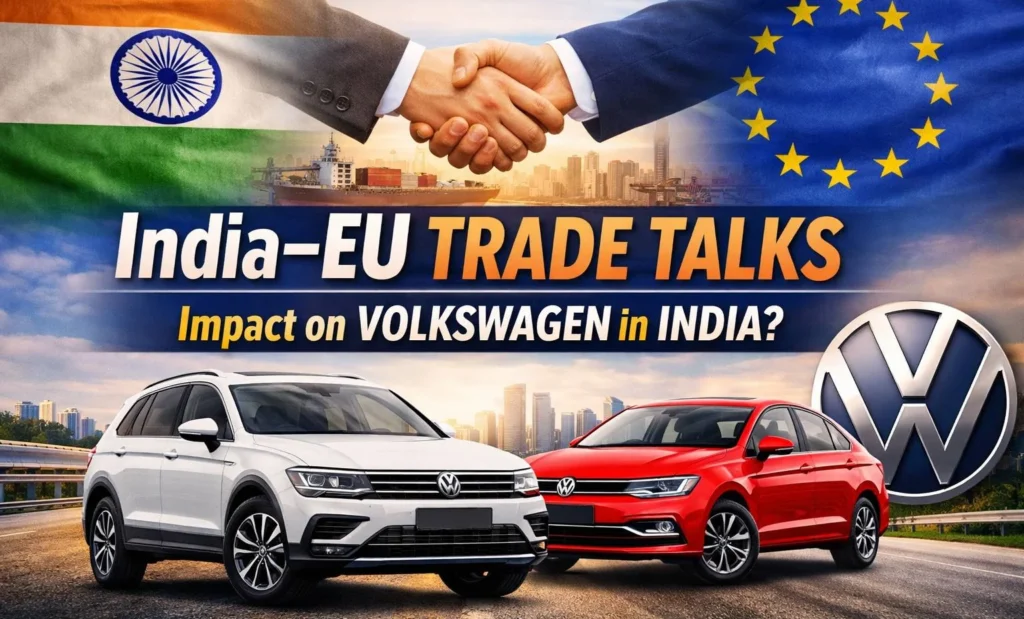
Ongoing trade negotiations between India and the European Union could reshape how European cars are priced and sold in the Indian market. For manufacturers like Volkswagen, which operate in India through a combination of local production, CKD assembly, and fully imported vehicles, any change in tariff policies could influence both pricing strategy and future product launches.
Automotive analysts suggest that the biggest impact of a potential India–EU Free Trade Agreement (FTA) would be felt in imported vehicles, particularly premium SUVs, performance cars, and electric vehicles. In contrast, Volkswagen’s locally produced models such as the Taigun and Virtus already rely heavily on domestic manufacturing and would likely see minimal pricing impact.
Status of the India–EU Trade Negotiations
India and the European Union officially resumed negotiations for a comprehensive Free Trade Agreement in 2022 after talks had remained stalled for nearly a decade. The proposed agreement aims to strengthen economic cooperation by:
- Reducing tariffs on goods traded between the two regions
- Simplifying regulatory procedures for cross-border trade
- Encouraging long-term investment and industrial collaboration
Automobiles remain one of the most sensitive sectors in the discussions. European policymakers have long argued that India’s high import tariffs restrict market access for international brands. India, however, has historically maintained these duties to protect domestic manufacturers and encourage global automakers to invest in local production facilities.
Industry bodies such as SIAM note that any tariff changes must balance consumer access with the long-term health of India’s automotive manufacturing sector, which supports millions of jobs and contributes significantly to industrial output.
Why Imported European Cars Are Expensive in India
One of the main reasons European cars carry significantly higher prices in India is the country’s import duty structure. Compared with other major automotive markets, India applies some of the highest tariffs on fully imported vehicles.
Current duties typically include:
- Approximately 60% customs duty for vehicles priced below $40,000
- Up to 100% duty for vehicles priced above $40,000
- Additional charges such as the Agriculture Infrastructure Development Cess, GST, logistics costs, and dealer margins
When these charges are combined, the landed cost of a fully imported vehicle can more than double its original price.
For example, a European SUV priced at around €35,000 (roughly ₹32–34 lakh) in Europe could reach nearly ₹60 lakh in India once import duties, shipping, and taxes are applied. This pricing structure is a key reason why many global automakers prefer assembling vehicles locally rather than importing them fully built.
Volkswagen’s Manufacturing Strategy in India
Volkswagen has addressed India’s tariff environment through its India 2.0 strategy, which focuses on designing and producing vehicles specifically adapted for emerging markets.
A major part of this initiative is the MQB-A0-IN platform, a localized version of Volkswagen’s global modular architecture. This platform allows the company to maintain global engineering standards while using a high percentage of locally sourced components.
Vehicles built on this platform include the Volkswagen Taigun SUV and the Volkswagen Virtus sedan, both manufactured at Volkswagen’s Chakan production facility near Pune.
Localization levels for these models exceed 90%, which helps control production costs and allows Volkswagen to price them competitively in the highly price-sensitive Indian market.
As of 2025:
- Virtus – starting around ₹11.5 lakh (ex-showroom)
- Taigun – starting around ₹11.7 lakh (ex-showroom)
Because these models rely heavily on domestic components and manufacturing, changes to import tariffs under the India–EU trade deal are unlikely to significantly influence their pricing.
Volkswagen Models Likely to Be Affected
Vehicles that rely on imported components or arrive in India as fully built units are more sensitive to changes in tariff policy. These include certain premium SUVs, performance models, and potential electric vehicle imports.
| Model | Current Price (Ex-Showroom) | Import Structure | Potential Price Range if Tariffs Decline |
|---|---|---|---|
| Volkswagen Tiguan | ₹38 lakh | CKD assembly using imported kits | ₹33–35 lakh |
| Volkswagen Golf GTI | ₹45–50 lakh (estimated if introduced) | Fully imported CBU | ₹38–42 lakh |
| Volkswagen ID.4 | ₹55–60 lakh (estimated import price) | Fully imported electric vehicle | ₹45–50 lakh |
Note: These projections assume a significant reduction in import duties. Final pricing will depend on the structure of the FTA and each manufacturer’s pricing strategy.
Electric Vehicles Could Benefit the Most
Electric vehicles could see the largest pricing changes if import tariffs are reduced. Currently, EVs imported into India face duties of up to 70% for models priced below $40,000 and around 100% for higher-priced vehicles.
Volkswagen’s global electric vehicle lineup is built on its MEB platform, which supports models such as the ID.3 and ID.4. Worldwide deliveries of MEB-based vehicles have already exceeded one million units.
If tariffs decline, introducing EVs like the ID.4 through limited imports could become more financially viable for Volkswagen. This would allow the company to evaluate demand before investing in large-scale local EV production.
Impact on Other European Car Brands
Any tariff reductions under the India–EU FTA would affect the broader premium automotive market, not just Volkswagen.
European manufacturers such as BMW, Mercedes-Benz, Audi, and Skoda currently import several models into India. Lower duties could allow these brands to expand their product range, particularly in segments such as luxury SUVs, performance sedans, and premium electric vehicles.
Greater competition in the premium segment could also encourage manufacturers to offer better equipment, improved pricing strategies, and more model choices for Indian consumers.
Actionable Advice for Buyers and Investors
- Car buyers: If you are considering a fully imported European vehicle, monitoring the progress of the India–EU trade negotiations could be worthwhile. Future tariff reductions may expand model availability and improve pricing flexibility.
- Investors: Volkswagen’s continued investment in the India 2.0 strategy and potential EV introductions highlight the company’s long-term commitment to the Indian market.
- Tracking new product announcements and EV launches from European manufacturers could offer early insight into future growth areas in India’s premium automotive segment.
Growth of India’s Premium Car Market
India’s premium car segment has grown steadily over the past few years. Industry data from SIAM shows that luxury vehicle sales reached approximately 48,000 units in 2023, representing nearly 20% year-on-year growth.
Although the market remains smaller than those in Europe, China, or the United States, rising incomes, improved financing options, and increasing consumer interest in SUVs and EVs are expected to support continued growth.
Several industry forecasts suggest that annual luxury car sales in India could exceed 60,000 units within the next few years if current demand trends continue.
Factors Beyond Import Duties
Even if import tariffs decline, several other factors will continue to influence the final retail price of European vehicles in India.
- International shipping and logistics costs
- Exchange rate fluctuations between the euro and Indian rupee
- Dealer margins and distribution costs
- Compliance with Indian safety and emissions regulations
Currency movements can be particularly important. A weaker rupee increases the landed cost of imported vehicles, which can offset some of the price benefits created by tariff reductions.
Conclusion
The proposed India–EU trade agreement could gradually improve the pricing competitiveness of imported European vehicles in India. For Volkswagen, the biggest beneficiaries would likely be imported SUVs, performance models, and electric vehicles rather than locally manufactured products.
Models such as the Taigun and Virtus, which are produced domestically with high localization levels, will likely remain largely unaffected by tariff changes.
For Indian consumers, the most noticeable outcome of the trade agreement may be a broader range of European models entering the market rather than dramatic price cuts.
Key Takeaways
- India currently imposes import duties that can exceed 100% on fully imported vehicles.
- The proposed India–EU FTA could lower tariffs on European cars.
- Locally manufactured Volkswagen models will likely remain unaffected.
- Imported SUVs, performance vehicles, and EVs could see the biggest price changes.
- India’s premium car market is growing steadily, attracting global manufacturers.
FAQ
Will Volkswagen cars become cheaper in India after the EU trade deal?
Imported models could become more competitively priced if tariffs decline, though locally produced vehicles are unlikely to see major changes.
Which Volkswagen models could benefit the most?
Imported or CKD-assembled models such as the Tiguan and potential EVs like the ID.4 would likely benefit the most from tariff reductions.
Why are imported cars expensive in India?
High customs duties, additional taxes, shipping costs, and dealer margins significantly increase the price of fully imported vehicles.
Is Volkswagen planning electric vehicles for India?
Volkswagen has evaluated introducing EVs based on its global MEB platform, though launch timelines depend on market demand and government policies.
How large is India’s luxury car market?
Luxury car sales reached roughly 48,000 units in 2023 and are expected to grow further as demand for premium SUVs and EVs increases.
About the Author
Ankush Kumar is an automotive content specialist with over 5 years of experience covering global car markets, hybrid technologies, and EV ecosystem developments. His work focuses on translating complex automotive engineering concepts into practical insights for Indian buyers.
He has analyzed vehicle platforms, powertrain systems, and real-world usability trends across multiple brands. His content emphasizes data-backed evaluation, regulatory awareness, and ownership practicality.