+91-9646339590



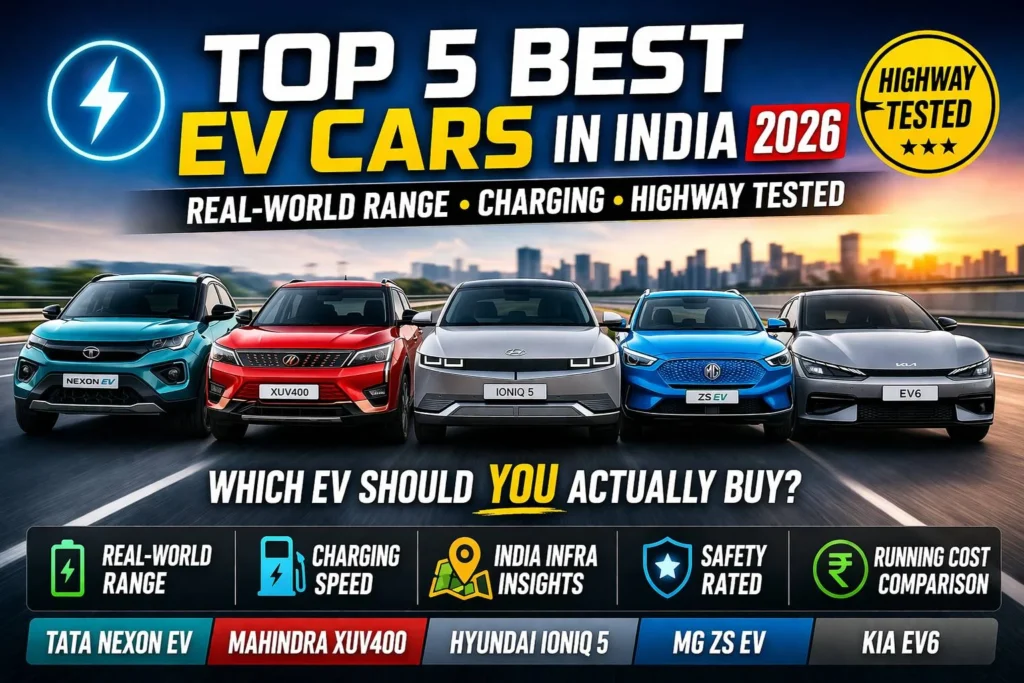
Choosing the right EV in India isn’t just about claimed range or price. Once you move beyond city limits, factors like sustained highway efficiency, charging speed consistency, and charger availability begin to define the real ownership experience. These variables often matter more than official specifications when evaluating an EV for Indian conditions.
This guide analyzes the Top 5 Best EV Cars in India (2026) through a practical lens—real-world range, charging behavior, and usability—so you can make an informed decision based on actual performance. Global trends also reinforce this shift, with insights from the IEA Global EV Outlook 2024 highlighting how real-world efficiency and charging infrastructure are becoming key factors in EV adoption worldwide.
Top 5 EV Cars in India 2026 (Quick Ranking by Use Case)
- Best Overall: Tata Nexon EV
- Best Performance Under ₹25L: Mahindra XUV400
- Best Premium Tech EV: Hyundai Ioniq 5
- Best Family EV: MG ZS EV
- Best Performance + Long Range: Kia EV6
1. Tata Nexon EV Facelift – Real India Benchmark
The Tata Nexon EV continues to dominate due to its balance of affordability, usable range, and strong service ecosystem across India.
- On-road price: ₹16.5 – ₹21 lakh
- Battery: 30 kWh / 40.5 kWh (LFP)
- Claimed range: 325–465 km
- Real city range: 300–380 km
- Highway (100–110 km/h): 220–280 km
- 0–100 km/h: ~9.2 sec
Real Insight: With AC and passengers, efficiency drops to ~5.5–6 km/kWh. Regenerative braking is well-calibrated for city driving.
Crash Rating: 5-Star Bharat NCAP
Braking: ~39 meters (100–0 km/h)
2. Mahindra XUV400 EV – Performance-Focused Budget EV
TheMahindra XUV400 is tuned for acceleration and delivers one of the quickest 0–100 times under ₹25 lakh.
- On-road price: ₹17 – ₹22.5 lakh
- Battery: 39.4 kWh (NMC)
- Highway range: 260–300 km
- 0–100 km/h: 8.3 sec
Real Insight: Strong torque makes city driving effortless, but efficiency drops faster than Nexon EV at higher speeds.
3. Hyundai Ioniq 5 – Technology & Efficiency Benchmark
Built on a dedicated EV platform, the Hyundai Ioniq 5 offers consistent efficiency and ultra-fast charging capabilities.
- On-road price: ₹48 – ₹52 lakh
- Battery: 72.6 kWh
- Real-world range: 480–520 km
- Highway range: ~420 km
- 0–100 km/h: 7.6 sec
Charging Advantage: Maintains high charging speeds even beyond 50%, unlike most EVs.
4. MG ZS EV – Practical Family EV
The MG ZS EV offers a balanced package of comfort, range, and features, making it suitable for family usage.
- On-road price: ₹27 – ₹31 lakh
- Battery: 50.3 kWh
- Real range: 340–380 km
- Highway range: ~300 km
5. Kia EV6 – Performance + Long-Distance Champion
The Kia EV6 combines strong performance, long range, and fast charging, making it ideal for highway travel.
- On-road price: ₹65 – ₹70 lakh
- Battery: 77.4 kWh
- Real range: 500–550 km
- Highway range: ~450 km
- 0–100 km/h: 5.2 sec
Charging Infrastructure Reality in India (2026)
Public charging infrastructure in India is improving, but still uneven outside metro cities. As per NITI Aayog’s EV policy roadmap, charging network expansion is a key focus area for accelerating EV adoption.
As of 2025, India has over 12,000 public charging stations, with higher density in cities like Delhi, Mumbai, and Bangalore.
- Fast chargers are still limited on highways and rural routes
- Long-distance travel requires planning charging stops in advance
- Apps like Tata Power EZ Charge, Statiq, and ChargeZone help locate available chargers in real time
Practical Insight: For highway users, vehicles with faster charging curves (like Ioniq 5 and EV6) reduce travel time significantly compared to smaller EVs.
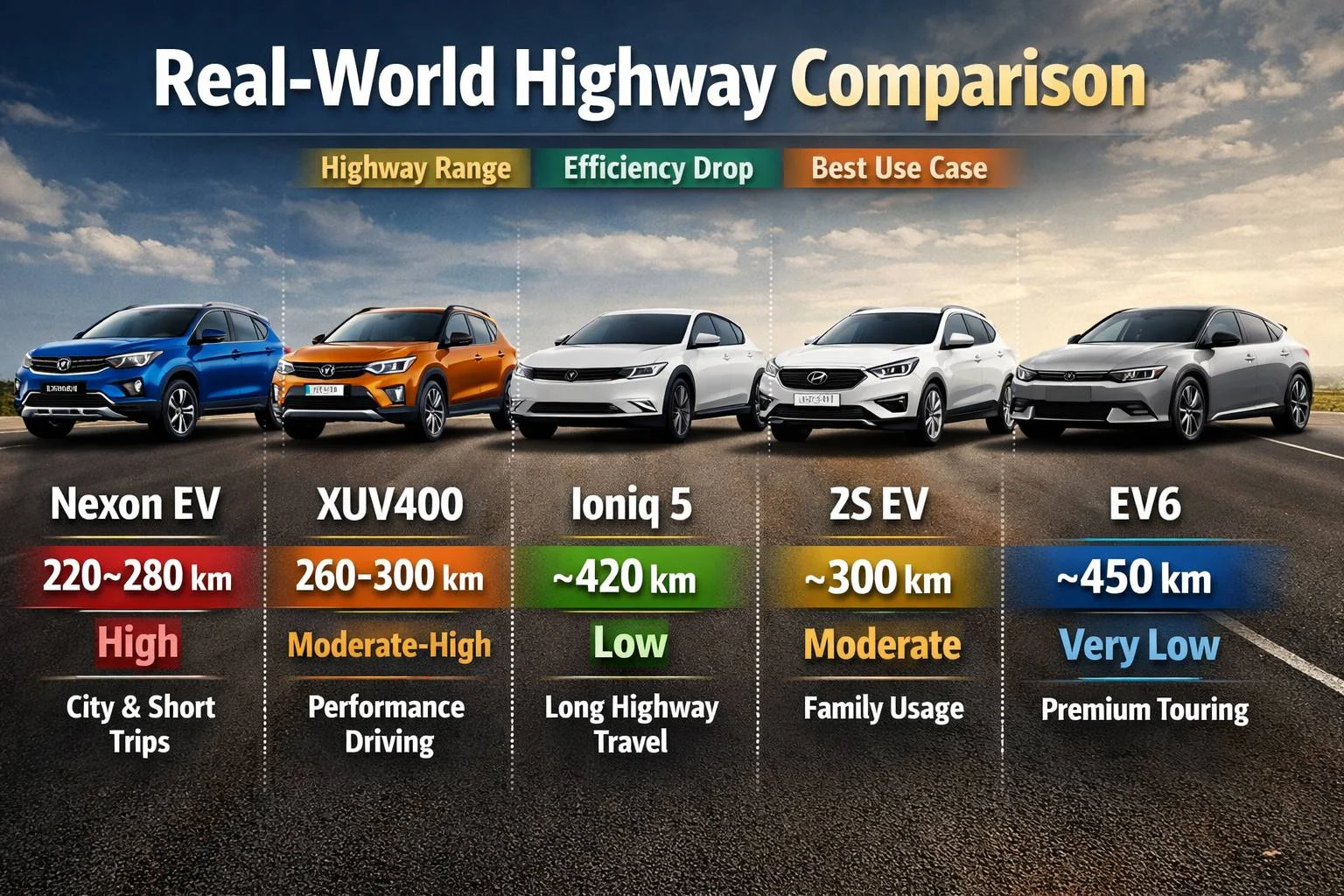
Real-World Highway Comparison
| Model | Highway Range | Efficiency Drop | Best Use Case |
|---|---|---|---|
| Nexon EV | 220–280 km | High | City + short highway trips |
| XUV400 | 260–300 km | Moderate-High | Performance-focused city driving |
| Ioniq 5 | ~420 km | Low | Long-distance highway travel |
| ZS EV | ~300 km | Moderate | Family usage |
| EV6 | ~450 km | Very Low | Premium + long-distance touring |
Delhi to Chandigarh EV Reality Check
- Nexon EV: Requires 1 charging stop
- XUV400: Borderline
- Ioniq 5: No charging needed
- EV6: No charging needed
Battery Technology (LFP vs NMC)
- LFP: Safer, longer life, slower charging
- NMC: Higher density, better performance
Ownership Cost Comparison
| Parameter | EV | Petrol SUV |
|---|---|---|
| Running Cost/km | ₹1–1.5 | ₹7–10 |
| Maintenance | Low | Higher |
Which EV Should You Actually Buy?
Choosing the right EV depends more on usage pattern than budget alone. Here’s a clear decision framework based on real-world practicality:
- Under ₹20 lakh (Best Overall): Tata Nexon EV – balanced range, affordability, and service network
- Performance Focus: Mahindra XUV400 – quickest acceleration in mid-range EV segment
- Family Usage: MG ZS EV – better comfort, space, and ride quality
- Highway Driving: Hyundai Ioniq 5 – superior efficiency and ultra-fast charging
- Performance + Long Range: Kia EV6 – best for premium buyers who travel frequently
Expert Insight: Buyers focusing only on claimed range often make poor decisions. Charging speed and highway efficiency matter far more in real-world usage.
Conclusion
EV buying decisions should be based on usage patterns rather than claimed specifications. City users benefit from compact EVs like Nexon, while highway users should prioritize efficiency and charging speed offered by premium EVs.
Key Takeaways
- Highway range matters more than claimed range
- Charging speed is critical for long-distance travel
- Nexon EV is best for city use
- Ioniq 5 and EV6 are ideal for highways
FAQs
Which is the best EV in India in 2026?
The best EV depends on your usage and budget. The Tata Nexon EV is the best overall choice for affordability and daily city use, while the Hyundai Ioniq 5 offers premium features, better efficiency, and faster charging for long-distance driving.
Which EV is best for long drives and highways?
For highway driving, EVs with higher range and faster charging are ideal. The Kia EV6 and Hyundai Ioniq 5 are the best options due to their long real-world range, stable highway efficiency, and ultra-fast charging capability.
Do electric cars save money in India?
Yes, EVs significantly reduce running costs. The average EV running cost in India is around ₹1–1.5 per km, compared to ₹7–10 per km for petrol SUVs. Maintenance costs are also lower due to fewer moving parts.
What is the real-world range of EV cars in India?
Real-world range is usually 15–30% lower than claimed figures. For example, a claimed range of 400 km typically translates to 280–340 km in actual city and highway conditions, depending on driving style and AC usage.
Is charging infrastructure reliable in India?
Charging infrastructure is improving but still limited outside major cities. Metro areas have better coverage, while highway charging requires planning. Apps like Tata Power EZ Charge, Statiq, and ChargeZone help locate chargers.
How long does it take to charge an EV?
Charging time depends on the charger type and battery size. Fast chargers can charge an EV up to 80% in 30–60 minutes, while home charging typically takes 6–10 hours for a full charge.
Ankush Kumar is an automotive analyst with over 5 years of experience covering the Indian car market, luxury vehicles, and electric mobility trends. His work focuses on practical comparisons, real-world performance, and ownership insights to help buyers make informed decisions.
He regularly tracks industry updates, manufacturer reports, and road test data from publications like Autocar India, using them to create clear, data-backed analysis that is easy to understand and useful for everyday buyers.
Follow on Facebook:
Ankush Kumar