+91-9646339590



For years, Skoda has occupied a unique position in India’s automotive landscape—respected by enthusiasts, yet approached cautiously by mainstream buyers. The brand built its identity on strong engineering, solid build quality, and refined driving dynamics, but struggled with inconsistent ownership perception.
What has changed over the past few years is not just Skoda’s product lineup—but its entire approach to the Indian market. Instead of chasing rapid expansion, the company has focused on structural correction. That shift is now beginning to show measurable impact.
The Core Problem: Strong Products, Weak Ownership Confidence
Historically, Skoda’s challenge in India was not product capability. Models like the Octavia and Superb established benchmarks in ride quality and driving engagement. The gap emerged in areas that influence buying decisions more directly.
– Perception of high and unpredictable service costs
– Limited dealer network beyond major cities
– Inconsistent after-sales experience
– Slow adaptation to changing market preferences
These factors created a disconnect—buyers admired the cars but hesitated at the purchase stage. Over time, this affected repeat purchase rates and brand trust.
India 2.0 Strategy: Structural Reset, Not Cosmetic Change
The turning point came with Volkswagen Group’s India 2.0 strategy, under which Skoda took operational leadership for both Skoda and Volkswagen brands in India.
At the center of this strategy is the MQB-A0-IN platform, a heavily localized version of Volkswagen Group’s global architecture. Localization levels exceed 90%, significantly reducing cost pressures while maintaining structural integrity and driving dynamics.
This was not a short-term sales push. It was a foundational reset aimed at long-term sustainability in a price-sensitive market.
Sales Reality Check: Gradual Growth, Not Breakout Success
Skoda’s sales performance reflects this measured approach. After the India 2.0 rollout:
– Skoda India reported over 53,000 units in 2022, according to company data (its highest-ever annual sales)
– Volumes stabilized in the 40,000–50,000 range through 2024–2025
While these numbers are modest compared to mass-market players, they represent a significant recovery from pre-2020 levels, when annual volumes were below 20,000 units. The broader Indian passenger vehicle market itself has expanded steadily in recent years, as reflected in industry data published by the Society of Indian Automobile Manufacturers (SIAM).
The key takeaway is not rapid growth—but improved stability.
Slavia and Kushaq: Strategic Products, Not Volume Leaders
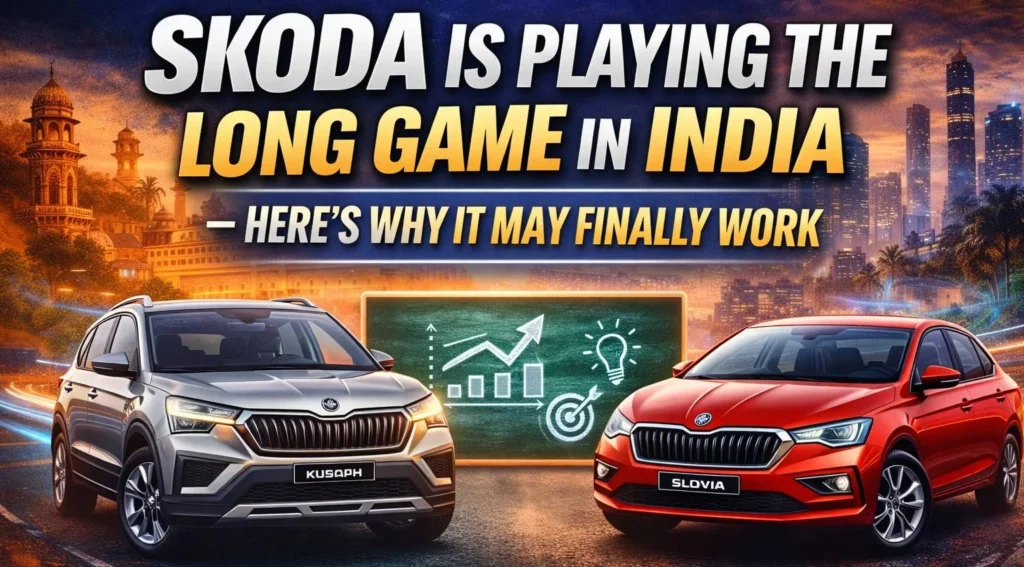
The Skoda Slavia and Kushaq are central to this transformation. Built on the MQB-A0-IN platform, they represent Skoda’s attempt to balance cost efficiency with brand DNA.
Technically, both models offer:
– 1.0 TSI engine (efficiency-focused, mass-market appeal)
– 1.5 TSI engine with active cylinder technology (performance-oriented buyers)
– Strong structural safety (5-star Global NCAP rating for Kushaq/Slavia platform)
These cars may not dominate sales charts, but they serve a more important purpose—rebuilding credibility.
Why Skoda Is Not Competing on Features Alone
The Indian automotive market has increasingly shifted toward feature-heavy competition—larger screens, connected tech, and cosmetic differentiation. Skoda has responded selectively, but not aggressively.
Instead, its core focus remains on:
– Chassis tuning suited to Indian road conditions
– Engine refinement and drivability
– Structural safety and high-speed stability
This approach limits mass-market appeal but strengthens long-term brand positioning.
After-Sales Transformation: The Most Critical Shift
One of the most significant, yet underreported, changes is in Skoda’s after-sales ecosystem.
The company has introduced:
– Standardized service packages (reducing cost uncertainty)
– Extended warranty programs up to 6 years
– Increased transparency in maintenance pricing
Dealer network expansion has also improved accessibility in Tier-2 and Tier-3 cities, although coverage still trails market leaders.
Customer feedback trends indicate a gradual improvement in ownership experience—arguably the most critical factor in rebuilding trust.
Market Timing: Why the Strategy May Finally Work
The Indian buyer profile is evolving. A growing segment of customers is moving beyond feature-heavy decision-making toward long-term value considerations such as safety, build quality, and driving comfort.
This shift aligns with Skoda’s strengths.
At the same time, “feature fatigue” is becoming visible in the market, where incremental additions no longer significantly influence buying decisions. Brands with clear engineering focus may benefit from this transition.
EV Strategy: Delayed Entry, Calculated Approach
Unlike competitors aggressively expanding EV portfolios, Skoda has taken a measured approach. Globally, the brand already has established electric models such as the Enyaq iV based on Volkswagen Group’s MEB platform.
In India, the delay reflects three key considerations:
– Charging infrastructure maturity
– Price sensitivity in the EV segment
– Long-term reliability expectations in high-temperature conditions
This cautious approach reduces early risk but also delays market entry advantages.
Sales vs Brand Value: A Different Success Metric
Skoda’s strategy suggests a shift away from volume-driven success metrics toward brand strength indicators:
– Higher customer retention rates
– Improved repeat purchase behavior
– Stronger positioning in urban premium segments
This approach prioritizes sustainable growth over short-term spikes.
Target Audience: Clearly Defined, Not Mass-Market
Skoda’s current lineup is not designed for universal appeal. Its target customer profile is more specific:
– Buyers prioritizing driving comfort and stability
– Long-term ownership (5–7 years)
– Preference for understated design
– Focus on safety over feature count
This narrower audience reduces scale but improves brand loyalty.
The Real Shift: From Perception Repair to Identity Clarity
The most important transformation is not in Skoda’s products—but in its positioning. Earlier, the brand was attempting to fix perception issues. Now, it appears to be defining its identity more clearly.
Instead of competing with every brand, Skoda is focusing on becoming the preferred choice for a specific type of buyer. That clarity is often more valuable than scale.
Conclusion
Skoda’s journey in India has been defined as much by restraint as by ambition. Instead of chasing scale at any cost, the brand has chosen to rebuild its foundation—cost structure, product relevance, and ownership experience—step by step.
This strategy does not promise rapid market share gains, and it doesn’t need to. What it offers instead is something far more durable: clarity of identity. Skoda is no longer trying to compete with every brand in the market—it is focusing on being the right choice for a specific kind of buyer.
In a market driven by volume battles and feature escalation, that clarity stands out. If execution remains consistent, Skoda’s future in India will not be defined by how many cars it sells—but by how strongly it is trusted.
Skoda may never dominate sales charts—but for the first time in years, it doesn’t have to.
Key Takeaways
– Skoda’s India 2.0 strategy focuses on long-term sustainability, not short-term sales
– MQB-A0-IN platform enabled high localization and cost control
– Sales recovery is stable, though not high-volume
– After-sales improvements are central to rebuilding trust
– EV entry is delayed but strategically calculated
– Brand is targeting a niche but loyal customer base
About the Author
Ankush Kumar is an automotive content specialist with over 5 years of experience covering global car markets, hybrid technologies, and EV ecosystem developments. His work focuses on translating complex automotive engineering concepts into practical insights for Indian buyers.
He has analyzed vehicle platforms, powertrain systems, and real-world usability trends across multiple brands. His content emphasizes data-backed evaluation, regulatory awareness, and ownership practicality.