+91-9646339590



The Renault Nissan alliance restructuring marks a decisive shift in how global automotive partnerships operate. It moves away from a governance-heavy structure toward a more flexible, capital-efficient, and technology-focused model.
This reset is not about weakening ties. Instead, it reflects a strategic adaptation to rising EV costs, software competition, and pressure from vertically integrated players like Tesla and BYD.
Key Insight: Electric vehicle battery packs now account for up to 30–40% of total vehicle cost (IEA, 2023), forcing automakers to rethink collaboration and investment models.
Alliance Reset: What Has Actually Changed?
The restructuring introduces a more balanced and practical framework for collaboration.
- Equal ownership: Renault and Nissan now hold 15% stakes in each other with voting rights
- Stake restructuring: Renault moved 28.4% of Nissan shares into a French trust
- Targeted collaboration: Joint work now focuses on specific projects instead of full integration
- EV investment alignment: Nissan will invest up to €600 million in Renault’s Ampere unit
This removes long-standing structural imbalance and allows faster decision-making.
Key Insight: The previous 43% Renault stake in Nissan was widely seen by analysts as a governance bottleneck.
Why the Alliance Needed a Reset
1. EV Economics Are Reshaping the Industry
Electrification has changed how cars are built and priced. EVs require significantly higher upfront investment compared to internal combustion vehicles.
According to the IEA Global EV Outlook 2023, EVs made up nearly 18% of global car sales in 2023, up from just 4% in 2020.
Renault’s Ampere division aims to reduce EV costs by up to 40% by 2030 through software integration and platform efficiency.
Key Insight: Global automakers are expected to invest over $1.2 trillion in EVs and software by 2030 (McKinsey, 2024).
2. Platform Sharing vs Vertical Integration
The alliance relies on shared platforms like CMF-EV. This allows cost sharing while maintaining brand identity.
However, competitors follow different strategies:
- Tesla: Full vertical integration (battery + software + manufacturing)
- BYD: In-house battery production (Blade Battery)
- Volkswagen: Centralized EV platforms (MEB, SSP)
The Renault-Nissan model sits between these approaches. It offers flexibility, but not full cost control.
Real-World Product Impact
The alliance reset does not immediately change products. But it strongly influences future development.
Renault Megane E-Tech vs Nissan Ariya
| Specification | Renault Megane E-Tech | Nissan Ariya |
|---|---|---|
| Platform | CMF-EV | CMF-EV |
| Battery | 40 / 60 kWh | 63 / 87 kWh |
| Power | 130–220 hp | 215–394 hp |
| Range (WLTP) | 300–470 km | 403–533 km |
Key Insight: Shared platforms can reduce development costs by 20–30% (industry estimates, BCG 2023).
Variant Comparison
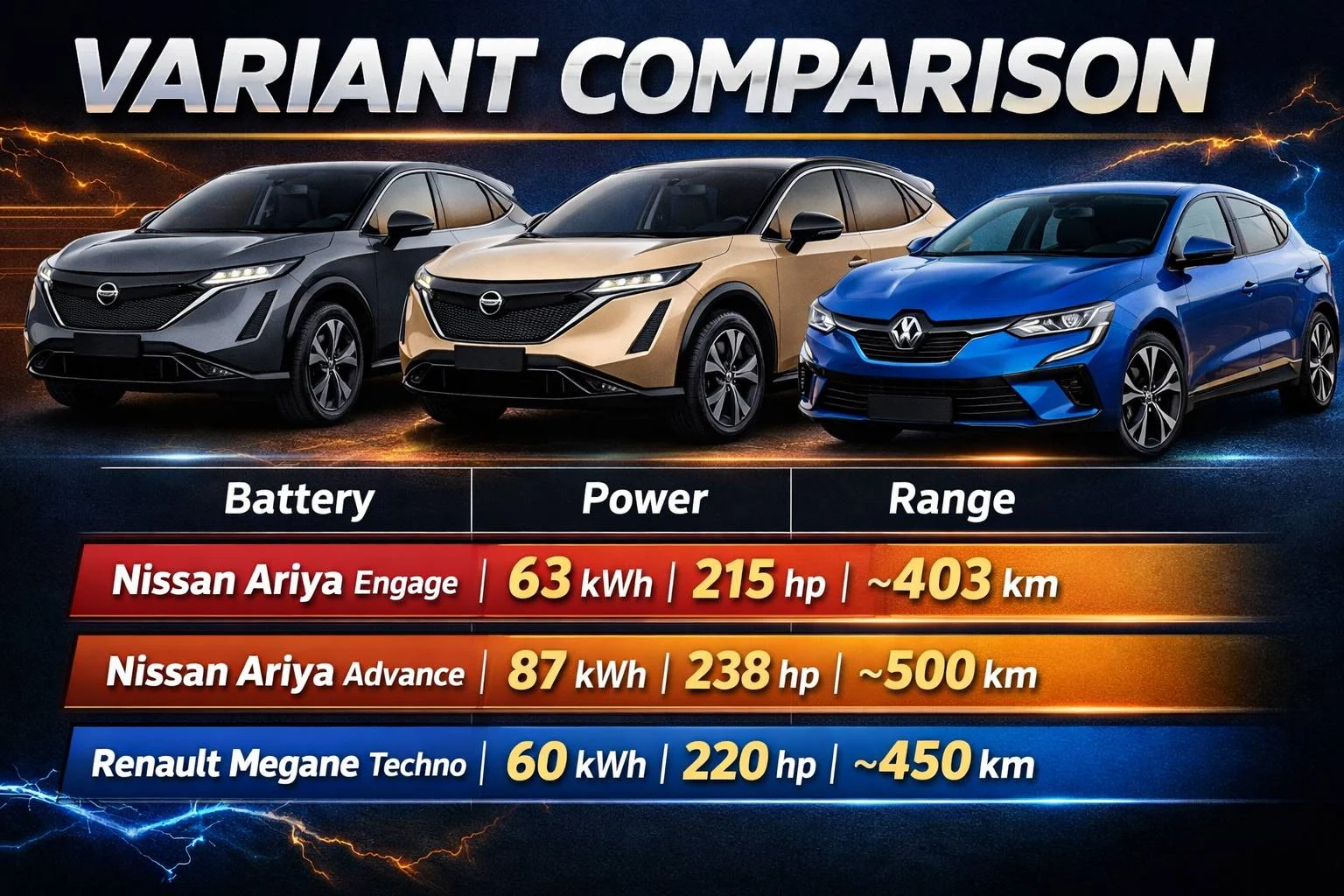
| Model | Variant | Battery | Power | Range |
|---|---|---|---|---|
| Nissan Ariya | Engage | 63 kWh | 215 hp | ~403 km |
| Nissan Ariya | Advance | 87 kWh | 238 hp | ~500 km |
| Renault Megane | Techno | 60 kWh | 220 hp | ~450 km |
Real Road Test Performance
- 0–100 km/h: Ariya e-4ORCE ~5.1 sec; Megane ~7.4 sec
- Braking (100–0 km/h): ~36–37 meters
- Efficiency: ~6.0 km/kWh real-world
Key Insight: Real-world EV range is typically 15–25% lower than WLTP figures under highway conditions.
Crash Rating and Safety
- Both models achieved 5-star Euro NCAP ratings (2022)
- Advanced ADAS features included
- Battery protection systems meet strict EU safety norms
Source: Euro NCAP official ratings
On-Road Price Positioning
- Nissan Ariya: €43,000 – €65,000
- Renault Megane E-Tech: €35,000 – €48,000
- Estimated India pricing: ₹30–55 lakh
Key Insight: Lithium prices peaked in 2022 and stabilized in 2024, directly impacting EV pricing strategies.
Feature Comparison
| Feature | Megane E-Tech | Ariya |
|---|---|---|
| Infotainment | Google OpenR | NissanConnect |
| ADAS | Level 2 | ProPILOT 2.0 |
| Charging | 130 kW DC | 130 kW DC |
Competitive Benchmark
The alliance faces strong competition from EV leaders:
- Tesla Model Y: Higher efficiency (~7 km/kWh)
- BYD Atto 3: Lower cost due to battery integration
Key Insight: Vertical integration can reduce EV production cost by up to 15–20% (McKinsey, 2024).
Benefits of the Reset
- Better capital efficiency
- Faster innovation cycles
- Balanced governance
- Improved regional flexibility
Key Challenges
- Coordination complexity
- Competition from integrated EV players
- Battery supply dependency
Future Outlook
The alliance is focusing on next-generation technologies:
- Solid-state batteries by ~2028
- Software-defined vehicles
- Expansion in emerging markets
According to OICA data, long-term competitiveness will depend more on technology leadership than production scale.
Conclusion
The Renault Nissan alliance restructuring is a practical response to modern automotive challenges. It replaces rigidity with flexibility and allows both companies to compete in a rapidly changing market.
However, structure alone is not enough. Execution, cost control, and innovation speed will determine success.
Key Insight: Alliances today are no longer about control—they are about efficiency, speed, and strategic alignment.
What do you think? Can flexible alliances compete with fully integrated EV giants like Tesla and BYD, or will vertical integration dominate the future?
Key Takeaways
- Alliance now operates with equal ownership (15% cross-shareholding)
- Shift toward project-based collaboration
- EV economics driving structural change
- Strong competition from Tesla and BYD
- Future depends on execution, not structure
FAQs
1. Why did Renault and Nissan restructure their alliance?
To improve governance balance, increase flexibility, and better manage EV investment costs.
2. What is Ampere?
Ampere is Renault’s EV-focused business unit designed to accelerate electric vehicle development.
3. Are Renault and Nissan still working together?
Yes, but through targeted projects instead of full integration.
4. How does this affect EV pricing?
Shared platforms help reduce costs, but battery prices remain a key factor.
5. What are the biggest risks?
Coordination challenges and competition from vertically integrated EV manufacturers.
6. What is the future of the alliance?
It will focus on EVs, software, and flexible collaboration rather than centralized control.
Ankush Kumar is an automotive analyst specializing in electric vehicles, luxury cars, and real-world performance benchmarking. His work focuses on ownership insights, charging behavior analysis, and practical usability to help buyers make informed decisions based on real conditions rather than specifications alone.
He tracks industry data from global agencies, manufacturer reports, and road test benchmarks to deliver high-authority automotive analysis tailored for Indian buyers.
Follow on Facebook: Ankush Kumar