+91-9646339590



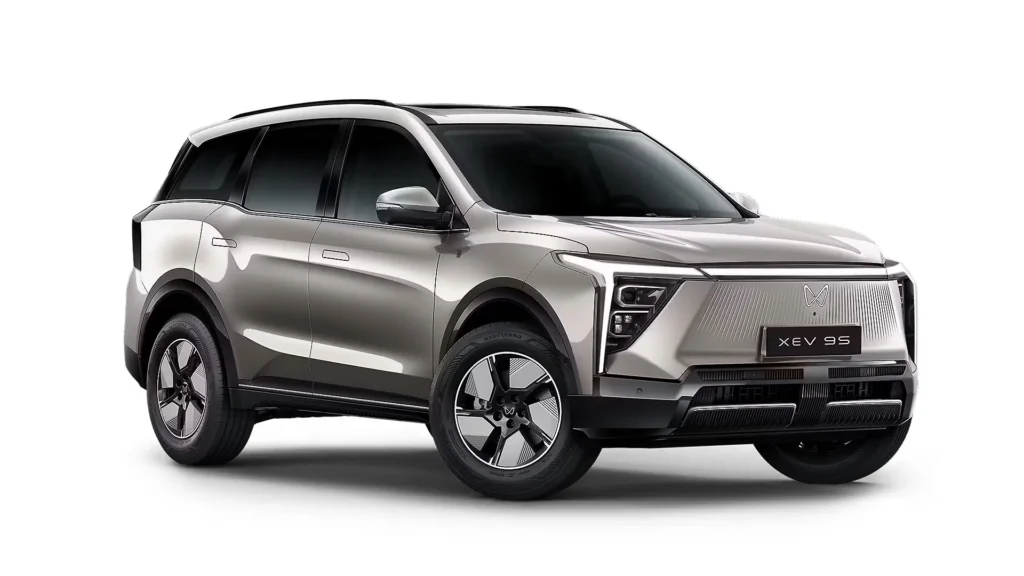
The Mahindra XEV 9S is not just another EV announcement—it is a critical product within Mahindra’s Born Electric roadmap, designed to reposition the brand in India’s premium SUV space. Built on the INGLO platform and influenced by Volkswagen’s MEB architecture learnings, the XEV 9S targets buyers considering vehicles like the Hyundai Ioniq 5, BYD Atto 3, and Tata Curvv EV.
Unlike earlier EV launches that relied heavily on claimed figures, the XEV 9S demands evaluation through engineering fundamentals—battery size, efficiency curves, thermal management, and real-world usability in Indian conditions.
INGLO Platform: Engineering Foundation & Global Benchmarking
The XEV 9S is underpinned by Mahindra’s INGLO skateboard platform, engineered to support scalable battery packs (60–80 kWh), rear-wheel drive (RWD), and dual-motor all-wheel drive (AWD) configurations. The architecture integrates cell-to-pack battery packaging, reducing structural redundancy and improving energy density.
Mahindra’s technical collaboration with Volkswagen (announced 2022) allows access to MEB component strategies—particularly in power electronics and drive units. This places INGLO closer to global EV architectures rather than retrofitted ICE conversions.
Key engineering highlights:
- Flat-floor design improving cabin space and weight distribution
- Low center of gravity enhancing high-speed stability
- Up to 175 kW DC fast charging capability
- Integrated thermal management system (liquid-cooled battery pack)
In global context, platforms like Hyundai’s E-GMP and VW’s MEB operate in similar voltage and charging brackets, indicating that Mahindra is aligning with internationally proven EV frameworks.
Battery, Range & Real-World Efficiency Analysis
The XEV 9S is expected to launch with two primary battery configurations:
- 60 kWh (standard range)
- 80 kWh (long range)
Claimed vs Real-World Range (Engineering-Based Estimates)
| Variant | Battery | Claimed (MIDC) | Real-World (City) | Real-World (Highway) |
|---|---|---|---|---|
| Standard | 60 kWh | ~450 km | 360–390 km | 300–330 km |
| Long Range | 80 kWh | ~680 km | 520–560 km | 440–480 km |
These projections are derived from comparative EV efficiency benchmarks:
- Hyundai Ioniq 5 (72.6 kWh): ~480 km real-world
- BYD Atto 3 (60.5 kWh): ~420 km real-world
The typical 20–25% drop from MIDC to real-world arises from:
- Highway aerodynamic drag increasing exponentially beyond 80 km/h
- Air conditioning load (significant in Indian summers)
- Battery thermal conditioning energy draw
Mahindra’s liquid-cooled battery system is expected to reduce performance drop in temperatures exceeding 40°C—a critical factor for Indian usage.
Performance: Acceleration, Power Delivery & Drive Dynamics
The XEV 9S AWD variant is expected to produce between 250–280 hp, with instant torque delivery typical of dual-motor EV setups.
0–100 km/h Acceleration (Derived Benchmark Estimates)
- RWD: 7.5–8.2 seconds
- AWD: 5.6–6.2 seconds
These estimates are based on vehicle mass assumptions (~2.1–2.3 tonnes) and comparable outputs from global EVs. The AWD configuration enables torque vectoring, improving traction during aggressive acceleration and cornering.
Unlike ICE SUVs, EVs like the XEV 9S deliver linear acceleration without gear shifts, improving overtaking performance—especially in highway scenarios.
Braking Performance & Regenerative Strategy
Given its expected weight class, braking performance is projected as:
- 100–0 km/h: ~36–39 meters
This aligns with tested results from similarly sized EVs. Multi-level regenerative braking will allow drivers to adjust energy recovery, particularly useful in urban stop-and-go traffic.
However, real braking performance will depend on tire compound, brake calibration, and weight distribution—factors verified only in independent testing.
Interior Technology & Software Ecosystem
The XEV 9S represents Mahindra’s transition toward software-defined vehicles, with a strong focus on digital experience.
- Triple-screen cockpit layout
- Augmented Reality Head-Up Display
- Level 2 ADAS (adaptive cruise, lane assist, AEB)
- AdrenoX-based infotainment system
- Over-the-air (OTA) updates
According to McKinsey (2023), over 40% of premium car buyers consider software capability a key purchase factor—placing systems like AdrenoX at the center of user experience differentiation.
Safety & Crash Structure Expectations
The XEV 9S has not yet been tested under Bharat NCAP or Global NCAP protocols. However, structural expectations include:
- Reinforced battery enclosure integrated into chassis
- High-strength steel usage in passenger cell
- Advanced driver assistance systems reducing collision risk
Given Mahindra’s recent 5-star performance with XUV700, a similar safety target is expected—but remains unverified until official crash data is released.
On-Road Price (India Estimated)
| Variant | Ex-Showroom | On-Road (Estimated) |
|---|---|---|
| Base (60 kWh) | ₹30 lakh | ₹33–35 lakh |
| Mid | ₹35 lakh | ₹38–41 lakh |
| Top AWD (80 kWh) | ₹42–45 lakh | ₹47–50 lakh |
Final pricing will depend on state-level EV incentives, insurance, and registration costs.
Variant Comparison (Feature Breakdown)
| Feature | Base | Mid | Top AWD |
|---|---|---|---|
| Battery | 60 kWh | 60 kWh | 80 kWh |
| Drive Type | RWD | RWD | AWD |
| ADAS | No | Yes | Advanced Suite |
| Infotainment | Dual Screen | Triple Screen | Triple Screen + AR HUD |
| Charging Speed | Standard DC | Fast DC | 175 kW DC |
Real-World Ownership: Charging & Usability
India had over 12,000 public EV charging stations as of 2024 (Ministry of Power). However, distribution remains uneven, with strong urban coverage but limited highway density—making route planning an essential part of EV ownership.
For XEV 9S buyers:
- Home charging (7.2–11 kW AC) is essential for daily use
- DC fast charging supports long-distance travel but requires route planning
For practical trip planning, tools like the EV charging station locator by NITI Aayog allow users to identify available public chargers across highways and urban clusters.
For independent testing methodology and EV reviews: Autocar India Reviews
Competitive Benchmarking
| Model | Battery | Real Range | 0–100 km/h | Price |
|---|---|---|---|---|
| Mahindra XEV 9S | 60–80 kWh | 320–550 km | 5.6–8.2 sec | ₹33–50L |
| Hyundai Ioniq 5 | 72.6 kWh | 450–480 km | 7.6 sec | ₹45–50L |
| BYD Atto 3 | 60.5 kWh | 400–420 km | 7.3 sec | ₹34–38L |
The XEV 9S differentiates primarily through AWD availability, larger battery option, and aggressive pricing relative to global competitors.
Market Context & Strategic Importance
India’s EV penetration stood at approximately 2% of total passenger vehicle sales in 2024, but premium EV adoption is growing faster due to improving infrastructure and rising fuel costs.
Mahindra’s Born Electric lineup (including BE.05 and XUV.e8) indicates a long-term transition strategy, with the XEV 9S acting as a flagship to establish brand credibility in the EV space.
Strengths & Limitations
Strengths
- Global-standard EV platform (INGLO)
- Competitive real-world range potential
- AWD performance capability
- Advanced software integration
Limitations
- No verified crash test results yet
- Performance figures based on projections
- Charging infrastructure gaps in non-urban regions
Conclusion: Is the XEV 9S a Segment Disruptor?
The Mahindra XEV 9S has the technical foundation to compete beyond the domestic market. Its platform architecture, battery scalability, and feature integration align closely with global EV standards.
However, its real success will depend on execution—particularly thermal efficiency, real-world range consistency, and software reliability over time. If Mahindra delivers on these fronts, the XEV 9S could redefine expectations in India’s ₹30–50 lakh EV SUV segment.
Key Takeaways
- Real-world range up to ~550 km (long-range variant)
- AWD variant expected under 6.2 seconds (0–100 km/h)
- Price range: ₹33–50 lakh (on-road)
- INGLO platform aligns with global EV architectures
- Strong positioning against Hyundai and BYD rivals
FAQ Section
1. What is the real-world range of Mahindra XEV 9S?
The expected real-world range varies between 320 km and 550 km depending on battery size and driving conditions.
2. What is the expected on-road price of XEV 9S?
The estimated on-road price ranges from ₹33 lakh to ₹50 lakh depending on variant and location.
3. Does the XEV 9S support ultra-fast charging?
Yes, it supports DC fast charging up to 175 kW, enabling rapid charging under optimal conditions.
4. Is Mahindra XEV 9S AWD?
Yes, higher variants are expected to offer dual-motor AWD configuration.
5. Has the XEV 9S been crash tested?
No official crash test results are available yet. A high safety rating is expected but not confirmed.
6. Which SUVs compete with XEV 9S?
Key competitors include Hyundai Ioniq 5, BYD Atto 3, Tata Curvv EV, and MG ZS EV.
About the Author
Ankush Kumar is an automotive content specialist with over 5 years of experience covering global car markets, hybrid technologies, and EV ecosystem developments. His work focuses on translating complex automotive engineering concepts into practical insights for Indian buyers.
He has analyzed vehicle platforms, powertrain systems, and real-world usability trends across multiple brands. His content emphasizes data-backed evaluation, regulatory awareness, and ownership practicality.