+91-9646339590




When comparing two cars, it is easy to focus on the features listed in the brochure: touchscreen size, sunroof, airbags and driver-assistance technology. But a more important question is how the vehicle is designed to protect its occupants when a collision actually happens.
India’s vehicle safety regulations are entering another phase. On October 19, 2026, the Ministry of Road Transport and Highways (MoRTH) issued notification S.O. 5723(E), published in the Gazette of India on October 21. It sets phased implementation dates for revised crash-protection standards, pedestrian protection, immobilisers and other vehicle safety requirements.
The first major deadline for the revised offset frontal and lateral collision standards is October 1, 2027, for new models covered by the rules. The corresponding deadline for all covered models is October 1, 2028. Other requirements begin in 2028, 2029 and later years, so there is no single date on which every new safety measure becomes compulsory.
For anyone planning to buy a car in 2026 or 2027, understanding these dates is more useful than reacting to headlines suggesting that all existing cars will suddenly need new equipment. The real questions are which rule applies to the vehicle, whether the requirement is final, and what evidence is available about the car’s safety performance.
Latest Update: What Has the Government Announced?
The October 2026 notification updates India’s existing vehicle-safety requirements and specifies when revised standards become applicable. It covers occupant protection in frontal and side collisions, pedestrian protection, rear-impact safety, restraint systems, foot controls, immobilisers and event data recorders.
Each requirement has its own implementation schedule. Some apply to new models first and then extend to all covered models. Others have a single deadline or concern approval of a particular safety system.
A separate development concerns Advanced Emergency Braking Systems (AEBS). On October 23, 2026, Autocar India reported that MoRTH had proposed a phased requirement for AEBS in passenger vehicles. This is a draft proposal, not the same as the notified requirements listed below.
Key Dates at a Glance
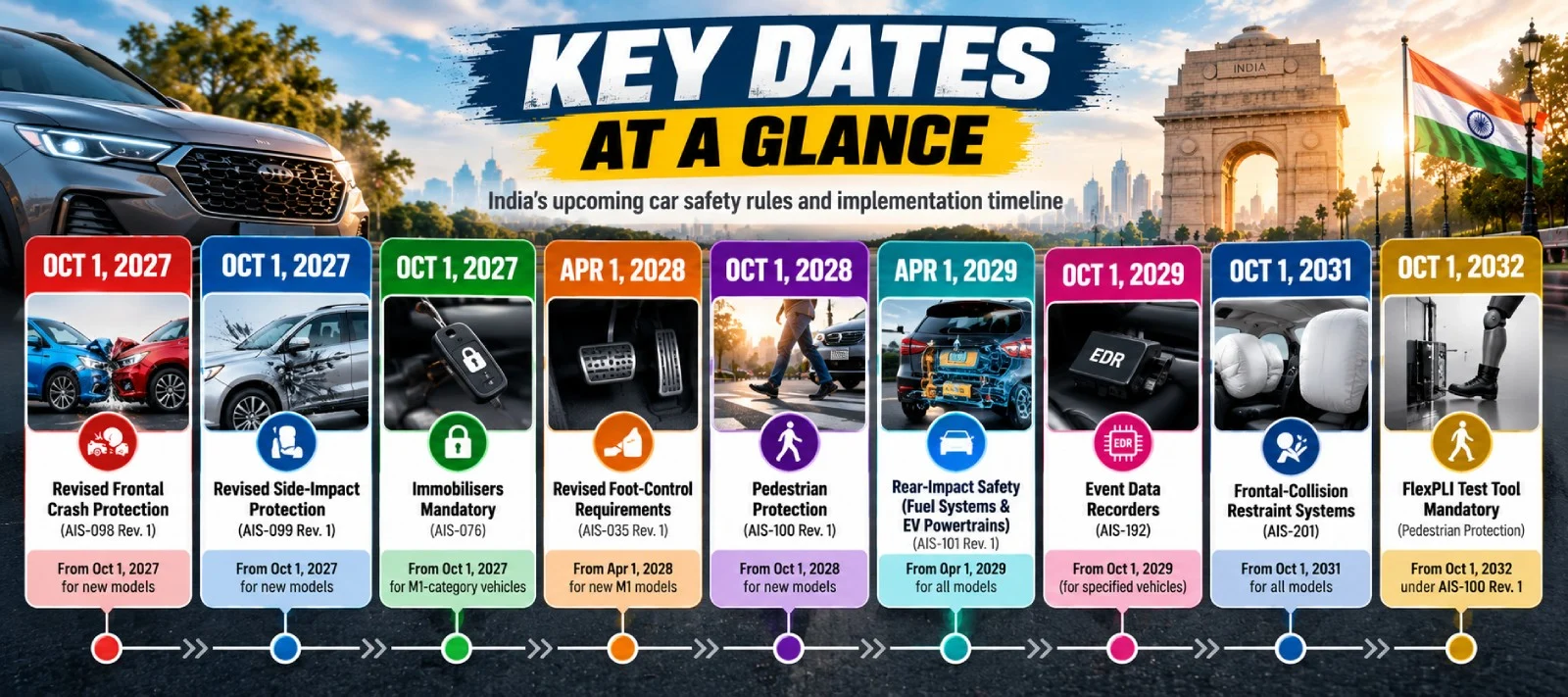
The table below summarises the principal dates in notification S.O. 5723(E). “New models” and “all models” refer to the applicable regulatory categories; they do not mean that every privately owned car must be retrofitted.
| Implementation date | Safety requirement | Who or what it covers |
|---|---|---|
| October 1, 2027 | Revised offset frontal collision protection (AIS-098 Rev. 1) | New models covered by the standard |
| October 1, 2027 | Revised lateral collision protection (AIS-099 Rev. 1) | New models covered by the standard |
| October 1, 2027 | Immobiliser fitment under AIS-076 | M1-category vehicles specified in the notification |
| April 1, 2028 | Revised foot-control requirements (AIS-035 Rev. 1) | New M1 models covered by the standard |
| October 1, 2028 | Revised offset frontal and lateral collision standards | All models covered by the respective standards |
| October 1, 2028 | Revised pedestrian protection (AIS-100 Rev. 1) | New models covered by the standard |
| April 1, 2029 | Rear-impact protection for fuel systems and electric powertrains (AIS-101 Rev. 1) | All models covered by the standard |
| October 1, 2029 | Frontal-collision restraint systems (AIS-201) | New models covered by the standard |
| October 1, 2029 | Event Data Recorder approval standard (AIS-192) | Vehicles specified in the standard |
| October 1, 2031 | AIS-201 frontal-collision restraint requirements | All models covered by the standard |
| October 1, 2032 | Mandatory use of the FlexPLI pedestrian-leg test tool | Pedestrian-protection testing under AIS-100 Rev. 1 |
Important: The table describes the implementation schedule in the notification, not a claim that every feature listed is new to every car. The exact technical requirements and applicability depend on the cited Automotive Industry Standard.
1. Frontal Crash Protection: Why October 2027 Matters
One of the main changes is the revised offset frontal collision standard, AIS-098 (Revision 1). It applies to new models from October 1, 2027, and to all covered models from October 1, 2028.
An offset collision occurs when only part of a car’s front end takes the initial impact. Unlike a full-width collision, the force is concentrated in a smaller section of the vehicle. Engineers must consider how the structure deforms, how the passenger compartment holds up and how restraint systems protect the people inside.
Meeting a revised standard can involve structural engineering, component validation and changes to occupant-restraint systems. The notification establishes the applicable standard and deadline; the detailed technical requirements are contained in AIS-098 Rev. 1.
What buyers should do:
- Check the model year and manufacturing date of the vehicle you are considering.
- Ask the manufacturer whether the specific model complies with the standard applicable to it.
- Look for independent crash-test results where available instead of relying only on brochure claims.
A car that shares its name with an older model may have a different engineering design or approval history after a generational change. It is better to verify the exact vehicle than assume that every version has the same safety performance.
2. Side-Impact Protection Gets a Revised Standard
The revised lateral collision standard, AIS-099 (Revision 1), follows the same October 2027 and October 2028 schedule for new models and all covered models, respectively.
Side impacts present a distinct challenge because there is less space between the outside of the vehicle and its occupants than there is at the front. The door structure, side of the passenger compartment and restraint systems all contribute to occupant protection.
The revised standard does not mean that every manufacturer must use identical components. It means that the vehicles within its scope must meet the applicable requirements through an approved design and testing process.
When comparing two variants, check the equipment fitted to each one. A safety feature advertised for a top-spec model should not automatically be assumed to be standard on the entry-level version.
3. Immobilisers Become Mandatory for Covered Passenger Cars
From October 1, 2027, the notification requires immobiliser fitment under AIS-076 for the specified M1-category vehicles. M1 generally refers to passenger vehicles with no more than eight passenger seats in addition to the driver’s seat.
An immobiliser is an electronic anti-theft system that prevents the engine from starting unless the vehicle recognises an authorised key or signal. It serves a different purpose from airbags and crash-protection systems: its primary function is to prevent unauthorised starting.
This is a vehicle-security requirement rather than a crash-test requirement. An immobiliser can make certain theft methods more difficult, but it does not guarantee that a vehicle cannot be stolen.
Buyers should confirm that the exact vehicle meets the applicable requirement. An alarm or central-locking system listed in a brochure is not, by itself, proof that the immobiliser requirement has been met.
4. Pedestrian Protection: New-Model Requirements From October 2028
Vehicle safety also involves people outside the cabin. In an impact with a pedestrian, the front structure and bonnet area can influence the forces experienced by the person struck.
The revised pedestrian and vulnerable-road-user protection standard, AIS-100 (Revision 1), applies to new models from October 1, 2028. The notification also makes use of the FlexPLI, a flexible pedestrian-leg impact test tool, mandatory from October 1, 2032.
These provisions concern how pedestrian protection is assessed under the applicable standard. They should not be confused with a guarantee that a vehicle can prevent every pedestrian injury.
For buyers, the useful distinction is between occupant protection and vulnerable-road-user protection. A long list of airbags and cabin features does not, by itself, establish how a vehicle performs in pedestrian-protection testing.
5. Rear-Impact Safety for Fuel Systems and Electric Powertrains
A rear-end collision can damage components that are not immediately visible from outside the car. In petrol and diesel vehicles, fuel-system damage can create a leakage risk. In electric vehicles, an impact can affect the battery pack or associated high-voltage components.
The revised AIS-101 (Revision 1) standard covers protection of the fuel system and safety of the electric powertrain in a rear impact. The implementation date for all models covered by the standard is April 1, 2029.
The specific engineering approach will vary by vehicle. Conventional cars and electric vehicles have different energy-storage systems, so the relevant safety assessments need to account for their respective designs.
For buyers choosing between petrol, diesel and electric vehicles, the practical point is to examine the safety evidence for the model itself. The powertrain alone does not establish how well a car will perform in every type of collision.
6. Frontal-Collision Restraint Systems From 2029
The notification introduces AIS-201 requirements for occupant protection in a frontal collision, with a focus on restraint systems. The deadline is October 1, 2029, for new models and October 1, 2031, for all covered models.
Restraint systems include components designed to manage occupant movement during a collision. Seatbelts, belt anchorages, pretensioners and airbags have different functions but are intended to work together as part of the vehicle’s overall protection system.
This is why airbag count alone should not be treated as a complete measure of safety. Airbags matter, but their performance depends on the wider restraint system and vehicle structure.
When shopping for a car, check which safety equipment is standard on your chosen variant and whether a relevant independent crash-test assessment is available for that vehicle.
7. Event Data Recorders: What Does an EDR Actually Do?
An Event Data Recorder (EDR) stores specified technical information associated with a crash. Depending on the system and the applicable requirements, this information can help investigators understand aspects of the vehicle’s behaviour immediately before and during an impact.
The notification specifies October 1, 2029, for the AIS-192 event-data-recorder approval standard for vehicles covered by that standard. This date should not be interpreted as proof that every passenger car must have an EDR installed.
An EDR is also different from a dashcam. A dashcam records video, while an EDR stores technical information according to its design and standard. It should not automatically be described as a device that continuously records cabin conversations or every moment of a journey.
Crash data can contribute to an investigation, but it does not automatically establish responsibility for an accident. Other evidence and the circumstances of the incident may also be relevant.
8. Revised Foot-Control Requirements From April 2028
The notification revises requirements for the arrangement and operation of foot controls under AIS-035 (Revision 1). The new-model implementation date for covered M1 vehicles is April 1, 2028.
Foot controls are a basic part of the driver’s interface, and their layout and operation are addressed through technical standards. The notification establishes the applicable approval timeline, while the detailed requirements sit in the standard itself.
This is not a feature that buyers can meaningfully judge from a typical showroom equipment list. It is primarily a design and compliance matter for manufacturers and vehicle approval authorities.
9. Is Automatic Emergency Braking Mandatory From 2027?
No. The reported AEBS timeline is part of a separate draft proposal, not the notified October 2026 requirements described above.
According to Autocar India’s report of October 23, 2026, the draft proposes the following schedule:
| Proposed date | Draft requirement |
|---|---|
| October 1, 2028 | M1 and N1 vehicles offered with AEBS would need to comply with AIS-185 under the proposal. |
| October 1, 2030 | AEBS would become mandatory for new M1 models under the draft. |
| October 1, 2032 | The proposed requirement would extend to all covered M1 models. |
The draft was reported as open for public consultation for 30 days. These dates should remain labelled as proposed unless a final notification confirms them.
AEBS uses sensors and control software to detect certain collision risks and apply the brakes when intervention is needed. Depending on the system, it may warn the driver first or brake automatically if the driver does not respond.
The technology can assist in specific circumstances, but it does not replace attentive driving. Performance depends on system design, speed, visibility, road conditions and the type of obstacle.
Which Cars Will Be Affected?
The answer depends on the specific standard and the vehicle category it covers. Some requirements apply first to new models and later to all covered models. Other requirements have a single deadline or concern approval of particular equipment.
For example, revised frontal and lateral collision standards begin for new models on October 1, 2027, before extending to all covered models on October 1, 2028. Revised pedestrian protection begins for new models in October 2028, while rear-impact protection has a 2029 deadline.
These implementation dates do not automatically make older, already-registered cars illegal. They establish compliance timelines for the vehicles covered by the relevant standards; they are not a blanket instruction for every existing owner to retrofit new systems.
Before buying a vehicle near a deadline, ask the manufacturer or authorised dealer to confirm:
- The exact model, variant and manufacturing date.
- The safety standards applicable to that vehicle.
- Whether the manufacturer confirms compliance with the relevant requirements.
- Whether the independent crash-test result, if any, applies to the exact model or configuration.
Mandatory Safety Standards vs Bharat NCAP Ratings
A legal safety requirement and a crash-test rating answer different questions. A regulation defines the requirements a vehicle must meet to comply with the law. A consumer crash-test programme assesses performance under its published testing procedures and communicates the result through a rating.
Bharat NCAP is India’s vehicle crash-safety assessment programme. Its ratings can help buyers compare the tested performance of vehicles, but the October 2026 notification does not establish a universal requirement for every car to achieve a five-star Bharat NCAP rating.
It is also important to check which vehicle was tested. Results can depend on the model, variant, safety equipment and the applicable assessment protocol. A result for one version should not automatically be assumed to apply to every version carrying the same model name.
For a more informed purchase, check both legal compliance and independent crash-test evidence where available. Neither a long feature list nor a star rating alone provides a complete picture of everyday road safety.
Will the New Rules Make Cars More Expensive?
Compliance can create engineering, testing and production costs. Depending on the requirement, a manufacturer may need to revise structural components, validate restraint systems, update electronics or conduct additional testing.
However, it would be misleading to assign a fixed price increase to every car before manufacturers announce their plans. A vehicle that already meets a future requirement may need fewer changes than a model built around an older specification. Component sourcing, production volume and the extent of redesign can also affect the final cost.
For buyers, compare the actual on-road price and safety equipment of the variants available. If a manufacturer announces a price revision or an updated safety package, assess that information directly rather than assuming every car will become more expensive by the same amount.
What Existing Car Owners Need to Know
The October 2026 notification does not, by itself, mean that every car already on Indian roads must be replaced or retrofitted. The applicability of each requirement depends on the wording of the relevant standard and its implementation provisions.
Before paying for an aftermarket safety modification, check whether it is appropriate and lawful for the vehicle. Unsuitable changes to airbags, braking systems, steering or other safety-critical components can introduce risks of their own.
Routine maintenance remains important regardless of future regulations. Keep tyres in good condition, maintain the brakes, ensure seatbelts work properly and investigate safety-system warning lights promptly.
Car-Buying Checklist for 2026–2027
- Check the manufacturing date: Model year and manufacturing date may affect which requirements apply.
- Confirm compliance: Ask the manufacturer about the specific standard applicable to your chosen model.
- Check standard equipment: Verify which airbags and other safety systems are fitted to your exact variant.
- Review crash-test evidence: Look for a relevant Bharat NCAP or other independent assessment where available.
- Separate present features from future rules: A technology offered today is not necessarily mandatory across all cars.
- Read the warranty terms: Understand how electronic safety systems are covered and maintained.
- Verify claims: Check important statements against official notifications rather than relying only on advertisements or verbal assurances.
Key Takeaways
- MoRTH notification S.O. 5723(E), dated October 19, 2026, sets phased implementation dates for several vehicle-safety standards.
- Revised offset frontal and lateral collision standards apply to new models from October 1, 2027, and all covered models from October 1, 2028.
- Immobiliser fitment is scheduled from October 1, 2027, for the M1-category vehicles specified in the notification.
- Pedestrian protection, rear-impact protection, restraint systems and EDR approval follow separate timelines.
- AEBS dates reported in October 2026 are part of a draft proposal and should not be presented as final law without a subsequent notification.
Frequently Asked Questions
What are the new car safety rules in India from 2027?
The notified changes include revised offset frontal and lateral collision standards for new models from October 1, 2027, and immobiliser fitment for covered M1-category vehicles from the same date. Other standards have different deadlines.
Will all cars have to meet the revised crash standards from October 2027?
No. The revised offset frontal and lateral standards begin for new models on October 1, 2027, and extend to all covered models on October 1, 2028. Other requirements follow their own schedules.
Will existing cars become illegal under the new rules?
Not automatically. The notification sets compliance dates for vehicles covered by the relevant standards. It does not, by itself, impose a blanket requirement on every existing owner to replace or retrofit a registered car.
Is a five-star Bharat NCAP rating mandatory for every new car?
No universal five-star Bharat NCAP requirement is established by this notification. A crash-test rating and mandatory legal compliance are different matters.
Will new car safety rules increase vehicle prices?
Compliance may involve engineering, equipment and testing costs, but the price effect will vary by model and manufacturer. A fixed increase across all cars cannot be established from the notification alone.
Conclusion: Read the Deadline, Not Just the Headline
India’s updated vehicle-safety framework introduces a series of implementation dates rather than a single deadline for every technology. October 2027 is particularly important for revised frontal and lateral collision protection in new models and immobiliser fitment for the specified passenger-vehicle category. Other requirements extend through 2028, 2029 and beyond.
For buyers, the best response is to ask precise questions before booking a car. Confirm which standards apply to the exact model, check the manufacturer’s compliance information and use independent crash-test evidence where available. Do not assume that every new launch is automatically safer, that every advertised feature is standard, or that a proposed rule is already law.
For manufacturers, the phased schedule provides time to validate designs and prepare production. For consumers, understanding the individual deadlines makes it easier to separate confirmed regulatory changes from speculation and to make a more informed buying decision.
Sources and Further Reading
- MoRTH Notification S.O. 5723(E), dated October 19, 2026 — notification text and implementation schedule.
- Ministry of Road Transport and Highways — official transport regulations and policy information.
- Autocar India: MoRTH proposes mandatory emergency braking for all cars from October 2032 — draft AEBS proposal, October 23, 2026.
- The Times of India: New car safety rules — reporting on the phased rollout, October 24, 2026.