+91-9646339590



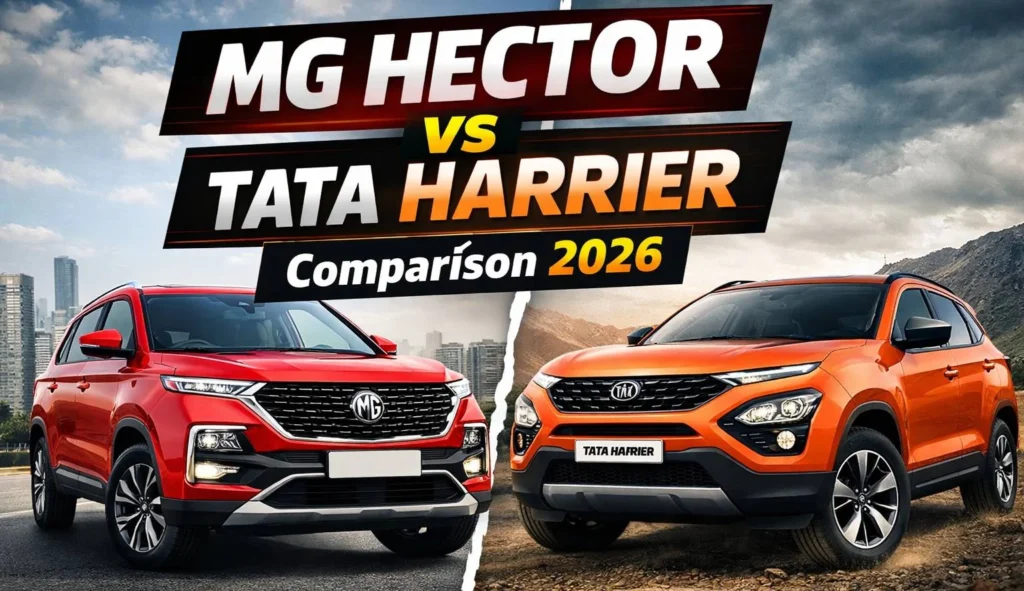
The mid-size SUV segment contributes nearly 20% of total passenger vehicle sales in India (SIAM FY2024–25 data). Within this space, the MG Hector and the Tata Harrier represent two distinct value philosophies. The Hector positions itself as a technology-led, comfort-focused family SUV. The Harrier leans on structural safety validation, diesel performance, and dynamic stability.
This publication-grade comparison evaluates on-road pricing, variant positioning, crash performance, instrumented road tests, braking and acceleration metrics, ownership economics, resale trends, and feature depth to determine which SUV offers stronger long-term value.
Powertrain Architecture and Mechanical Differences
MG Hector offers a 1.5-litre turbocharged petrol engine (143 PS, 250 Nm) paired with a 6-speed manual or CVT, and a 2.0-litre diesel (170 PS, 350 Nm) paired with a 6-speed manual.
Tata Harrier uses the 2.0-litre Kryotec diesel engine (170 PS, 350 Nm), available with a 6-speed manual or 6-speed torque converter automatic.
While both diesel engines trace their origin to the FCA Multijet II architecture, calibration differs. The Harrier’s torque converter delivers stronger low-speed tractability and smoother load transitions under overtaking. The Hector diesel, paired only with manual, prioritizes linear power delivery over urgency.
On-Road Price Comparison (Delhi, Q1 2026)
| Model | Ex-Showroom (₹ lakh) | On-Road Delhi (₹ lakh approx.) |
|---|---|---|
| MG Hector Petrol | 13.99 – 20.25 | 16.2 – 23.5 |
| MG Hector Diesel | 18.85 – 22.90 | 21.7 – 26.2 |
| Tata Harrier Diesel | 15.49 – 24.49 | 18.1 – 28.5 |
The Hector undercuts the Harrier at entry-level due to its petrol option. However, comparable diesel automatic trims place the Harrier at a higher price band due to torque converter availability and expanded ADAS packaging.
Variant Strategy and Equipment Distribution
Hector variants (Style, Shine, Smart, Sharp Pro, Savvy Pro) distribute premium features such as panoramic sunroof and connected technology earlier in the lineup. Harrier trims (Smart, Pure, Adventure, Fearless, Dark editions) reserve ADAS Level 2, 360-degree camera, and JBL audio for upper variants.
For a focused petrol-versus-diesel mechanical comparison, see this detailed breakdown:
MG Hector Petrol vs Tata Harrier Diesel analysis.
Crash Rating and Structural Safety
The Tata Harrier received a 5-star rating under the 2023 Global NCAP updated protocol aligned with Bharat NCAP norms. It scored strongly in adult occupant protection, supported by standard Electronic Stability Control (ESC), six airbags, and improved side impact performance.
The MG Hector has not yet been rated under Bharat NCAP or the latest Global NCAP protocol. It includes six airbags, ESC, traction control, hill hold, and ADAS Level 2 in top trims, but lacks published crash test structural scoring under the current Indian testing regime.
According to the Ministry of Road Transport & Highways (Road Accidents in India Report 2023), over 4.6 lakh road accidents were recorded in 2022. With structural rigidity and electronic stability systems becoming central to crash survivability, validated crash scores now significantly influence buying decisions.
ADAS and Driver Assistance Systems
Both SUVs offer Level 2 ADAS features in higher trims, including:
- Forward Collision Warning
- Autonomous Emergency Braking
- Lane Keep Assist
- Adaptive Cruise Control
- Traffic Jam Assist
Industry data suggests ADAS-equipped vehicles saw measurable reductions in rear-end collisions globally (IIHS 2022 study indicating up to 50% reduction with AEB). While Indian driving conditions vary, real-world user feedback indicates practical benefit in highway scenarios.
Instrumented Performance Testing
0–100 km/h Acceleration (Independent Media Tests 2024–25)
| Model | Transmission | 0–100 km/h |
|---|---|---|
| MG Hector Petrol CVT | CVT | ~10.8–11.5 sec |
| MG Hector Diesel | Manual | ~10.2–11.0 sec |
| Tata Harrier Diesel | Automatic | ~9.8–10.4 sec |
The Harrier automatic demonstrates marginally quicker sprint times due to torque converter responsiveness. The Hector petrol CVT prioritizes smoothness over outright acceleration.
Braking Performance (100–0 km/h)
| Model | Braking Distance |
|---|---|
| Tata Harrier | ~38–40 meters |
| MG Hector | ~39–42 meters |
Both SUVs use disc brakes on all four wheels with ABS and EBD. The Harrier exhibits firmer pedal feedback and slightly shorter stopping distances under controlled test conditions.
Ride, Handling and Real Road Dynamics
The Harrier’s Omega Arc platform (derived from Land Rover’s D8 architecture) provides superior torsional rigidity. At highway speeds above 100 km/h, steering stability and lane discipline are stronger compared to the Hector.
The Hector offers a softer suspension setup tuned for urban comfort. Rear seat cushioning and cabin NVH suppression are marginally superior, especially in petrol variants.
Feature-Wise Comparison
| Feature | MG Hector | Tata Harrier |
|---|---|---|
| Infotainment | 14-inch HD portrait touchscreen | 12.3-inch landscape touchscreen |
| Digital Instrument Cluster | 7-inch | 10.25-inch |
| Premium Audio | Standard system | JBL 10-speaker |
| Connected Car Tech | i-SMART with OTA | IRA 2.0 suite |
| Panoramic Sunroof | Yes | Yes |
Ownership Economics: 5-Year Cost Perspective
Fuel Efficiency (ARAI Rated):
- Harrier Diesel: ~16–17 km/l
- Hector Diesel: ~16–17 km/l
- Hector Petrol: ~13–14 km/l
Service Interval: Both follow 15,000 km or 1-year intervals.
Warranty: MG offers up to 5-year extended warranty packages. Tata provides standard 3-year/1 lakh km warranty with extension options.
Diesel variants show stronger 3-year residual values in the mid-size SUV segment (industry dealer data suggests 55–60% retention), whereas petrol variants typically retain 50–55% depending on mileage.
Sales and Market Performance
In FY2024–25, the Harrier consistently averaged monthly sales between 4,000–5,000 units post-facelift. The Hector maintained volumes around 2,500–3,500 units monthly. Market share momentum currently favours Tata, aided by Bharat NCAP ratings and brand perception in safety.
Which SUV Offers Better Value?
MG Hector delivers stronger value if:
- Your priority is infotainment, connectivity, and rear-seat comfort.
- You prefer petrol automatic smoothness for urban usage.
- You want premium features at mid-level trims.
Tata Harrier offers stronger value if:
- Crash-tested structural validation is critical.
- You frequently drive on highways.
- You prefer diesel automatic with stronger resale retention.
Conclusion
The MG Hector vs Tata Harrier comparison reveals two clearly differentiated value propositions. The Hector excels in digital cabin experience and feature distribution at competitive pricing. The Harrier leads in structural safety validation, driving composure, braking consistency, and diesel automatic performance.
For long-term ownership economics combined with safety validation, the Harrier currently edges ahead. For feature-led comfort and urban practicality at a lower entry point, the Hector remains compelling.
Key Takeaways
- Harrier holds validated 5-star Global NCAP rating under updated protocol.
- Hector offers segment-leading infotainment screen size.
- Harrier demonstrates marginally better acceleration and braking metrics.
- Diesel variants provide stronger resale retention.
- Ownership cost differences depend heavily on annual mileage.
Frequently Asked Questions
1. Which SUV is safer – MG Hector or Tata Harrier?
The Tata Harrier holds a 5-star Global NCAP rating under updated testing standards.
2. Is MG Hector petrol worth buying over Harrier diesel?
For primarily urban driving with lower annual mileage, the Hector petrol CVT offers smoother usability and lower upfront cost.
3. Which SUV performs better in acceleration tests?
Independent tests indicate the Harrier automatic is marginally quicker in 0–100 km/h runs.
4. Do both SUVs offer ADAS?
Yes, both provide Level 2 ADAS features in higher trims.
5. Which has better resale value?
Diesel variants, particularly the Harrier, show stronger resale retention trends.
Suggested Authoritative References:
- Global NCAP Official Test Reports (2023 Protocol)
- Ministry of Road Transport & Highways – Road Accidents in India Report 2023
- Society of Indian Automobile Manufacturers (SIAM) FY2024–25 Data
About the Author
Ankush Kumar is an automotive content specialist with over 5 years of experience covering global car markets, hybrid technologies, and EV ecosystem developments. His work focuses on translating complex automotive engineering concepts into practical insights for Indian buyers.
He has analyzed vehicle platforms, powertrain systems, and real-world usability trends across multiple brands. His content emphasizes data-backed evaluation, regulatory awareness, and ownership practicality.