+91-9646339590



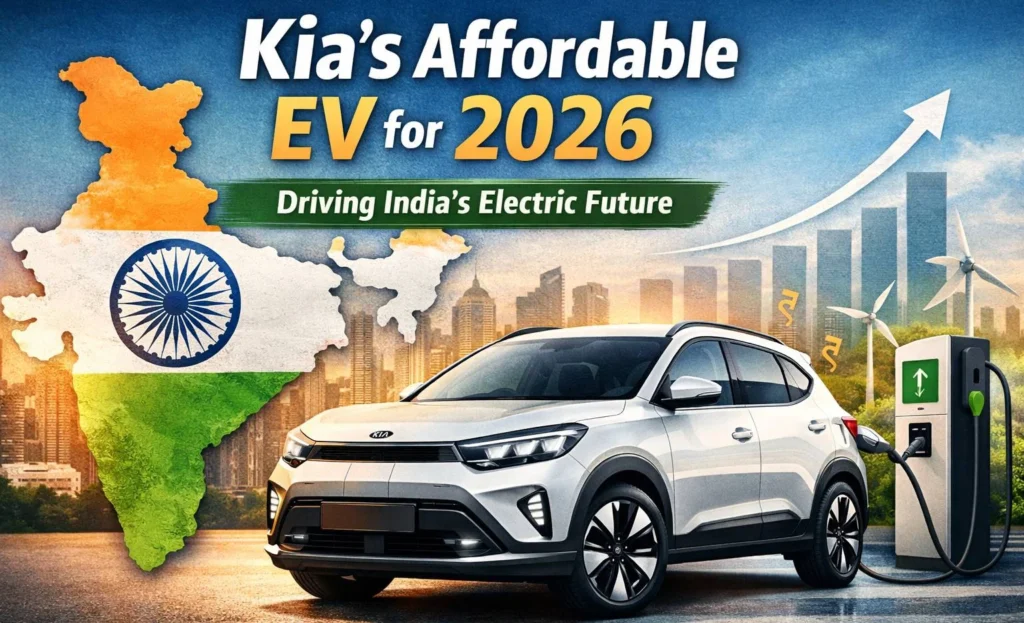
India’s electric vehicle market is entering a critical growth phase. Rising fuel prices, government incentives, and improving charging infrastructure are pushing more buyers toward EVs. Within this transition, Kia is preparing to introduce an affordable locally manufactured electric vehicle targeted at mainstream Indian buyers.
Unlike premium EV models that focus on luxury segments, Kia’s upcoming compact electric vehicle is expected to emphasize practicality, usable driving range, family-friendly space, and competitive pricing. If executed successfully, this strategy could accelerate EV adoption in India’s mid-price car segment.
Meta Snapshot: Market Context and Vehicle Focus
- Primary topic: Kia affordable electric vehicle for India (expected 2026 launch)
- Related topics: compact EV India, EV range comparison, charging infrastructure, EV safety features, real-world EV ownership
- Industry context: Electric vehicles currently represent roughly 5–6% of new passenger car sales in India, with domestic manufacturers such as Tata Motors and Mahindra leading early adoption.
Understanding the Product: Kia’s Upcoming Compact EV
Kia has announced plans to expand its electric vehicle portfolio globally while strengthening local manufacturing in India. The upcoming affordable EV is expected to be positioned below premium models such as the EV6 and EV9 and will likely target the growing compact SUV and MPV segments.
The strategy focuses on three priorities:
- Competitive pricing enabled through local production.
- Multiple battery configurations allowing buyers to choose between cost and driving range.
- Modern EV technology including fast charging and advanced driver assistance systems.
Although final specifications are yet to be confirmed, early industry reports suggest the vehicle will compete directly with India’s popular compact EVs.
Expected Price and Market Positioning
The expected price range for Kia’s affordable EV is estimated between ₹17 lakh and ₹25 lakh (ex-showroom). On-road pricing in major cities could reach approximately ₹20–₹28 lakh depending on the variant and state incentives.
This price band places the vehicle directly against several established electric models already available in the Indian market.
For many Indian buyers considering their first electric vehicle, this price segment represents the point where EV ownership becomes financially comparable to premium petrol or diesel SUVs.
Battery Options, Range and Charging
Battery technology will play a critical role in the vehicle’s competitiveness. Industry estimates suggest two battery configurations may be offered.
- Standard battery: Approximately 40–45 kWh
- Extended battery: Approximately 50–55 kWh
Expected certified driving range figures could fall between 400 km and 500 km per charge depending on the variant and testing cycle.
Charging capabilities are expected to include:
- AC home charging compatibility
- DC fast-charging support
- Estimated 10–80% fast charge in around 30–40 minutes depending on charger capacity
These figures would place the vehicle among the longest-range options currently available in the sub-₹30 lakh EV segment.
Technical Specifications (Expected)
| Specification | Expected Value |
|---|---|
| Battery Capacity | Approx. 40–55 kWh |
| Driving Range | Approx. 400–500 km |
| Motor Output | Approx. 120–150 kW |
| Drivetrain | Front-Wheel Drive |
| Fast Charging | 10–80% in ~30–40 minutes |
| Seating Capacity | 5–7 seats depending on body style |
Performance Expectations
Electric motors deliver instant torque, making even family-oriented EVs feel quick in everyday driving. Based on comparable vehicles in this segment, acceleration from 0–100 km/h could be achieved in roughly 8–9 seconds.
For urban commuting, the more relevant advantages include smooth acceleration, quiet operation, and reduced maintenance compared with internal combustion engines.
Feature Comparison with Popular EV Rivals
| Feature | Kia Upcoming EV | Tata Nexon EV | Mahindra XUV400 |
|---|---|---|---|
| Estimated Range | 400–500 km | Up to ~465 km | Up to ~456 km |
| Fast Charging | Yes | Yes | Yes |
| ADAS Features | Expected in higher trims | Limited | Limited |
| Seating | 5–7 seats possible | 5 seats | 5 seats |
| Connected Car Tech | Expected | Available | Available |
Interior Technology and Features
Kia vehicles are known for feature-rich interiors, and the upcoming EV is expected to continue that trend. Likely features include:
- Large touchscreen infotainment system
- Digital instrument cluster
- Wireless smartphone connectivity
- Connected vehicle services
- Ventilated seats in higher variants
- Advanced driver assistance systems (ADAS)
These features are increasingly important in India’s competitive compact SUV market, where buyers often compare technology offerings across brands.
Safety and Crash Testing
Official crash-test ratings for the upcoming Kia EV will only be available after launch. However, modern EV platforms are typically engineered with reinforced battery protection structures and advanced electronic stability systems.
Vehicles launched in India may be evaluated under the Bharat NCAP crash testing program, which assesses frontal, side, and safety-assist performance. Strong ratings in this program can significantly influence buyer confidence.
Real-World Ownership Considerations
For many buyers, EV ownership decisions depend not only on vehicle specifications but also on infrastructure and daily usability.
- Home charging remains the most convenient solution for most EV owners.
- Public charging networks are expanding rapidly in major Indian cities.
- Lower running costs and fewer mechanical components can reduce long-term maintenance expenses.
As infrastructure improves, EVs in this price segment are increasingly capable of replacing traditional petrol or diesel cars for everyday use.
Challenges Facing EV Adoption in India
- Charging Infrastructure: Availability still varies significantly between urban and rural regions.
- Initial Purchase Cost: EVs remain more expensive than comparable petrol vehicles.
- Battery Perception: Some buyers remain concerned about battery longevity and resale value.
Manufacturers entering the affordable EV segment must address these concerns through warranties, service support, and transparent ownership costs.
Conclusion
Kia’s upcoming affordable electric vehicle represents an important step in the evolution of India’s EV market. By combining local manufacturing, competitive pricing, and modern EV technology, the company aims to bring electric mobility to a wider audience.
If the final product delivers strong range, reliable charging capability, and practical family space, it could become one of the most influential electric vehicles in India’s mid-price segment.
Key Takeaways
- Kia plans to introduce a competitively priced electric vehicle for the Indian market.
- Expected driving range could reach up to 500 km depending on battery configuration.
- The vehicle will compete with popular EVs from Tata, Mahindra, and MG.
- Growing charging infrastructure will play a crucial role in adoption.
FAQ
- What will be the expected price of Kia’s affordable EV in India? Industry estimates suggest an ex-showroom price between ₹17 lakh and ₹25 lakh depending on the variant.
- What driving range can buyers expect? Depending on battery configuration, the vehicle may deliver between 400 km and 500 km on a full charge.
- How long will fast charging take? With DC fast charging, 10–80% battery replenishment could take approximately 30–40 minutes.
- Will the vehicle include advanced driver assistance systems? ADAS features are likely to be offered in higher variants, though final specifications will be confirmed at launch.
- Can this EV replace a petrol car for long trips? With ranges approaching 500 km and growing fast-charging networks, many modern EVs are increasingly capable of handling intercity travel.
External References
- Autocar India – EV Sales Hit Record High in 2025 — Detailed industry analysis and trends for electric vehicle adoption and sales in India, including passenger EV performance.
- Society of Indian Automobile Manufacturers (SIAM) – Official Reports & Publications — Primary source for EV sales data, industry reports, and official statistics on the automobile sector in India.
- Government of India FAME India EV Incentive Scheme Documentation — Official government scheme *Faster Adoption and Manufacturing of (Hybrid &) Electric Vehicles* to promote EV purchase and manufacturing.
About the Author
Ankush Kumar is an automotive content specialist with over 5 years of experience covering global car markets, hybrid technologies, and EV ecosystem developments. His work focuses on translating complex automotive engineering concepts into practical insights for Indian buyers.
He has analyzed vehicle platforms, powertrain systems, and real-world usability trends across multiple brands. His content emphasizes data-backed evaluation, regulatory awareness, and ownership practicality.