+91-9646339590



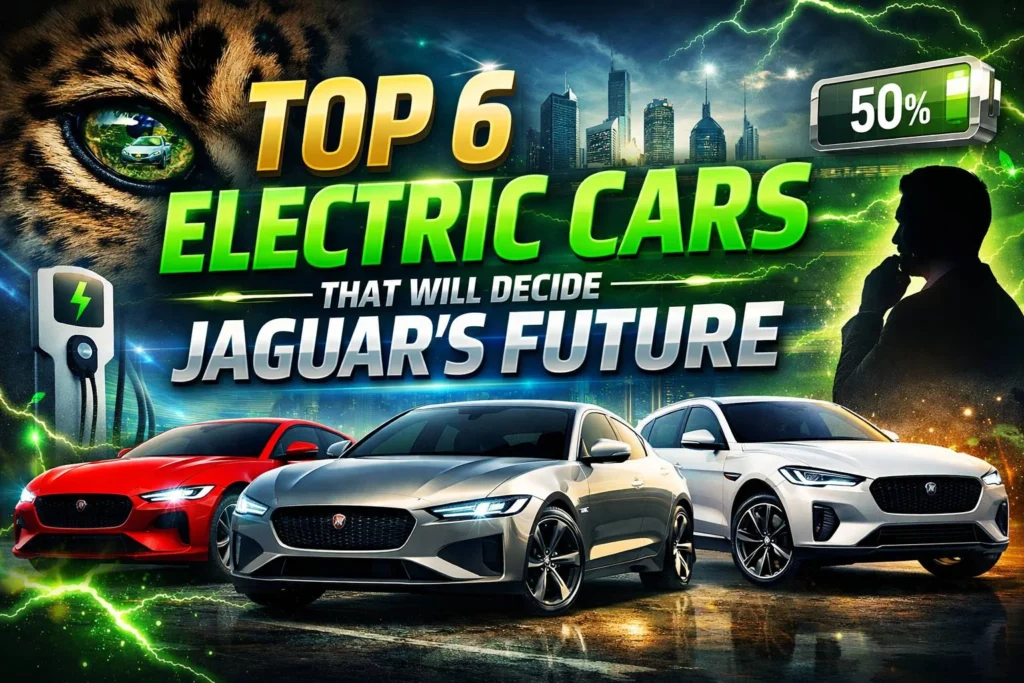
Jaguar is not transitioning to EVs—it is redefining its survival strategy around them. The brand’s “Reimagine” plan is a deliberate shift toward becoming a low-volume, high-margin luxury electric manufacturer. This repositioning places Jaguar directly against deeply established EV players like Tesla, BMW, Mercedes-Benz, and Porsche—brands that already lead in software, charging ecosystems, and real-world usability.
According to the International Energy Agency’s Global EV Outlook 2025, global EV sales exceeded 14 million units in 2024, contributing to nearly 18% of total car sales. In the premium segment, success is no longer defined by range figures alone—buyers now prioritize charging consistency, software stability, and real-world efficiency.
This analysis evaluates six Jaguar electric cars that will define the brand’s future—through real-world performance, ownership simulation, and competitive benchmarks.
1. Jaguar I-PACE — Early Innovation, Now Outpaced
The Jaguar I-PACE was among the earliest premium EVs, but its first-generation architecture now limits its competitiveness.
- On-road price (India): ₹1.26–1.35 crore
- Variants: S, SE, HSE
- Battery: 90 kWh (NMC)
- Range (WLTP): 470 km
- Real-world range: 340–380 km
- 0–100 km/h: 4.8 seconds
- Braking (100–0 km/h): ~35.5 m
- Charging: 100 kW (0–80% ~45 min)
- Crash rating: 5-star (Euro NCAP)
Jaguar I-PACE detailed specs and review (Car and Driver)
Real Road Insight: The I-PACE consumes around 24–26 kWh/100 km, significantly higher than newer EVs (~15–18 kWh/100 km). This directly reduces highway efficiency and increases charging frequency.
Ownership Simulation (Delhi → Jaipur):
- Start at 90% battery
- After ~220 km → ~35% remaining
- Charging stop: ~40 minutes
- Total delay vs petrol SUV: ~40–45 minutes
Key Insight: The limitation is not range—it is the charging curve and efficiency consistency, which impacts real travel time.
2. Jaguar Type 00 Electric GT — Flagship Risk, Flagship Opportunity
Jaguar’s upcoming electric GT will define its premium positioning. Built on the new JEA platform, it targets both performance and profitability.
- Expected price: ₹1.8–2.2 crore
- Range: 700+ km
- 0–100 km/h: ~3.5 seconds
- Charging: 800V (10–80% ~20 min)
Reality Check: A 700 km range claim is only meaningful if charging speeds remain stable beyond 50%. Vehicles like the Porsche Taycan succeed because of flat charging curves, not just peak numbers.
Strategic Risk: If pricing exceeds perceived value, even strong engineering will struggle to convert into sales.
3. Next-Gen Jaguar Electric SUV — The Core Revenue Driver
Replacing the F-PACE, this SUV will determine Jaguar’s commercial success in the EV era.
- Expected price: ₹1.2–1.5 crore
- Range: 600–650 km
- 0–100 km/h: ~4.5 seconds
Real-World Conditions (India):
- Expected actual range: 450–500 km
- Efficiency target: 18–20 kWh/100 km
- Factors: traffic, AC usage, ambient temperature
Critical Requirement: To compete with BMW iX and Tesla Model Y, Jaguar must deliver software reliability and consistent efficiency—not just strong specifications.
4. Jaguar Electric XJ — Luxury Benchmark Test
The revival of the XJ will define Jaguar’s identity in the luxury EV segment.
- Range: 650–700 km
- Segment: Luxury sedan
Market Reality: Buyers in this segment expect:
- Silent, refined cabins
- Seamless infotainment and OTA updates
- Rear-seat comfort comparable to executive sedans
Risk: Design alone will not be enough. Without strong technology integration, Jaguar risks falling behind competitors like Mercedes EQS.
5. Jaguar Compact Electric Crossover — Volume vs Brand Balance
This model is crucial for attracting new buyers while maintaining premium positioning.
- Expected price: ₹70–90 lakh
- Range: 450–500 km
Reality Check: This segment is highly competitive. Buyers compare:
- Features per price
- Charging speed
- Software experience
Key Challenge: Jaguar must deliver measurable value—not just brand appeal.
6. Jaguar Electric Performance Coupe — Brand Halo Effect
Replacing the F-TYPE, this model will shape Jaguar’s performance identity.
- 0–100 km/h: ~3.0 seconds
- Top speed: ~250 km/h
Insight: Halo cars do not drive volume but significantly enhance brand perception and desirability.
Ownership Reality: 5-Year Cost & Practical Usage
EV ownership economics depend heavily on charging access and usage patterns.
| Factor | Jaguar I-PACE | Petrol Luxury SUV |
|---|---|---|
| 5-year fuel/energy cost | ₹2–3 lakh | ₹10–15 lakh |
| Maintenance | Lower | Higher |
| Battery degradation | ~8–12% (5 years) | Not applicable |
Charging Reality:
- Home charging: most cost-effective
- Public fast charging: 2–3x higher cost
- Long trips depend on infrastructure availability
Key Insight: Without home charging, EV cost advantages reduce significantly.
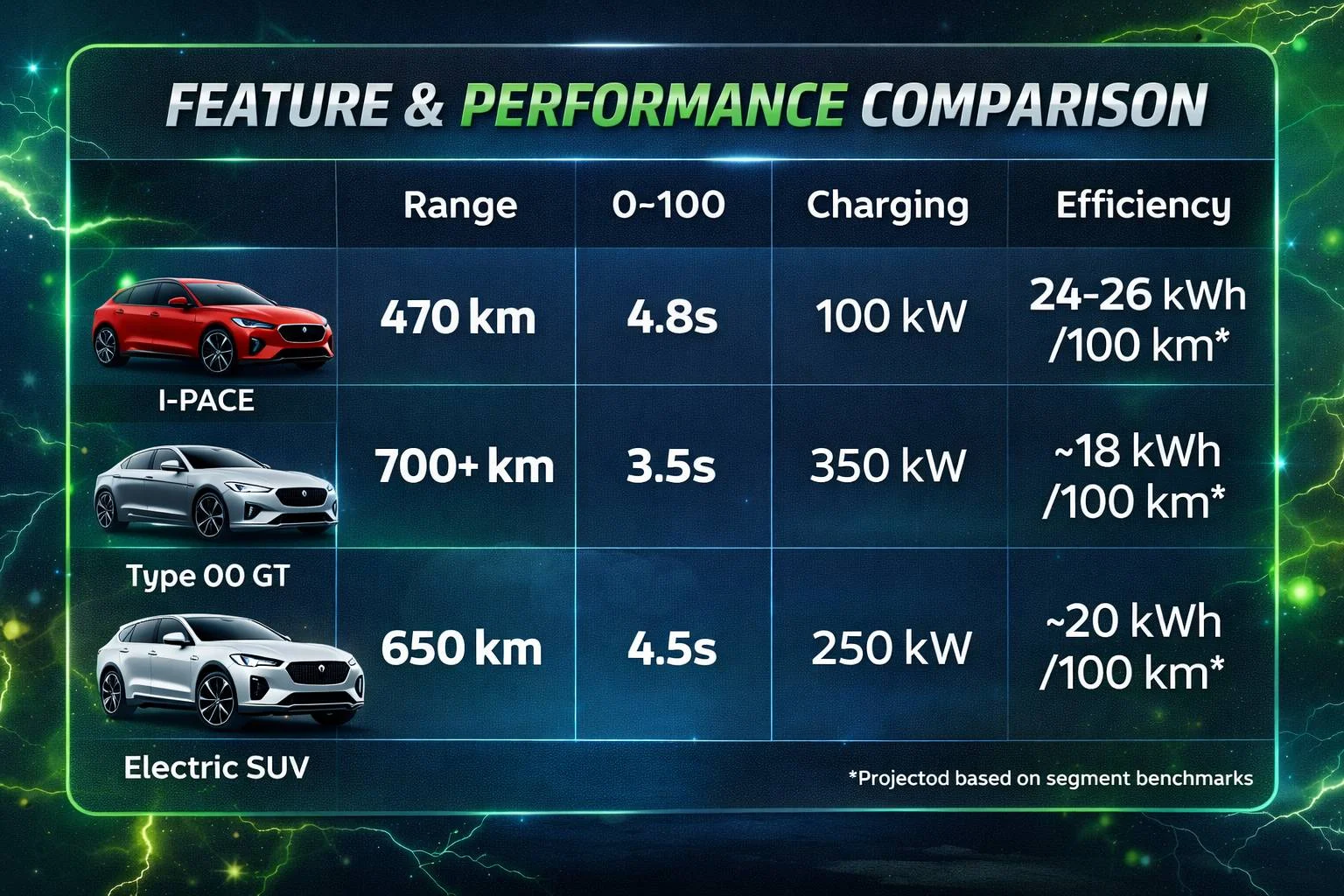
Feature & Performance Comparison
| Model | Range | 0–100 | Charging | Efficiency |
|---|---|---|---|---|
| I-PACE | 470 km | 4.8s | 100 kW | 24–26 kWh/100 km |
| Type 00 GT | 700+ km | 3.5s | 350 kW | ~18 kWh/100 km* |
| Electric SUV | 650 km | 4.5s | 250 kW | ~20 kWh/100 km* |
*Projected based on segment benchmarks
Insight from Data:
- Efficiency improvement (~25%) reflects next-gen platform evolution
- Charging jump (100 → 350 kW) is Jaguar’s biggest upgrade
- Performance gains are significant, but usability will depend on execution
Who Should Buy a Jaguar EV?
- Urban luxury buyers with home charging
- Users prioritizing design, comfort, and exclusivity
- Short-to-medium distance daily usage
Who Should Avoid It?
- Frequent long-distance highway drivers
- Users without reliable charging access
- Buyers expecting Tesla-level software ecosystem
Key Strategic Challenges
Software Gap: Jaguar still trails competitors in OTA updates and system stability.
Charging Infrastructure: Limited ultra-fast charging affects real-world usability.
Pricing Pressure: Premium positioning increases expectations and reduces margin for error.
Core Insight: Jaguar’s biggest threat is not competition—but failure to deliver consistent real-world usability at its price point.
Conclusion
Jaguar’s electric transformation will not be decided by specifications alone. The next generation of EVs must deliver consistent real-world performance, reliable software, and practical ownership experience. In a segment where competitors already offer mature ecosystems, Jaguar’s success depends on execution—not ambition.
Key Takeaways
- Jaguar is transitioning to a fully electric brand by 2030
- Real-world range is typically 20–30% lower than WLTP
- Charging behavior matters more than peak range
- Ownership cost depends heavily on charging access
- Pricing strategy will determine market success
FAQ
- Is Jaguar going fully electric?
Yes, Jaguar plans to become an all-electric brand by 2030. - What real-world range can Jaguar EVs deliver?
Typically 20–30% lower than WLTP figures depending on conditions. - Are Jaguar EVs expensive to maintain?
No, maintenance is generally lower than petrol vehicles. - Is home charging necessary?
Yes, it significantly improves cost efficiency and convenience. - How does Jaguar compare with Tesla?
Jaguar focuses on luxury and design, while Tesla leads in efficiency and software. - Are Jaguar EVs practical in India?
They are practical in metro cities but depend on charging infrastructure.
Ankush Kumar is an automotive analyst specializing in electric vehicles, luxury cars, and real-world performance benchmarking. His work focuses on ownership insights, charging behavior analysis, and practical usability to help buyers make informed decisions based on real conditions rather than specifications alone.
He tracks industry data from global agencies, manufacturer reports, and road test benchmarks to deliver high-authority automotive analysis tailored for Indian buyers.
Follow on Facebook: Ankush Kumar