+91-9646339590



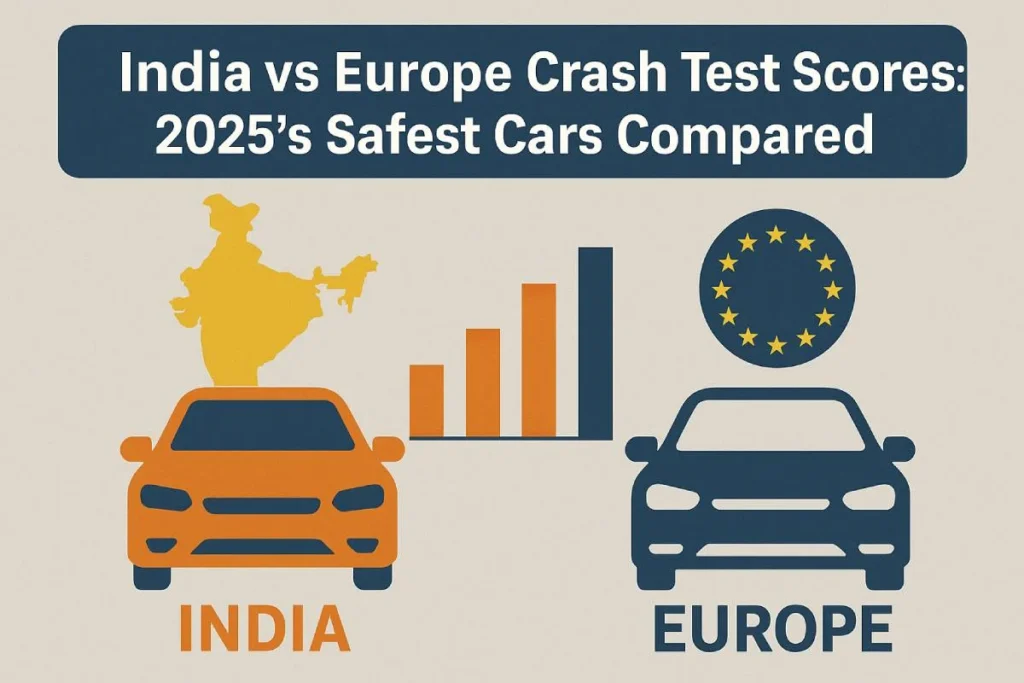
India’s safety transformation is no longer theoretical—it’s measurable. In 2025, multiple mass-market cars now achieve 5-star crash ratings under Bharat NCAP, a shift that would have been unlikely just five years ago. At the same time, Europe has moved the goalpost further by redefining safety as crash avoidance rather than just crash survival.
According to the Ministry of Road Transport & Highways, India recorded over 1.68 lakh road fatalities in 2023, with overspeeding responsible for nearly 70% of cases. This data highlights a critical reality—structural safety alone is not enough. The comparison between Indian and European crash standards in 2025 must therefore be viewed through both protection and prevention.
India vs Europe Crash Test: Key Difference
Indian crash tests focus mainly on structural safety and occupant protection, while European crash tests include advanced driver assistance systems (ADAS) that help prevent accidents before they occur.
Crash Testing Frameworks: Bharat NCAP vs Euro NCAP
Bharat NCAP evaluates cars primarily on frontal offset (64 km/h) and side impact tests, focusing on occupant protection. The scoring structure prioritizes body shell integrity, airbag deployment, and restraint systems. Detailed protocols can be reviewed through official government testing documentation, which outlines scoring for adult and child protection separately.
Euro NCAP, however, integrates a far broader safety ecosystem. Its 2025 protocols include junction assist, cyclist detection, driver monitoring systems, and far-side impact evaluation. As per the Euro NCAP official site, advanced driver assistance systems (ADAS) now contribute significantly to the final rating, often determining whether a vehicle achieves a 5-star score.
This difference explains why two 5-star cars—one from India and one from Europe—may not offer the same real-world safety envelope.
Top Crash-Tested Cars in India (2025)
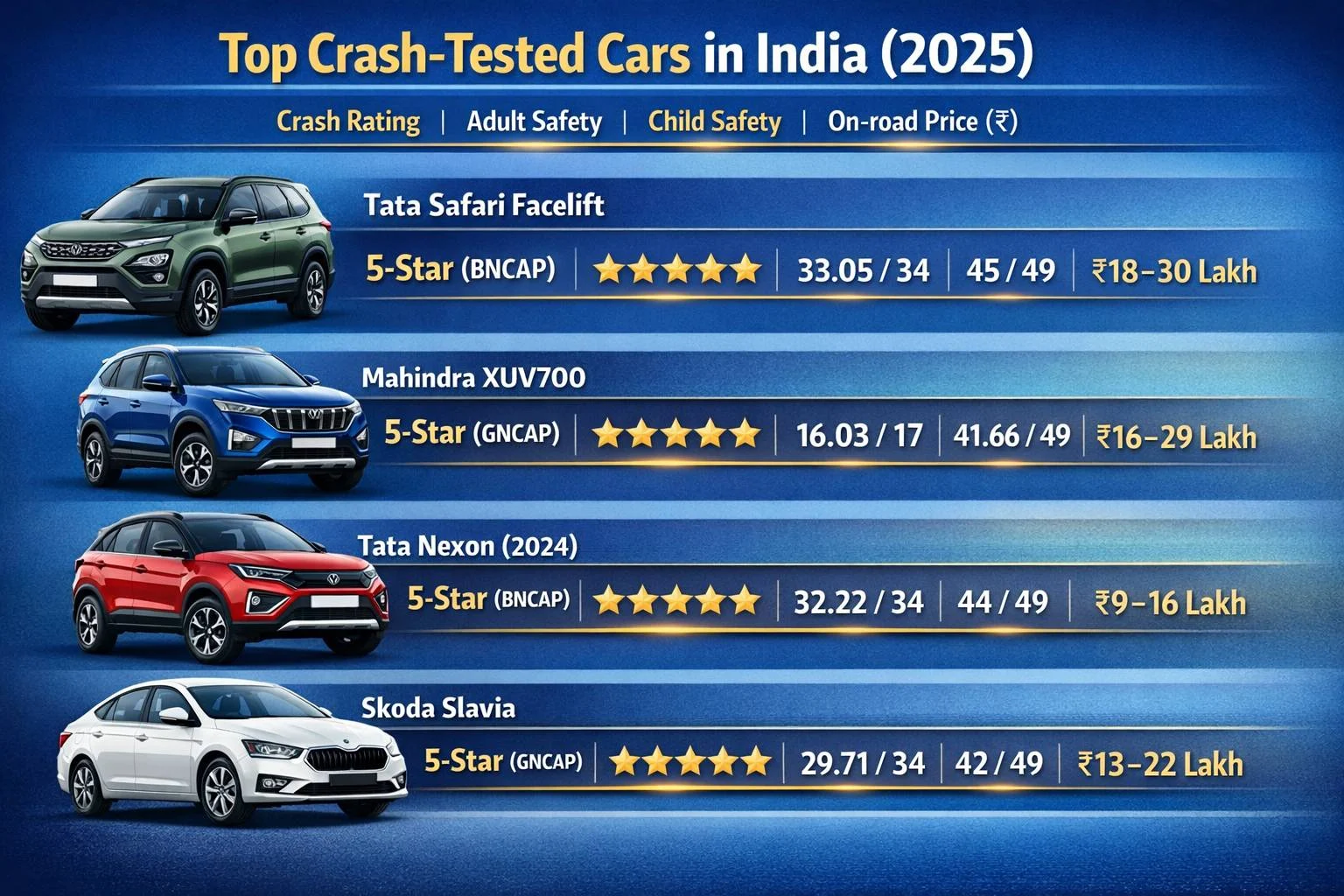
| Car Model | Crash Rating | Adult Safety | Child Safety | On-road Price (₹) |
|---|---|---|---|---|
| Tata Safari Facelift | 5-Star (BNCAP) | 33.05/34 | 45/49 | ₹18–30 lakh |
| Mahindra XUV700 | 5-Star (GNCAP) | 16.03/17 | 41.66/49 | ₹16–29 lakh |
| Tata Nexon (2024) | 5-Star (BNCAP) | 32.22/34 | 44.52/49 | ₹9–16 lakh |
| Skoda Slavia | 5-Star (GNCAP) | 29.71/34 | 42/49 | ₹13–22 lakh |
Tata Motors has focused heavily on high-strength steel cage structures, particularly in the Nexon and Safari, which maintain cabin integrity even under severe deformation loads. Mahindra’s XUV700 uses a reinforced monocoque platform with optimized load paths to distribute crash energy away from occupants.
Top Crash-Tested Cars in Europe (2025)
| Car Model | Crash Rating | Adult Safety | Child Safety | Price (Converted ₹) |
|---|---|---|---|---|
| Volvo XC60 | 5-Star (Euro NCAP) | 98% | 87% | ₹75–85 lakh |
| Tesla Model Y | 5-Star (Euro NCAP) | 97% | 87% | ₹60–70 lakh |
| Hyundai Ioniq 5 | 5-Star (Euro NCAP) | 88% | 86% | ₹50–55 lakh |
| Volkswagen ID.4 | 5-Star (Euro NCAP) | 93% | 89% | ₹55–65 lakh |
European manufacturers integrate safety at the platform level. Volvo’s SPA (Scalable Product Architecture) is engineered for controlled deformation, while Tesla’s structural battery pack enhances chassis rigidity and lowers the center of gravity, improving both crash stability and rollover resistance.
Crash Rating Comparison: Passive vs Active Safety
| Factor | India (BNCAP/GNCAP) | Europe (Euro NCAP) |
|---|---|---|
| Structural Integrity | High | Very High |
| ADAS Integration | Limited | Extensive |
| Crash Prevention | Basic | Advanced |
| Pedestrian Safety | Developing | Highly Refined |
Indian cars now match global benchmarks in structural safety, but European vehicles extend safety beyond impact scenarios. Systems like autonomous emergency braking and lane centering actively reduce accident probability, especially at highway speeds.
Real-World Driving Observations: Safety Beyond Lab Tests
In controlled testing, both Indian and European cars perform predictably. However, real-world conditions expose key differences.
On highways, vehicles like the Mahindra XUV700 maintain stability under emergency braking, but body roll becomes noticeable during sudden lane changes at speeds above 90 km/h. In contrast, cars like the Hyundai Ioniq 5 exhibit flatter cornering and more controlled weight transfer due to a lower center of gravity from their battery placement.
Similarly, panic braking scenarios reveal differences in pedal feel and response time. European vehicles tend to deliver sharper initial bite and shorter stopping distances, supported by brake assist algorithms that pre-load braking force when a collision is predicted.
0–100 km/h Acceleration Comparison
| Car Model | 0–100 km/h | Powertrain |
|---|---|---|
| Tata Nexon Petrol | 11.5 sec | 1.2L Turbo |
| Mahindra XUV700 | 9.5 sec | 2.0L Turbo |
| Tesla Model Y | 5.0 sec | Electric AWD |
| Hyundai Ioniq 5 | 7.6 sec | Electric |
Higher acceleration increases kinetic energy exponentially, which directly impacts crash severity. European EVs compensate for this with predictive stability control and traction management systems that continuously adjust torque delivery.
Braking Performance Comparison (100–0 km/h)
| Car Model | Braking Distance | Technology |
|---|---|---|
| Tata Safari | 39–41 meters | ABS + EBD |
| Mahindra XUV700 | 38–40 meters | All-disc brakes |
| Tesla Model Y | 33–35 meters | Regenerative + Disc |
| Volvo XC60 | 34–36 meters | ESC + AEB |
The braking gap is not purely mechanical. European systems integrate radar and camera inputs to predict braking needs, allowing earlier intervention compared to driver-only response systems common in Indian vehicles.
Variant-Level Safety Comparison
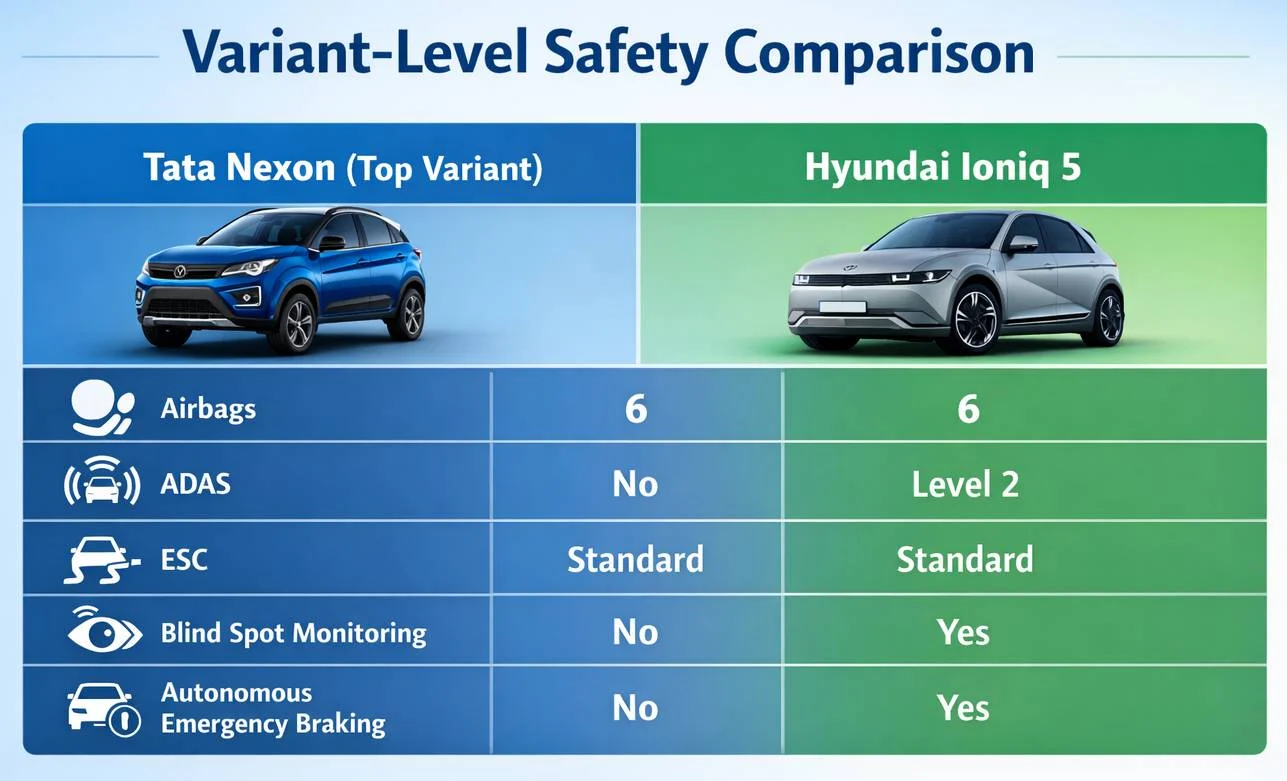
| Feature | Tata Nexon (Top Variant) | Hyundai Ioniq 5 |
|---|---|---|
| Airbags | 6 | 6 |
| ADAS | No | Level 2 |
| ESC | Standard | Standard |
| Blind Spot Monitoring | No | Yes |
| Autonomous Emergency Braking | No | Yes |
This gap highlights the shift from reactive to predictive safety. While Indian vehicles ensure survival during impact, European vehicles increasingly aim to avoid impact altogether.
Price vs Safety Value
India offers unmatched affordability in structural safety. A 5-star rated vehicle like the Tata Nexon is available below ₹10 lakh, making high crash protection accessible to a broader audience.
European vehicles command higher prices due to mandatory ADAS integration, sensor hardware, and compliance with stricter pedestrian safety norms. These additional layers significantly increase production costs but also expand the overall safety envelope.
Conclusion
India’s progress in crash safety is substantial and measurable. Structural integrity, airbag deployment, and crashworthiness now meet global expectations across several segments. However, Europe continues to lead in redefining safety through intelligent systems that actively prevent accidents.
For buyers in 2025, the distinction is no longer about whether a car can survive a crash—but whether it can help avoid one.
Key Takeaways
• Indian cars now deliver strong structural safety at accessible prices
• European cars lead in ADAS and crash avoidance technologies
• Real-world safety depends heavily on braking, stability, and driver assistance
• ADAS adoption is the next major shift for Indian automotive safety
• Safety evaluation is increasingly moving from impact protection to accident prevention
FAQs
1. Are Indian 5-star cars as safe as European cars?
They are comparable in crash protection but lack advanced crash avoidance systems.
2. What is the key difference between Euro NCAP and Bharat NCAP?
Euro NCAP includes extensive ADAS testing, while Bharat NCAP focuses more on impact safety.
3. Which is the safest budget car in India in 2025?
Tata Nexon is among the safest affordable cars with a 5-star rating.
4. Why do European cars stop faster?
Advanced braking algorithms and better system integration reduce stopping distances.
5. Does ADAS work effectively in India?
It works best on highways but is limited by road conditions and traffic unpredictability.
6. Is structural safety enough?
It is essential, but modern safety increasingly depends on preventing accidents before impact.
About the Author
Ankush Kumar is an automotive content specialist with over 5 years of experience covering global car markets, hybrid technologies, and EV ecosystem developments. His work focuses on translating complex automotive engineering concepts into practical insights for Indian buyers.
He has analyzed vehicle platforms, powertrain systems, and real-world usability trends across multiple brands. His content emphasizes data-backed evaluation, regulatory awareness, and ownership practicality.