+91-9646339590



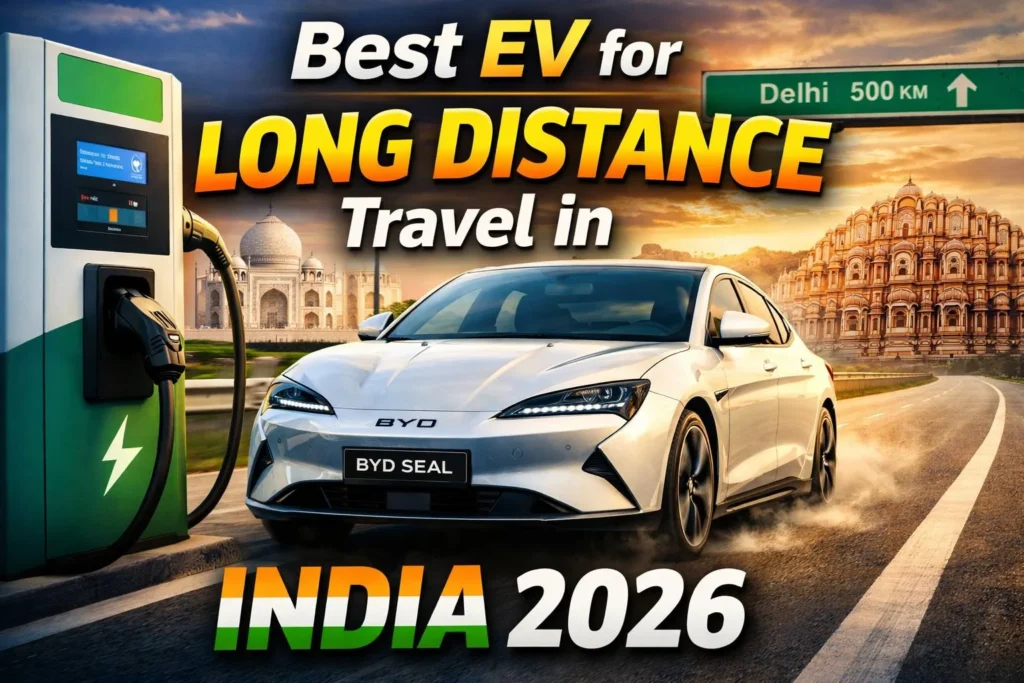
Best EV For Long Distance Travel In India 2026 (Real Ownership Analysis + Highway Testing)
Electric cars in India have reached a stage where intercity travel is no longer experimental—but the experience still varies significantly depending on the vehicle you choose. Real-world highway performance depends less on claimed range and more on efficiency under load, charging behavior, and infrastructure compatibility.
This guide identifies the best EV for long distance travel in India 2026 using real-world ownership insights, highway test data, and route-level practicality—not brochure specifications.
What Actually Defines a Long-Distance EV in India?
For Indian conditions, long-distance capability is determined by how an EV behaves at sustained highway speeds (90–110 km/h), not city driving cycles.
- Real highway range above 400 km reduces charging dependency
- Fast charging (100 kW+) minimizes downtime during trips
- Thermal stability ensures consistent performance in 35–45°C temperatures
- Charging curve matters more than peak charging speed
- Access to reliable charging networks is critical
According to the IEA Global EV Outlook 2024, charging infrastructure growth is accelerating, but consistency and uptime remain key challenges in emerging EV markets like India.
Contrarian Insight: Bigger Battery ≠ Better Highway EV
A common assumption is that a larger battery automatically means better long-distance performance. In reality, efficiency losses at high speeds can offset battery size advantages.
For example, heavier EVs with poor aerodynamics consume significantly more energy at 100 km/h. This is why sedans like BYD Seal often outperform larger SUVs despite similar battery sizes.
Similarly, ARAI range figures are not reliable indicators for highway usage. Real-world range drops by 20–30% at sustained speeds due to aerodynamic drag and drivetrain load.
Top EVs for Long Distance Travel in India (2026)
1. BYD Seal — Most Efficient Highway EV
- Real Highway Range: 480–520 km
- Battery: 82.5 kWh (LFP Blade)
- Drag Coefficient: 0.219 Cd
- Charging: 150 kW DC
The Seal’s advantage comes from its aerodynamic efficiency and stable battery chemistry. Even at 100 km/h cruising speeds, energy consumption remains controlled, making it ideal for 400–500 km uninterrupted travel.
2. Hyundai Ioniq 5 — Best Charging Experience
- Real Highway Range: 420–460 km
- Architecture: 800V
- Charging: Up to 350 kW
The Ioniq 5 is not the most efficient at high speed, but it compensates with faster charging cycles. In real trips, shorter charging stops can offset slightly lower range.
3. Kia EV6 — Best for High-Speed Stability
- Real Highway Range: 450–500 km
- 0–100 km/h: 5.2 sec
Its low stance and balanced chassis make it better suited for expressway driving at consistent high speeds compared to taller EV SUVs.
4. MG ZS EV — Predictable Mid-Range Option
- Real Highway Range: 320–350 km
Reliable and consistent, but requires planned charging stops on longer routes.
5. Tata Nexon EV LR — Entry-Level Highway EV
- Real Highway Range: 280–320 km
Best suited for occasional highway travel rather than frequent long-distance usage.
Real Ownership Reality: What Happens on Actual Trips?
Highway EV travel in India is practical—but not frictionless. Based on user experiences and highway runs:
- Charging stations may be occupied, adding 15–30 minutes wait time
- Some chargers deliver lower speeds than advertised (common issue)
- Route planning becomes essential beyond metro corridors
- AC usage and high speeds can reduce range noticeably
For example, a driver using a Nexon EV on a 500 km trip will typically need 1–2 charging stops, each taking 40–60 minutes depending on charger availability.
Real Journey Simulation (India Highway Scenario)
Delhi to Jaipur (~280 km)
- BYD Seal / EV6 / Ioniq 5: No charging required
- MG ZS EV: Optional top-up (~20–30 min)
- Nexon EV: 1 charging stop (~40 min)
Delhi to Chandigarh (~250 km)
- All premium EVs complete without charging
- Nexon EV can complete but may require careful driving
Delhi to Manali (~540 km)
- BYD Seal: 1 stop (~30–40 min)
- Ioniq 5 / EV6: 1 fast stop (~20–30 min)
- MG ZS EV: 2 stops (~60–80 min total)
- Nexon EV: 2–3 stops (~90–120 min total)
This highlights a critical point: long-distance EV travel is possible, but trip duration increases depending on vehicle capability.
Performance Data 0–100 km/h
| Model | Time |
|---|---|
| BYD Seal AWD | 3.8 sec |
| Kia EV6 | 5.2 sec |
| Ioniq 5 | 7.6 sec |
| MG ZS EV | 8.5 sec |
| Nexon EV | 8.9 sec |
Faster acceleration improves overtaking confidence, especially on undivided highways where quick maneuvers are often required.
Braking (100–0 km/h)
| Model | Distance |
|---|---|
| BYD Seal | 36–38 m |
| EV6 | 37–39 m |
| Ioniq 5 | 38–40 m |
| MG ZS EV | 41–43 m |
| Nexon EV | 42–45 m |
Sub-40 meter braking distances indicate strong high-speed safety performance, which is particularly important for highway driving.
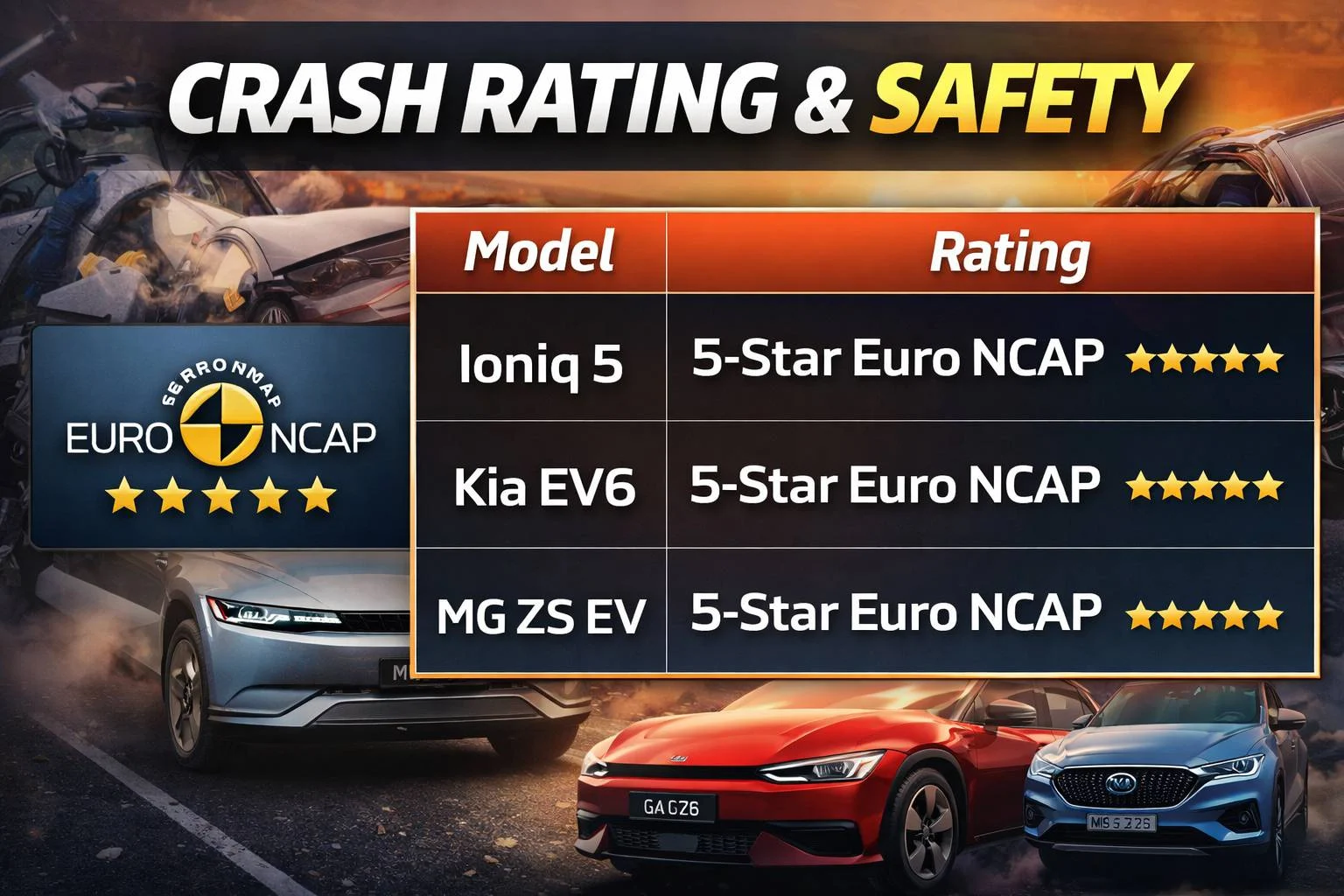
Crash Rating & Safety
| Model | Rating |
|---|---|
| Ioniq 5 | 5-Star Euro NCAP |
| Kia EV6 | 5-Star Euro NCAP |
| MG ZS EV | 5-Star Euro NCAP |
| Nexon EV | 5-Star Global NCAP (platform) |
Charging Infrastructure Reality
India has over 12,000 public charging stations (Ministry of Power, 2025), but reliability varies:
- Strong coverage: Delhi NCR, Mumbai, Bangalore
- Moderate: Punjab, Rajasthan
- Limited: Hill regions and rural highways
Using apps like PlugShare is essential for real-time route planning.
Common Buyer Mistakes (Critical for Decision Making)
- Buying based only on ARAI range: Real highway range is always lower
- Ignoring charging speed: Slow charging adds hours on long trips
- Choosing SUVs over sedans blindly: SUVs are less efficient at high speeds
- Not checking route infrastructure: Charging gaps still exist
- Underestimating time impact: EV trips require planned stops
Which EV Should You Choose?
- Frequent long highway trips: BYD Seal
- Fastest charging experience: Hyundai Ioniq 5
- High-speed driving: Kia EV6
- Budget option: Nexon EV LR
- Balanced usage: MG ZS EV
Conclusion
The best EV for long distance travel in India 2026 is not defined by maximum range, but by efficiency, charging behavior, and real-world usability. Vehicles like BYD Seal, Hyundai Ioniq 5, and Kia EV6 demonstrate that long-distance EV travel is now viable—but still requires informed decision-making.
For buyers, the key is to align vehicle choice with actual travel patterns rather than marketing specifications. The gap between “claimed capability” and “real experience” remains the most important factor in EV ownership today.
Key Takeaways
- Highway range is 20–30% lower than claimed figures
- Charging speed impacts total travel time more than battery size
- Premium EVs significantly reduce travel friction
- Route planning remains essential for long trips
- Sedans are generally more efficient than SUVs for highways
FAQs
Which EV is best for long highway trips in India?
BYD Seal is currently the most efficient and practical option for long-distance travel.
How much extra time does EV travel take?
Typically 20–40% more than petrol vehicles depending on charging stops.
Do EVs lose range at high speed?
Yes, range drops significantly above 90 km/h due to aerodynamic drag.
Is charging infrastructure reliable in India?
Reliable in major corridors but inconsistent in remote regions.
Should I buy an EV for highway use?
Yes, if you choose the right model and plan routes properly.
About the Author
Ankush Kumar is an automotive analyst with over 5 years of experience covering the Indian car market, luxury vehicles, and electric mobility trends. His work focuses on practical comparisons, real-world performance, and ownership insights to help buyers make informed decisions.
He regularly tracks industry updates, manufacturer reports, and road test data from publications like Autocar India, using them to create clear, data-backed analysis that is easy to understand and useful for everyday buyers.
Follow on Facebook:
Ankush Kumar