+91-9646339590



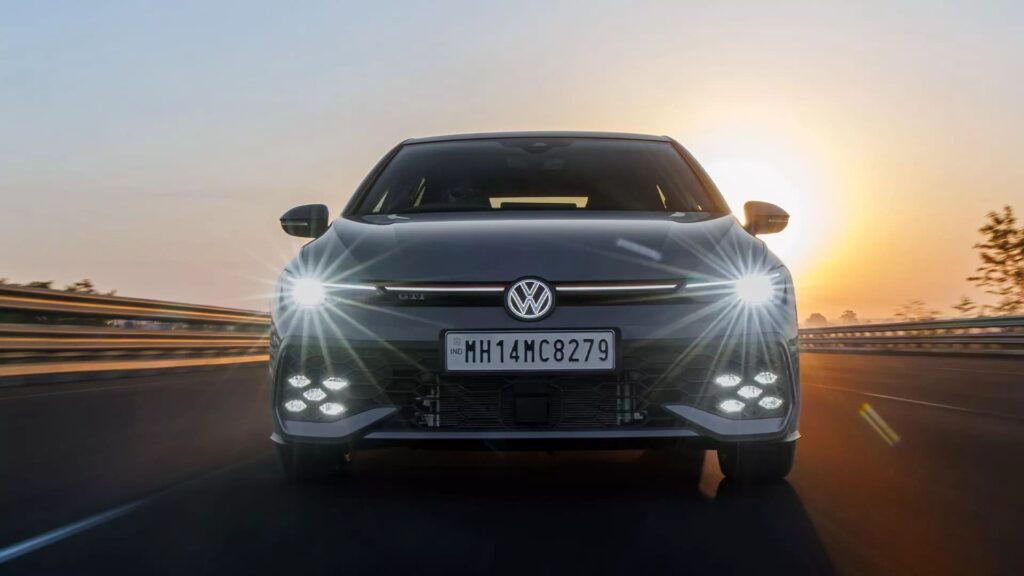
Volkswagen is no longer leading the auto industry—it is trying to catch up.
The Volkswagen new direction is no longer a strategic pivot on paper—it is a high-stakes restructuring of one of the world’s largest automakers under real competitive pressure. The shift reflects a hard reality: Volkswagen is no longer setting the pace in the global auto industry. Instead, it is catching up in areas where competitors like Tesla and BYD have already built structural advantages.
Volkswagen’s new direction refers to its shift toward electric vehicles, software-driven platforms, and a margin-focused business model aimed at competing with Tesla and BYD.
Under CEO Oliver Blume, Volkswagen is transitioning from a scale-driven manufacturing giant into a software-enabled mobility company. But unlike earlier transitions, this one is constrained by legacy complexity, internal cost structures, and execution delays—particularly in software.
Volkswagen’s own strategy documents acknowledge this transformation as a multi-year effort: Volkswagen Group Strategy.
A Strategic Reset Driven by Competitive Pressure
Volkswagen’s traditional strength lay in modular engineering (MQB, MLB platforms) and global scale. That model delivered efficiency in the internal combustion era but is less effective in an EV-dominated landscape where software, battery cost, and vertical integration define competitiveness.
Between 2020 and 2024, Volkswagen’s market share in China—the world’s largest EV market—declined sharply. According to China Association of Automobile Manufacturers (2024), domestic EV brands now command over 60% share, led by BYD.
This has forced Volkswagen to shift from:
- Volume maximization → Margin discipline
- Centralized global platforms → Regional customization
- Mechanical engineering focus → Software-first development
This is not a gradual evolution—it is a forced correction.
The Hard Truth: Volkswagen Still Trails Tesla and BYD
While Volkswagen has committed billions to electrification, it still faces a structural gap compared to EV leaders.
- Tesla: Industry-leading gross margins (~25% in peak years) driven by vertical integration and software monetization
- BYD: Battery cost leadership through in-house Blade battery production
- Volkswagen: EV margins remain several percentage points lower than its ICE vehicles (company disclosures, 2024)
The gap is not just technological—it is economic. Tesla writes its own software stack. BYD builds its own batteries. Volkswagen, historically reliant on suppliers, is still restructuring its ecosystem.
This explains why Volkswagen’s new direction is focused as much on cost structure as it is on product innovation.
CARIAD: From Over-Ambition to Controlled Execution
Volkswagen’s software arm, CARIAD, was originally designed to unify software development across brands. However, delays in execution disrupted key vehicle launches and forced a strategic rethink.
Instead of building everything in-house, Volkswagen is now:
- Partnering with technology firms such as Bosch and Qualcomm
- Reducing internal complexity in software stacks
- Prioritizing scalable, deployable solutions over ambitious timelines
The lesson is clear: automotive software cannot be scaled with traditional engineering processes.
Industry analysis suggests software-defined vehicles could generate up to $650 billion in annual revenue by 2030. Detailed breakdown: McKinsey SDV Report.
Platform Consolidation: The Economics Behind SSP
Volkswagen’s SSP (Scalable Systems Platform) is the backbone of its future lineup. It replaces multiple architectures (MEB, PPE, MQB derivatives) with a single unified system.
This is not just an engineering decision—it is a cost strategy.
- Reduced manufacturing complexity
- Shared software architecture across brands
- Faster development cycles
Combined with its PowerCo battery division, Volkswagen aims to reduce battery costs by up to 50% before 2030—critical to closing the gap with BYD.
China: The Decisive Battleground
Volkswagen’s future relevance depends heavily on its recovery in China.
Local competitors offer:
- Faster infotainment innovation cycles
- Highly localized user interfaces
- Aggressive pricing enabled by domestic supply chains
Volkswagen’s response includes a €2.4 billion investment in Horizon Robotics and the development of China-specific EV platforms.
This marks a fundamental shift: Volkswagen is no longer exporting global products—it is building region-specific ecosystems.
India Strategy: Engineering Identity Over Feature Wars
In India, Volkswagen has chosen a different path. Instead of competing on feature density, it is positioning itself around structural safety, driving dynamics, and build quality.
The MQB-A0-IN platform enables cost localization while preserving core engineering characteristics.
On-Road Price (India, 2026 Estimated)
- Volkswagen Virtus: ₹13.5 lakh – ₹21.5 lakh
- Volkswagen Taigun: ₹14 lakh – ₹22.5 lakh
Variant Comparison (Volkswagen Virtus)
- Comfortline: Functional baseline with essential safety
- Highline: Balanced feature set with infotainment upgrades
- GT Plus: 1.5L TSI EVO (150 PS), DSG gearbox, Active Cylinder Technology
Crash Safety: Structural Strength as Core Strategy
Volkswagen’s India lineup reinforces its safety-first positioning:
- Virtus: 5-star Global NCAP rating
- Taigun: 5-star Global NCAP rating
Unlike some competitors, safety engineering is consistent across variants, not limited to top trims. Official results: Global NCAP.
Real Road Tests: Where Volkswagen Still Leads
Despite strategic upheaval, Volkswagen’s core engineering strengths remain intact—and are evident in real-world testing.
- 0–100 km/h: ~8.7–9.0 seconds
- Braking (100–0 km/h): ~38 meters
- Fuel efficiency: 17–19 km/l
Deeper driving analysis:
- Steering: Linear response with strong on-center stability; maintains composure beyond 120 km/h
- High-speed dynamics: Minimal body roll during lane changes; predictable weight transfer
- Suspension tuning: Firm bias improves highway confidence but transmits sharp urban undulations
- Brake feel: Progressive pedal modulation with consistent bite under repeated hard stops
- DSG behavior: Quick shifts under load; occasional hesitation in stop-go traffic
This highlights Volkswagen’s continued differentiation: it builds cars for drivers, not just spec sheets.
Feature and Technical Comparison
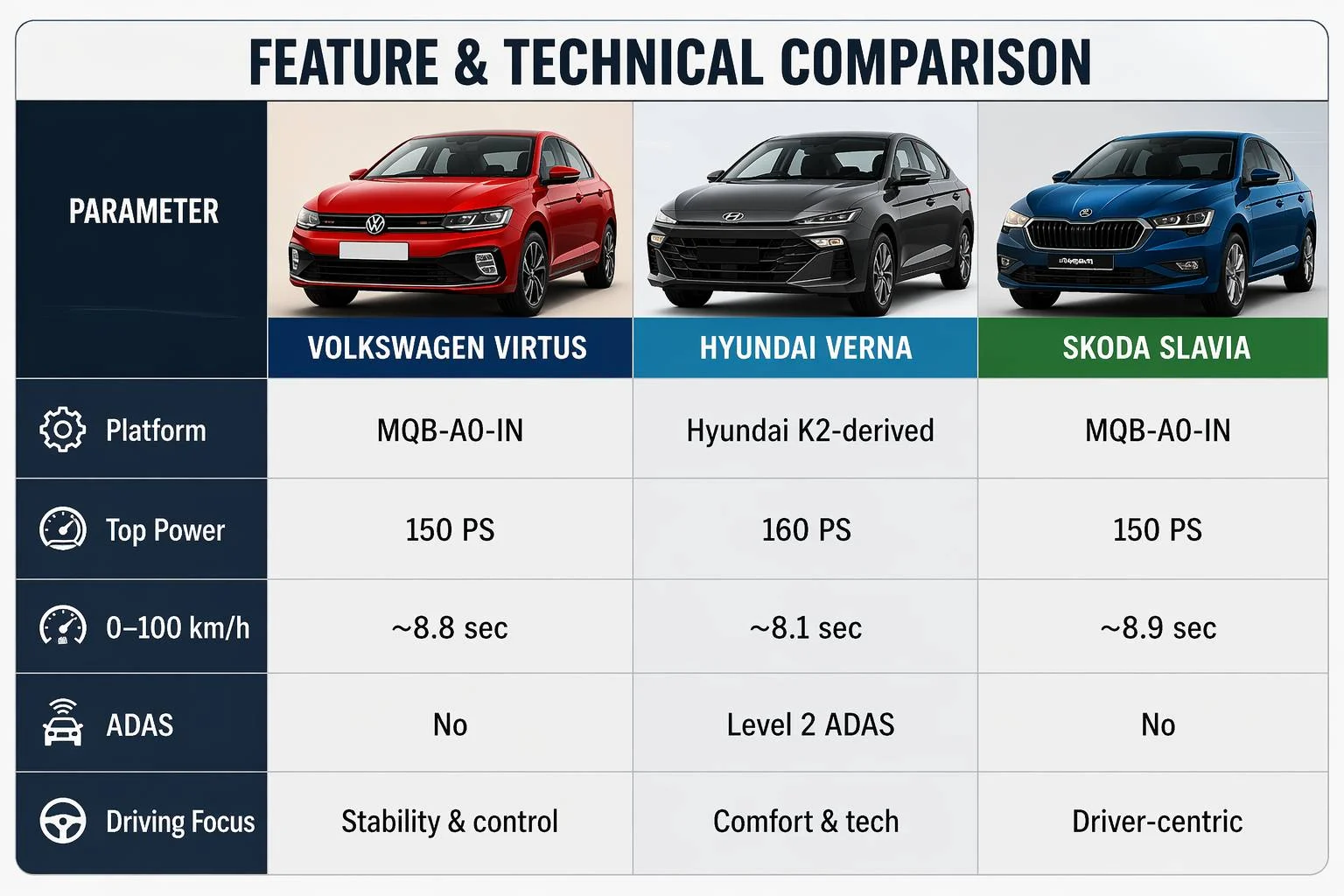
| Parameter | Volkswagen Virtus | Hyundai Verna | Skoda Slavia |
|---|---|---|---|
| Platform | MQB-A0-IN | Hyundai K2-derived | MQB-A0-IN |
| Top Power | 150 PS | 160 PS | 150 PS |
| 0–100 km/h | ~8.8 sec | ~8.1 sec | ~8.9 sec |
| ADAS | No | Level 2 ADAS | No |
| Driving Focus | Stability & control | Comfort & tech | Driver-centric |
Execution Risks: The Real Challenge Ahead
Volkswagen’s strategy is directionally sound—but execution remains uncertain.
- Software delays: CARIAD timelines still under scrutiny
- EV profitability gap: Margins lag behind Tesla and BYD
- Organizational complexity: Multi-brand structure slows decision-making
Internal restructuring, including cost cuts and platform consolidation, will determine whether the strategy delivers results.
Conclusion
The Volkswagen new direction is not a confident leap forward—it is a necessary correction in response to structural disruption in the automotive industry.
Volkswagen is attempting something few legacy automakers have achieved: transforming a century-old industrial system into a software-driven mobility business while remaining profitable. The ambition is credible. The execution, however, remains the defining variable.
If Volkswagen succeeds in aligning its software capabilities with its engineering strengths and reduces its cost disadvantages, it can remain globally competitive. If not, it risks becoming a fast follower in an industry it once dominated.
Key Takeaways
- Volkswagen is shifting from volume-driven growth to margin-focused strategy
- Software and EV platforms are central to its transformation
- It currently trails Tesla and BYD in cost and software integration
- India strategy focuses on safety and driving dynamics
- Execution—especially in software—will determine long-term success
Frequently Asked Questions (FAQ)
What is Volkswagen’s new direction?
It refers to Volkswagen’s shift toward software-defined vehicles, electrification, and a more profit-focused global operating model.
Is Volkswagen behind Tesla and BYD?
Yes, particularly in software integration and EV cost efficiency, though it is investing heavily to close the gap.
Are Volkswagen cars still good to drive?
Yes, driving dynamics remain a strong point, especially in turbocharged models like the Virtus GT.
Why is Volkswagen focusing on software?
Software enables new revenue streams, over-the-air updates, and better user experience—critical in modern vehicles.
How safe are Volkswagen cars in India?
Recent models have achieved 5-star Global NCAP ratings, indicating strong crash protection.
Will Volkswagen fully transition to electric vehicles?
Volkswagen aims for significant EV adoption by 2030, but will continue selling combustion-engine vehicles during the transition.
Ankush Kumar is an automotive analyst specializing in electric vehicles, luxury cars, and real-world performance benchmarking. His work focuses on ownership insights, charging behavior analysis, and practical usability to help buyers make informed decisions based on real conditions rather than specifications alone.
He tracks industry data from global agencies, manufacturer reports, and road test benchmarks to deliver high-authority automotive analysis tailored for Indian buyers.
Follow on Facebook: Ankush Kumar