+91-9646339590



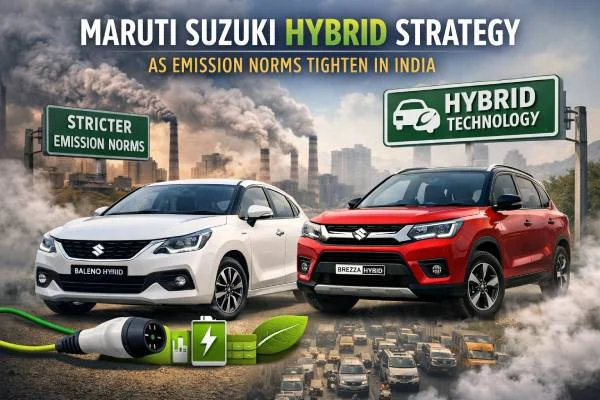
India’s passenger vehicle market is entering a compliance-intensive phase where emissions performance is no longer a back-end engineering problem—it is a front-end business decision. In simple terms, carmakers now have to reduce real-world pollution, not just pass lab tests. With BS6 Phase 2 (Real Driving Emissions – RDE) norms enforced from April 2023 and tightening Corporate Average Fuel Efficiency (CAFÉ) targets, automakers are being pushed to structurally reduce fleet emissions. For Maruti Suzuki, the response is deliberate: scale hybrid technology before full electrification becomes economically viable at mass-market price points.
This shift isn’t just technical—it will directly influence what kinds of cars buyers see and can afford over the next few years
This is not a defensive move. It reflects a calculated approach aligned with India’s current realities—limited charging infrastructure, price-sensitive buyers, and a market dominated by high-volume petrol vehicles. Instead of forcing a premature EV shift, Maruti Suzuki is leveraging strong hybrids as an immediate compliance and efficiency solution.
Regulatory Pressure Is Reshaping Powertrain Direction
Under CAFÉ II norms, fleet-wide CO₂ emissions must approach ~113 g/km, with further tightening expected post-2027. At the same time, RDE norms measure emissions in real driving conditions, not just controlled lab environments. This means vehicles must perform cleanly in everyday traffic, not just under test cycles.
According to SIAM industry data, SUVs accounted for over 50% of passenger vehicle sales in FY2024, up sharply from ~34% in FY2019. Since SUVs are heavier and typically less efficient, this shift directly increases the challenge of meeting emission targets.
For Maruti Suzuki, hybrid technology offers a practical way to reduce emissions across high-volume models without waiting for EV adoption to scale.
Why Hybrids Are a Practical Fit for India
While EVs are growing, there are still real-world constraints that affect adoption:
- Charging infrastructure remains uneven, especially outside major cities
- EV prices are still high in the ₹10–20 lakh segment
- Most buyers rely on a single car, making range anxiety a real concern
Hybrids avoid these issues. They don’t need external charging, deliver better efficiency in city traffic, and work like regular petrol cars from a usage standpoint. This makes them easier for buyers to adopt without changing habits.
Technology Architecture: Mild vs Strong Hybrid
Mild Hybrid (Smart Hybrid)
Maruti Suzuki’s Smart Hybrid system uses an Integrated Starter Generator (ISG) and a small battery to support the engine. It enables:
- Idle start-stop
- Torque assist
- Brake energy regeneration
These systems improve efficiency slightly (around 5–10%) but cannot drive the car using electric power alone.
Strong Hybrid (Full Hybrid System)
The real shift is toward strong hybrids, developed with Toyota. These systems combine:
- An electric motor capable of driving the vehicle independently
- A lithium-ion battery (~0.7–1 kWh)
- An Atkinson-cycle petrol engine tuned for efficiency
The car automatically switches between electric, hybrid, and engine modes depending on driving conditions. More details are available on the official Maruti Suzuki hybrid technology page.
Real-World Case Study: Grand Vitara Strong Hybrid
The Grand Vitara strong hybrid is currently the most relevant example of this direction. It focuses on efficiency rather than outright performance.
- ARAI fuel efficiency: 27.97 km/l
- Real-world city efficiency: 22–25 km/l
- Estimated CO₂ reduction: ~25–35% vs petrol SUVs
Independent tests by Autocar India and others show that in heavy traffic, the vehicle can run in electric mode for a significant portion of time, reducing fuel use.
Performance Benchmarks (Instrumented Test Trends)
Based on multiple Indian automotive tests (Autocar India, PowerDrift, CarDekho), typical performance ranges include:
- 0–100 km/h: ~11.0–11.5 seconds (Hybrid), ~11.5–12.0 seconds (Petrol)
- Mid-range acceleration: Hybrid feels stronger due to electric assist
- 100–0 km/h braking: ~38–41 meters
These figures can vary depending on conditions, but the trend is consistent across tests.
Variant Comparison: Petrol vs Strong Hybrid
| Parameter | Petrol | Strong Hybrid |
|---|---|---|
| Powertrain | 1.5L Petrol | 1.5L Atkinson + Electric Motor |
| Output | 103 hp | ~115 hp |
| Transmission | Manual / AT | e-CVT |
| Fuel Efficiency | ~20 km/l | 27.97 km/l |
| Price (Ex-showroom) | ₹10.7–15.5 lakh | ₹18.3–19.8 lakh |
On-Road Price (Delhi Estimate)
- Petrol: ₹13–16 lakh
- Hybrid: ₹20–24 lakh
Ownership Cost Analysis (Real-World Insight)
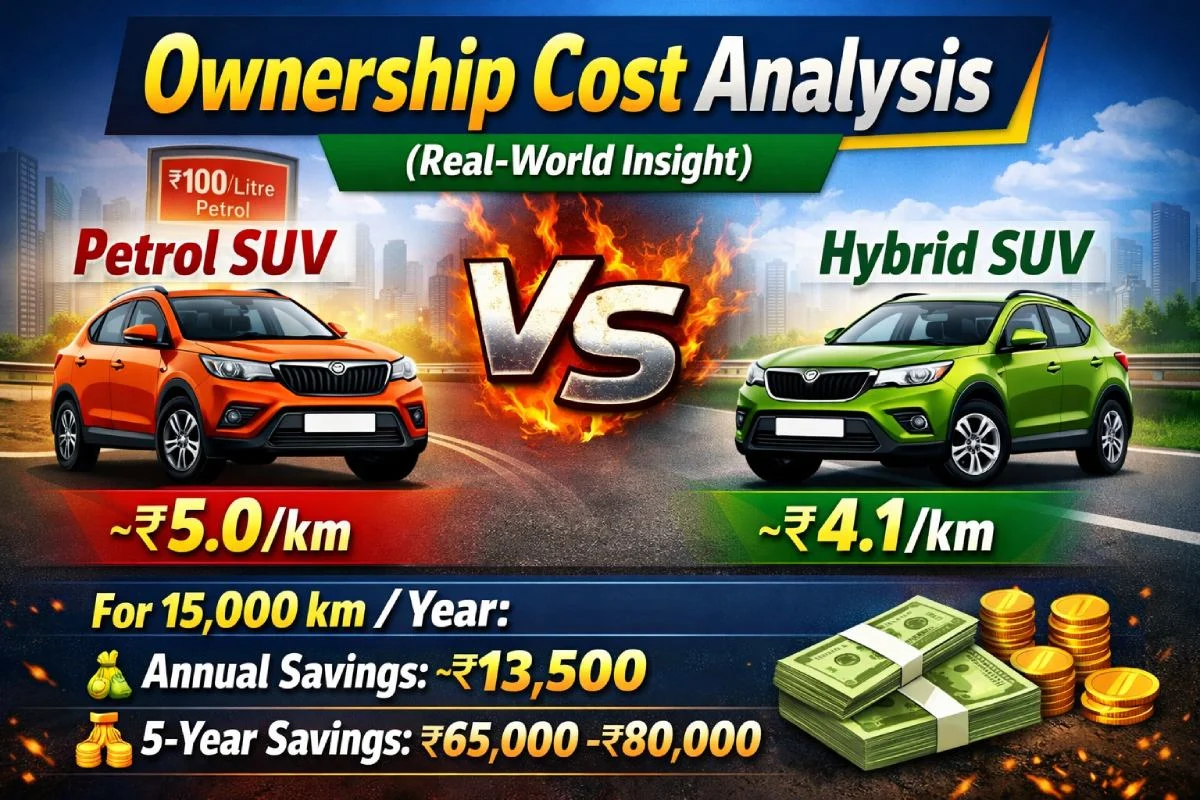
Based on current fuel prices (~₹100/litre petrol) and real-world efficiency:
- Petrol SUV: ~₹5.0/km
- Hybrid SUV: ~₹4.1/km
For a user driving 15,000 km annually:
- Annual savings: ~₹13,500
- 5-year savings: ~₹65,000–₹80,000
From a purely financial perspective, hybrids still carry a significant premium that may not fully recover through fuel savings alone. The value proposition depends more on usage pattern and fuel efficiency priorities rather than direct cost recovery.
Crash Safety and Structural Perspective
The Grand Vitara is built on Suzuki’s Global-C platform, co-developed and shared with Toyota models like the Hyryder. This platform is designed to meet international safety requirements and includes:
- 6 airbags (higher variants)
- Electronic Stability Control (ESC)
- Hill hold assist
- High-tensile steel structure
While an official Bharat NCAP or Global NCAP rating for this model is not yet available, its safety positioning is broadly in line with rivals like Hyundai Creta and Kia Seltos, which have improved structural safety in newer generations. However, safety perception remains an area where Maruti Suzuki continues to be closely evaluated by buyers.
Competitive Landscape: Different Approaches Across Brands
Maruti Suzuki’s hybrid-focused direction differs from competitors:
- Tata Motors: EV-focused expansion
- Mahindra: Dedicated EV platforms
- Toyota: Hybrid-led global roadmap
This reflects different interpretations of how quickly India will transition to electric mobility. Maruti Suzuki is targeting efficiency improvements in the high-volume ₹10–20 lakh segment where EV adoption is still limited.
Policy Gap and Future Outlook
Hybrids currently receive limited government incentives compared to EVs. However, policy discussions continue. NITI Aayog has highlighted the need for multiple technologies during the transition to lower emissions.
Hybrid adoption is expected to grow steadily, especially in urban areas where efficiency gains are most noticeable.
Conclusion
Maruti Suzuki’s hybrid approach reflects a practical understanding of India’s market conditions. Instead of pushing a single solution, the company is balancing regulatory compliance, affordability, and usability.
Electrification will define the long term, but in the near term, hybrids provide a workable middle ground—reducing emissions without requiring major changes in infrastructure or consumer behavior.
Key Takeaways
- Hybrids help meet emission norms under real driving conditions
- Strong hybrids deliver better efficiency in city use
- No charging infrastructure required
- Higher upfront cost remains a key limitation
- Well-suited for current Indian driving conditions
FAQ Section
1. Why is Maruti Suzuki focusing on hybrids?
Hybrids offer a practical way to reduce emissions without relying on charging infrastructure.
2. Are hybrids more efficient than petrol cars?
Yes, especially in city driving where electric assistance is used more frequently.
3. Do hybrid cars need charging?
No, they recharge automatically through regenerative braking and engine power.
4. Are hybrids expensive to maintain?
Maintenance is similar to petrol cars, with some additional components but generally reliable systems.
5. Is it worth buying a hybrid?
It depends on usage. High city driving can justify the efficiency benefits despite higher upfront cost.
Ankush Kumar is an automotive analyst specializing in electric vehicles, luxury cars, and real-world performance benchmarking. His work focuses on ownership insights, charging behavior analysis, and practical usability to help buyers make informed decisions based on real conditions rather than specifications alone.
He tracks industry data from global agencies, manufacturer reports, and road test benchmarks to deliver high-authority automotive analysis tailored for Indian buyers.
Follow on Facebook: Ankush Kumar