+91-9646339590



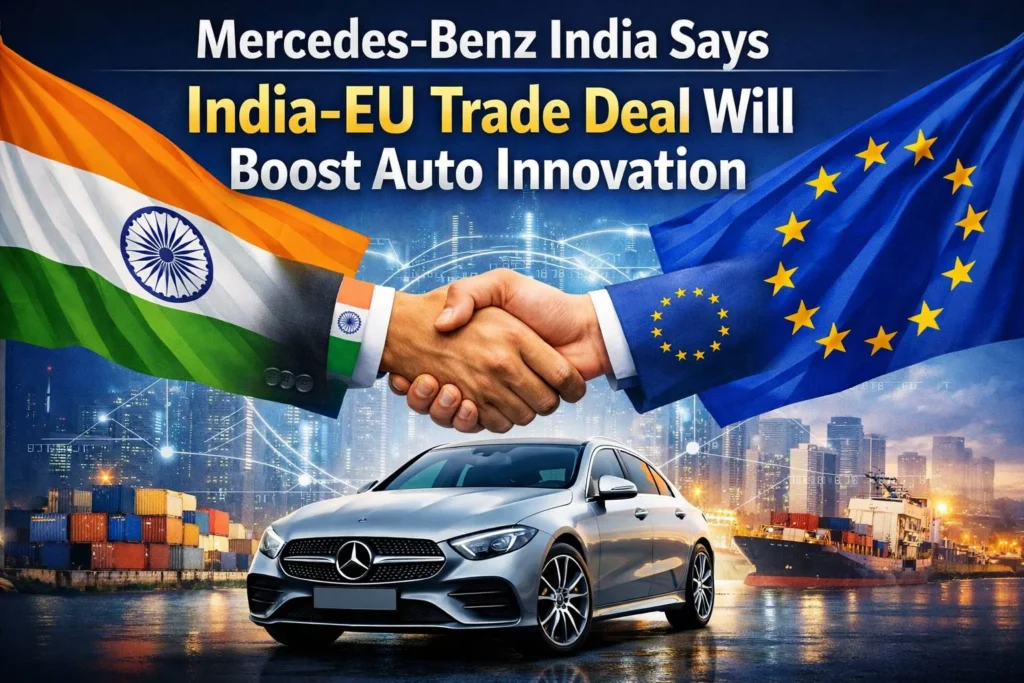
The proposed India–EU Free Trade Agreement (FTA) is emerging as more than a tariff negotiation—it could become a structural catalyst for India’s premium automotive evolution. For Mercedes-Benz India, the opportunity extends beyond cost rationalisation to faster access to global technologies, deeper localisation of electric vehicles (EVs), and tighter integration with Europe’s advanced automotive ecosystem.
Industry assessments and ongoing trade discussions indicate that tariff rationalisation could significantly accelerate the adoption of EV architectures, software-defined vehicle platforms, and high-value components in India. The real shift is not just about pricing—it is about compressing India’s automotive technology adoption cycle.
India is now the world’s third-largest passenger vehicle market, while the European Union remains a global leader in electrification, regulatory systems, and automotive R&D. This scale–technology combination creates a powerful foundation for long-term industry transformation.
Why the India–EU Trade Deal Matters for Automakers
India currently imposes import duties of up to 100% on fully built premium vehicles, significantly impacting affordability and limiting access to cutting-edge technologies. Although automakers such as Mercedes-Benz have expanded CKD (completely knocked down) operations, critical EV components, semiconductors, and software systems remain heavily import-dependent.
The proposed agreement focuses on three key structural changes:
- Gradual reduction of tariffs on premium vehicles and advanced components
- Alignment of safety, emission, and software standards
- Incentives for joint R&D and technology transfer
According to the European Commission, India is a strategic partner in sectors like clean mobility and advanced manufacturing. Read more.
Impact insight: Lower duties on battery cells, power electronics, and chipsets could materially improve localisation economics, enabling automakers to reduce costs while maintaining global specifications.
Mercedes-Benz India: From Assembly Base to Technology Hub
Mercedes-Benz India’s Chakan facility in Pune produces key models including the C-Class, E-Class Long Wheelbase, GLC, and the EQS electric sedan. The company has also reported record sales momentum in recent years, reflecting rising demand in India’s premium segment.
The locally assembled EQS 580 4MATIC represents a turning point. It integrates advanced battery architecture, high-performance electronics, and next-generation software systems—highlighting India’s transition from a consumption market to a technology integration hub.
With tariff reductions, this shift could accelerate further. Access to critical EV components at lower cost would enable higher localisation without compromising on technology depth.
Importantly, competitors such as BMW India, Audi India, and Volvo Car India—all of whom rely on CKD operations—are likely to benefit similarly, making this a sector-wide inflection point.
Electric Vehicles: A Structural Growth Lever
The European Union is one of the most advanced EV markets globally, with electric vehicles accounting for over 20% of new car registrations in 2023, according to ACEA. View data.
India, by comparison, remains at an early stage, with EV penetration below 3% in passenger vehicles. However, government initiatives such as FAME II and the PLI scheme are steadily building momentum.
Stronger India–EU cooperation could enable:
- Joint development of advanced battery technologies
- Scalable battery recycling ecosystems
- Standardised fast-charging infrastructure
- Diversified EV supply chains
Key insight: This collaboration could narrow the cost gap between EVs and ICE vehicles in the premium segment—currently one of the biggest adoption barriers.
Regulatory Alignment: The Hidden Accelerator
Regulatory complexity remains a major barrier to innovation. Europe operates under highly mature frameworks for safety, emissions, and software validation, while India follows its own certification systems.
FTA-driven alignment could significantly reduce duplication and shorten development cycles, enabling faster rollout of:
- Advanced Driver Assistance Systems (ADAS)
- Over-the-air (OTA) updates
- Enhanced safety technologies
Practical impact: Indian consumers could gain access to global automotive innovations much earlier than current timelines allow.
Software-Defined Vehicles and Data Policy Alignment
Modern premium vehicles are increasingly software-defined, with features evolving through continuous updates rather than hardware upgrades.
However, differences between Europe’s strict data protection laws and India’s evolving digital regulations create compliance challenges.
Greater alignment could unlock smoother deployment of:
- Connected car ecosystems
- AI-powered infotainment systems
- Predictive maintenance and remote diagnostics
Strategic view: Data policy alignment will be as critical as tariff reduction in shaping the future competitiveness of automakers.
Supply Chain Strength and Semiconductor Collaboration
Recent semiconductor shortages exposed vulnerabilities in global automotive supply chains, particularly for premium vehicles reliant on electronics.
India and the EU are investing in semiconductor manufacturing and supply resilience. Deeper collaboration could:
- Improve chip availability for automotive applications
- Reduce dependence on single-region suppliers
- Strengthen long-term production stability
Key takeaway: Supply chain security is now as important as cost efficiency in premium automotive manufacturing.
Challenges That Could Limit Immediate Impact
Despite strong potential, several structural challenges remain:
- Balancing tariff reductions with domestic industry protection
- Limited EV charging infrastructure
- Currency fluctuations impacting import costs
- Execution complexity in long-term policy alignment
Reality check: Even with tariff reductions, affordability and infrastructure constraints mean the impact will be gradual rather than immediate.
Conclusion: A Strategic Inflection Point
The India–EU Free Trade Agreement has the potential to redefine India’s automotive trajectory. For Mercedes-Benz India and its peers, it represents a shift from cost optimisation to deep technological integration and faster innovation cycles.
If executed effectively, the agreement could position India not just as a large car market, but as a globally relevant hub for next-generation mobility, spanning EVs, software-defined vehicles, and advanced manufacturing.
Final insight: The real opportunity is not cheaper cars—it is faster convergence with global automotive innovation.
Key Data Snapshot
| Metric | India | European Union |
|---|---|---|
| Passenger Vehicle Market Rank | 3rd Largest | Among Global Leaders |
| EV Penetration (Passenger Vehicles) | <3% | >20% |
| Import Duties (Premium Cars) | Up to 100% | Low / Standardised |
| Technology Leadership | Emerging | Advanced |
Key Takeaways
- The India–EU FTA could reduce tariffs and improve access to advanced automotive technologies
- EV collaboration and localisation will drive long-term growth
- Regulatory alignment can significantly accelerate innovation cycles
- Software and data policies are becoming critical competitive factors
- Infrastructure and policy execution remain key constraints
Frequently Asked Questions
1. How will the India–EU trade deal impact car prices?
Tariff reductions on vehicles and components could improve cost efficiency, potentially lowering prices in the premium segment over time.
2. Will EV adoption increase due to this agreement?
Yes, improved access to technology and supply chains is expected to accelerate EV adoption, especially in higher segments.
3. What role does Mercedes-Benz India play?
It is expanding local manufacturing and EV integration, including models like the EQS, positioning India as a key market in its global strategy.
4. What are the biggest challenges?
Infrastructure gaps, regulatory complexity, and supply chain risks remain key concerns.
5. Can India become a global automotive hub?
Yes, with consistent policy execution, infrastructure development, and sustained investment in advanced technologies.
Ankush Kumar is an automotive analyst specializing in electric vehicles, luxury cars, and real-world performance benchmarking. His work focuses on ownership insights, charging behavior analysis, and practical usability to help buyers make informed decisions based on real conditions rather than specifications alone.
He tracks industry data from global agencies, manufacturer reports, and road test benchmarks to deliver high-authority automotive analysis tailored for Indian buyers.
Follow on Facebook: Ankush Kumar