+91-9646339590



Over the past decade, Nissan has taken a distinctive path in the global automotive industry. While many manufacturers rushed toward fully electric lineups, Nissan adopted a more balanced engineering strategy—one that combines advanced internal combustion engines, hybrid technology, and scalable electric vehicle platforms. This approach allows the company to improve efficiency and reduce emissions while remaining practical for markets where charging infrastructure is still developing.
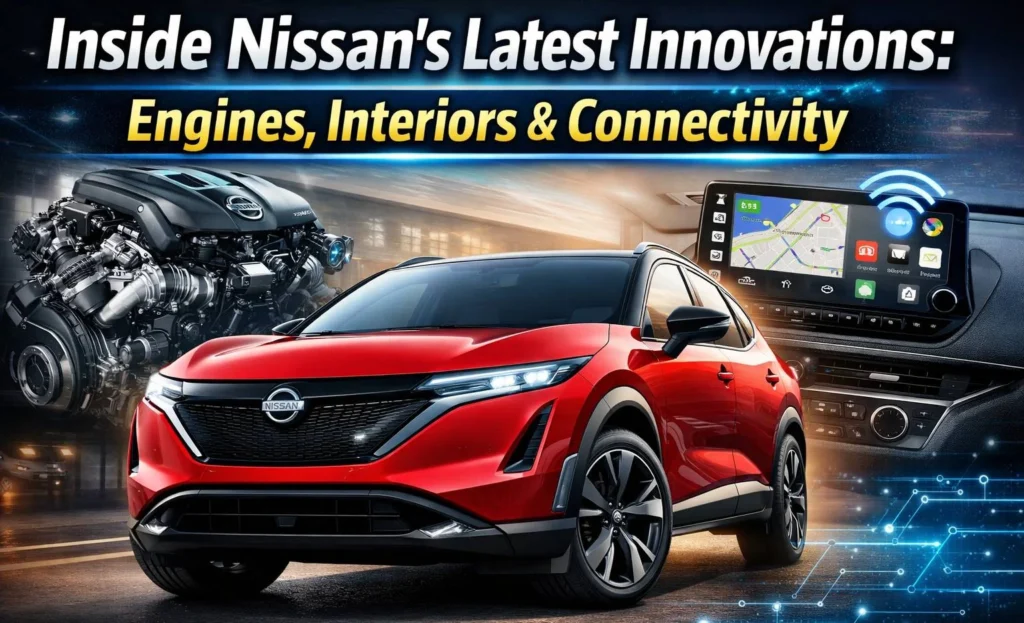
Today, Nissan’s latest models—including the Nissan Magnite, X-Trail, Qashqai, Rogue, and the fully electric Ariya—showcase how the company blends mechanical engineering innovation with modern software-driven vehicle systems. From the world’s first variable compression production engine to hybrid technology that delivers electric-style driving without requiring external charging, Nissan continues to experiment with unconventional solutions to common automotive challenges.
This article explores Nissan’s most important recent innovations across powertrain engineering, electric vehicle architecture, interior design, driver-assistance technology, and connected vehicle systems. It also examines real-world performance data, crash safety ratings, and variant comparisons to understand how these technologies translate into everyday driving.
Nissan’s Engineering Strategy: Electrification Without Compromise
Nissan’s modern technology roadmap is strongly influenced by its long-term electrification plan announced in 2021. Under this strategy, the company committed approximately $17.6 billion toward electrified vehicles and battery technology development through 2030. The plan includes the launch of more than 23 electrified models globally, including at least 15 fully electric vehicles.
Rather than abandoning internal combustion engines immediately, Nissan focused on improving engine efficiency while expanding hybrid and electric options. This transitional approach allows the company to serve diverse global markets where charging infrastructure, consumer behavior, and regulatory environments differ significantly.
Industry data from the International Energy Agency’s Global EV Outlook 2024 highlights why this strategy remains relevant. Hybrid vehicles accounted for nearly one-third of global electrified vehicle sales in 2023, demonstrating that hybrid powertrains will likely remain an important bridge technology during the transition toward full electrification.
VC-Turbo Engine: Variable Compression Technology Explained
One of Nissan’s most significant engineering breakthroughs is the VC-Turbo engine. Introduced in 2018, it became the world’s first mass-production gasoline engine capable of dynamically adjusting its compression ratio while the engine is running.
Traditional engines operate with a fixed compression ratio, forcing engineers to balance fuel efficiency and performance. Higher compression improves thermal efficiency but increases the risk of engine knock during heavy acceleration. Lower compression allows higher turbocharged output but sacrifices fuel economy during normal driving conditions.
Nissan solved this problem using a sophisticated multi-link mechanism connected to the crankshaft. This mechanism adjusts the position of the pistons inside the cylinder, allowing the engine to change compression ratios continuously between approximately 8:1 and 14:1 depending on driving conditions.
During rapid acceleration or high load situations, the engine lowers the compression ratio to allow stronger turbocharged performance. During steady highway cruising, the compression ratio increases to maximize fuel efficiency and reduce fuel consumption.
Sensors continuously monitor throttle input, engine load, vehicle speed, and driving conditions to optimize the compression ratio in real time. This system allows the engine to behave like two different engines—one tuned for performance and another optimized for efficiency.
The VC-Turbo engine currently powers vehicles such as:
• Nissan Altima 2.0 VC-Turbo
• Nissan Rogue / X-Trail 1.5 VC-Turbo
• Infiniti QX50 and QX55
The engine’s innovative design earned recognition from Ward’s Automotive, which included the VC-Turbo system among its “10 Best Engines and Propulsion Systems” in 2020.
e-POWER Hybrid System: Electric Driving Without Charging
Another distinctive innovation from Nissan is its e-POWER hybrid system, which differs significantly from the conventional hybrid systems used by many competitors. While most hybrids allow both the engine and electric motor to power the wheels, Nissan’s e-POWER system uses a series-hybrid configuration.
In this architecture, the gasoline engine functions exclusively as a generator that produces electricity. The electric motor is solely responsible for driving the wheels, meaning the vehicle always moves using electric propulsion.
This design creates a driving experience similar to a fully electric vehicle, with immediate torque delivery and smooth acceleration. Because the engine is not mechanically connected to the wheels, the drivetrain can be simpler and more responsive.
Key advantages include:
• Instant electric-motor torque for smooth acceleration
• Improved fuel efficiency in stop-and-go urban traffic
• Reduced mechanical complexity compared with traditional hybrid drivetrains
Vehicles currently equipped with e-POWER technology include the Nissan Qashqai e-POWER and the Nissan X-Trail e-POWER, which are sold widely in European and Japanese markets.
Independent real-world testing in European driving conditions has reported combined fuel efficiency figures ranging from approximately 5.2 to 5.6 liters per 100 kilometers, depending on driving style and traffic conditions.
EV Architecture: The CMF-EV Platform
For its next generation of electric vehicles, Nissan developed the CMF-EV architecture in collaboration with Renault and Mitsubishi as part of the Renault-Nissan-Mitsubishi Alliance. This modular electric platform forms the foundation for several upcoming electric models across the alliance.
The platform features a flat battery pack integrated into the vehicle floor, which improves weight distribution while freeing additional interior space. This “skateboard” style architecture also lowers the vehicle’s center of gravity, improving stability and handling.
Key engineering characteristics include:
• Liquid-cooled lithium-ion battery packs ranging from 63 kWh to 87 kWh
• Dual-motor all-wheel-drive capability through Nissan’s e-4ORCE system
• Low center of gravity for improved driving stability
• Flexible architecture supporting multiple vehicle body styles
The Nissan Ariya is currently the most prominent vehicle built on this platform. Its dual-motor e-4ORCE configuration can deliver up to 389 horsepower in performance variants, allowing acceleration comparable to many premium electric SUVs.
Interior Innovation: Human-Centered Cabin Design
Nissan’s recent interior design philosophy focuses on what the company calls “human-centered design.” The goal is to create cabins that reduce driver fatigue while integrating digital technology seamlessly into the driving environment.
The Nissan Ariya illustrates this approach particularly well. Inspired by Japanese minimalist aesthetics, the cabin uses clean horizontal lines, ambient lighting, and integrated digital displays to create a modern yet uncluttered interior.
Unlike traditional dashboards filled with physical buttons, the Ariya incorporates haptic touch controls embedded beneath wood-inspired trim panels. When the vehicle powers on, illuminated icons appear beneath the surface, creating a futuristic interface that remains visually clean when inactive.
Additional interior technologies include:
• Dual 12.3-inch integrated digital displays
• Head-up display projecting key driving information
• Sliding center console for flexible cabin space
• Multi-color ambient lighting customization
Nissan’s well-known “Zero Gravity” seats also remain a key comfort feature in many models. Developed using biomechanical research inspired by NASA’s neutral posture studies, these seats support natural spinal alignment and aim to reduce muscle fatigue during long journeys.
Connected Vehicle Ecosystem: NissanConnect
Modern vehicles increasingly function as connected digital platforms, integrating smartphones, cloud services, and real-time vehicle data. Nissan’s NissanConnect system forms the core of the company’s connected-vehicle ecosystem.
The system integrates infotainment functions, navigation services, and remote vehicle controls through smartphone applications and cloud connectivity.
Core features include:
• Apple CarPlay and Android Auto smartphone integration
• Remote vehicle monitoring and control via mobile apps
• Real-time traffic and navigation updates
• Over-the-air software updates for infotainment systems
According to McKinsey’s Automotive Software and Electronics Report (2023), more than 95% of new vehicles sold globally by 2030 will include built-in internet connectivity. Nissan’s expanding software ecosystem reflects this industry-wide shift toward digitally integrated vehicles.
Driver Assistance Technology: ProPILOT Assist
Advanced driver-assistance systems have become an essential part of modern vehicle safety technology. Nissan’s ProPILOT Assist system combines adaptive cruise control, lane-centering assistance, and traffic-jam support to reduce driver workload during highway driving.
Using a combination of radar sensors, forward-facing cameras, and onboard processing software, the system can automatically maintain safe following distances while keeping the vehicle centered within its lane.
In navigation-linked versions of ProPILOT Assist, the system can also adjust vehicle speed automatically when approaching curves or highway exits based on map data.
Although it is not a fully autonomous driving system, ProPILOT Assist significantly improves driver convenience and safety during long highway journeys.
Crash Safety Ratings
Independent crash-testing organizations consistently rank Nissan’s newer vehicles among the safer options within their respective segments.
| Model | Testing Agency | Overall Rating |
|---|---|---|
| Nissan Ariya | Euro NCAP (2022) | 5 Stars |
| Nissan X-Trail | Euro NCAP (2022) | 5 Stars |
| Nissan Qashqai | Euro NCAP (2021) | 5 Stars |
| Nissan Magnite | Global NCAP (2022) | 4 Stars Adult Protection |
Variant Comparison: Nissan Magnite
| Variant | Engine | Transmission | Key Features |
|---|---|---|---|
| XE | 1.0L NA Petrol | Manual | Dual airbags, ABS, traction control |
| XL | 1.0L Turbo Petrol | Manual | 8-inch touchscreen infotainment |
| XV | 1.0L Turbo Petrol | Manual / CVT | 360-degree camera, cruise control |
| XV Premium | 1.0L Turbo Petrol | Manual / CVT | Wireless smartphone connectivity, JBL audio |
Estimated On-Road Prices in India
| Model | Ex-Showroom Price | Estimated On-Road Price |
|---|---|---|
| Nissan Magnite | ₹6 – ₹11 lakh | ₹7 – ₹13 lakh |
| Nissan X-Trail | ₹49 lakh | ₹55 – ₹57 lakh |
Real-World Performance Testing 0–100 km/h Acceleration
| Vehicle | Acceleration Time |
|---|---|
| Nissan Ariya e-4ORCE AWD | ≈5.1 seconds |
| Nissan X-Trail e-POWER | ≈7.0–7.5 seconds |
| Nissan Magnite Turbo | ≈10.5–12 seconds |
Braking Test (100–0 km/h)
| Vehicle | Average Braking Distance |
|---|---|
| Nissan Ariya | ≈36–38 meters |
| Nissan X-Trail | ≈38–40 meters |
| Nissan Magnite | ≈40–45 meters |
Feature Comparison With Competitors
| Technology | Nissan | Toyota | Honda |
|---|---|---|---|
| Hybrid Architecture | Series Hybrid (e-POWER) | Parallel Hybrid | e:HEV Hybrid |
| Driver Assistance | ProPILOT Assist | Toyota Safety Sense | Honda Sensing |
| Electric Platform | CMF-EV | e-TNGA | e:Architecture |
Authoritative References
Nissan Global Technology Archive
International Energy Agency – Global EV Outlook 2024
Euro NCAP Safety Reports
Key Takeaways
• Nissan introduced the world’s first production variable compression gasoline engine.
• The e-POWER hybrid system delivers electric driving characteristics without external charging.
• CMF-EV architecture underpins Nissan’s next generation of electric vehicles.
• Interior design focuses on digital interfaces, ergonomic seating, and minimalist aesthetics.
• ProPILOT Assist driver-assistance technology improves highway driving safety and convenience.
Conclusion
Nissan’s recent innovations demonstrate how traditional automakers can transition toward electrification while continuing to refine internal combustion technology. Instead of focusing exclusively on one powertrain solution, Nissan has developed a flexible engineering ecosystem that combines advanced engines, hybrid systems, and fully electric platforms.
This diversified strategy allows Nissan to adapt to different markets where infrastructure, regulations, and consumer expectations vary significantly. For drivers, the result is a growing range of vehicles that offer improved efficiency, advanced safety systems, and increasingly sophisticated digital connectivity.
FAQ
What makes Nissan’s VC-Turbo engine unique?
The VC-Turbo engine can dynamically adjust its compression ratio between roughly 8:1 and 14:1, allowing the engine to balance performance and fuel efficiency depending on driving conditions.
How does the e-POWER hybrid system work?
In Nissan’s e-POWER system, a gasoline engine generates electricity while an electric motor drives the wheels. This configuration provides smooth, EV-like acceleration without requiring external charging.
Which Nissan model accelerates the fastest?
The Nissan Ariya e-4ORCE dual-motor electric SUV can accelerate from 0–100 km/h in around 5 seconds depending on the variant.
Is the Nissan Magnite safe?
Yes. The Nissan Magnite received a 4-star adult occupant safety rating from Global NCAP testing in 2022, making it one of the safer compact SUVs in its price segment.
What connectivity features do modern Nissan vehicles offer?
Most new Nissan vehicles include NissanConnect, which provides smartphone integration, navigation services, remote vehicle monitoring, and over-the-air software updates.
Ankush Kumar is an automotive analyst specializing in electric vehicles, luxury cars, and real-world performance benchmarking. His work focuses on ownership insights, charging behavior analysis, and practical usability to help buyers make informed decisions based on real conditions rather than specifications alone.
He tracks industry data from global agencies, manufacturer reports, and road test benchmarks to deliver high-authority automotive analysis tailored for Indian buyers.
Follow on Facebook: Ankush Kumar