+91-9646339590



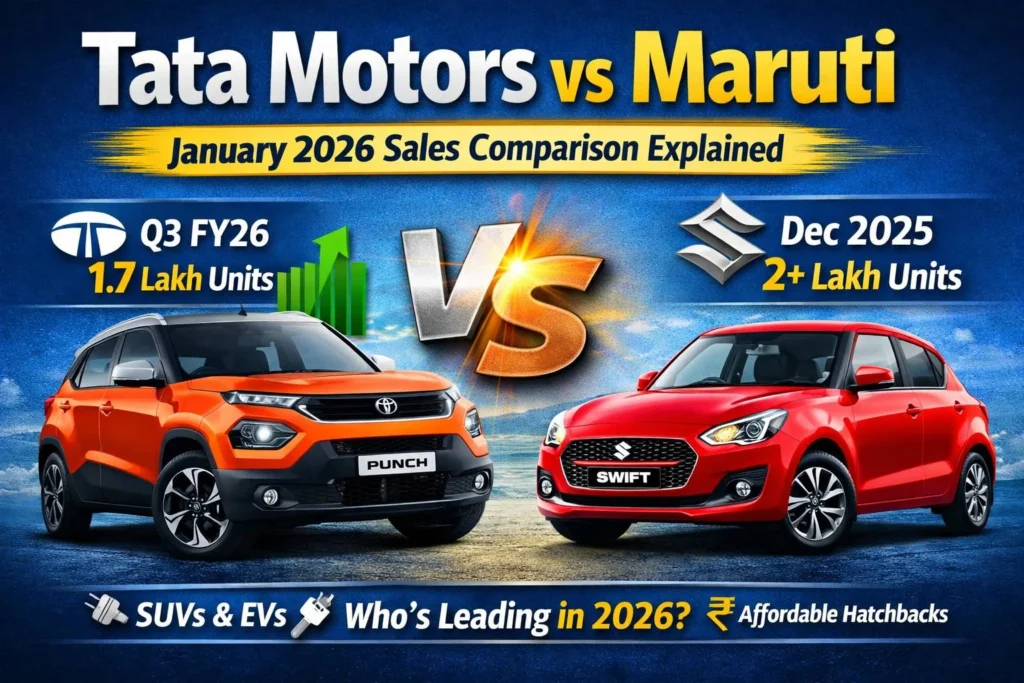
January 2026 passenger vehicle (PV) sales data highlights a clear contrast in strategy and execution between Tata Motors and Maruti Suzuki. While Maruti Suzuki continues to dominate in absolute volumes, Tata Motors is strengthening its position in high-growth segments such as SUVs and electric vehicles.
According to official company-reported dispatch data, Maruti Suzuki recorded 173,599 units in domestic PV sales in January 2026. Tata Motors reported 54,033 units in the same period. These figures represent wholesale dispatches to dealerships, the standard metric tracked by the Society of Indian Automobile Manufacturers (SIAM).
For official monthly data verification, refer to: SIAM Monthly Vehicle Sales Data
Market Share and Growth Context
Based on total industry volumes of approximately 4.2 lakh units in January 2026, Maruti Suzuki retained a market share of about 41.3%, while Tata Motors held around 12.8%.
Year-on-year performance shows:
– Maruti Suzuki: ~13% growth driven by SUVs and steady hatchback demand
– Tata Motors: ~7% growth led by Nexon and Punch volumes
This divergence reflects not just demand differences, but also product portfolio focus.
Entry-Level Hatchbacks: Maruti’s Volume Backbone
Maruti Suzuki continues to dominate the entry-level and compact hatchback segment with models such as Alto K10, WagonR, and Swift. WagonR alone crossed 20,000 units in January 2026, maintaining its position among India’s highest-selling cars.
This segment remains critical due to:
– Strong rural demand
– Lower acquisition cost
– High fuel efficiency and low maintenance
Tata Motors’ Tiago contributes steady volumes in the 7,000–8,000 range but does not compete aggressively on pricing due to higher material and safety costs.
SUV Segment: Tata’s Growth Engine
SUVs now account for over 50% of passenger vehicle sales in India (2025 industry data), making this the most competitive segment.
Tata Motors’ January 2026 performance was driven by:
– Nexon (ICE + EV): 17,000+ units
– Punch: 13,000+ units
– Harrier & Safari: 5,000+ units combined
Maruti Suzuki’s SUV lineup also delivered strong results:
– Brezza: 15,000+ units
– Fronx: 12,000+ units
– Grand Vitara: ~10,000 units
Tata’s advantage lies in perceived build quality, design differentiation, and safety positioning, particularly among urban buyers.
Electric Vehicles: Tata’s Clear Lead
Tata Motors remains the leader in India’s EV passenger vehicle segment, holding over 70% market share in 2025 and continuing strong momentum into 2026.
Its EV portfolio includes:
– Nexon EV (30.2 kWh and 40.5 kWh battery options)
– Tiago EV
– Tigor EV
The Nexon EV Long Range delivers a real-world range of approximately 300–320 km, compared to its ARAI-certified 465 km.
Maruti Suzuki has not yet launched a mass-market EV but is expected to enter the segment with its upcoming eVX-based model. Currently, it is focusing on strong hybrid systems to bridge the transition.
Technology Strategy Comparison
Maruti Suzuki:
– HEARTECT lightweight platform
– Strong hybrid systems (Grand Vitara)
– Focus on fuel efficiency and affordability
Tata Motors:
– ALFA and OMEGA architectures
– Ziptron EV technology
– Focus on electrification and safety
Maruti prioritizes efficiency and scale, while Tata focuses on future-ready technologies.
Distribution Strength and Rural Penetration
Maruti Suzuki’s network exceeds 3,700 sales outlets across India, giving it unmatched reach in rural and semi-urban markets.
Tata Motors has expanded to over 1,000 outlets but still trails in rural penetration and service consistency.
This difference plays a significant role in sustaining Maruti’s volume leadership.
Cost Structure and Profitability
Maruti operates a high-volume, cost-efficient model supported by:
– Deep localization
– Supplier scale advantages
– Lightweight engineering
Tata Motors, in contrast, has higher costs due to:
– Heavier build structures
– Battery costs in EVs (30–40% of vehicle cost)
– Lower economies of scale
However, Tata offsets this through higher per-unit realization in SUVs and EVs.
Ownership Economics
Ownership cost is increasingly influencing buyer decisions:
Maruti Advantages:
– Lower service costs
– Better fuel efficiency
– Higher resale value
Tata Advantages:
– Lower running cost in EVs (₹1–1.5/km)
– Better safety features
– Strong SUV value proposition
For example, an EV user can save ₹5,000–₹6,000 per month on fuel compared to petrol vehicles under typical usage.
Regulatory Impact
Government policies continue to shape the market:
– FAME-II incentives supporting EV adoption
– BS6 Phase 2 norms increasing ICE compliance costs
– State EV subsidies boosting demand in urban regions
These policies provide a structural advantage to Tata’s EV portfolio.
Urban vs Rural Demand Trends
Urban Demand:
– Preference for SUVs and EVs
– Safety and features prioritized
– Strong Tata performance
Rural Demand:
– Price-sensitive buyers
– Preference for hatchbacks
– Dominated by Maruti Suzuki
Future Outlook
Over the next 2–3 years:
Tata Motors:
– Expansion of EV portfolio (Curvv EV, Harrier EV)
– Dedicated EV platforms
– Focus on connected technology
Maruti Suzuki:
– Entry into EV segment
– Continued hybrid expansion
– Strengthening premium offerings
Conclusion
The January 2026 sales comparison reflects a deeper structural shift in India’s automotive market. Maruti Suzuki continues to lead through scale, affordability, and distribution strength. Tata Motors is building momentum through SUVs, safety, and electric mobility.
The competition is no longer about direct volume comparison alone. It is about how each company aligns with future mobility trends and evolving consumer expectations.
Key Takeaways
– Maruti Suzuki sold 173,599 units in January 2026
– Tata Motors sold 54,033 units with strong SUV contribution
– Tata leads EV market with over 70% share
– Maruti dominates rural and entry-level segments
– SUVs and EVs are reshaping market dynamics
FAQs
1. Who sold more cars in January 2026?
Maruti Suzuki sold 173,599 units, significantly higher than Tata Motors’ 54,033 units.
2. Why is Tata Motors growing faster in SUVs?
Tata’s focus on design, safety, and feature-rich SUVs has helped it gain traction in urban markets.
3. Does Maruti Suzuki have EVs?
As of January 2026, Maruti has not launched a mass-market EV but is expected to enter soon.
4. Which company is better for long-term ownership?
Maruti offers lower maintenance and better resale value, while Tata provides stronger safety and EV benefits.
5. What is driving Tata Motors’ growth?
Strong SUV demand and leadership in electric vehicles are the primary growth drivers.
6. Which segment is growing fastest?
The SUV segment remains the fastest-growing, followed by electric vehicles.
BMW has introduced a new AI-powered driving experience with the rollout of Operating System 9, a software platform that enables natural voice interaction, adaptive navigation, and continuous over-the-air updates.
BMW is entering a new phase of digital mobility by integrating advanced artificial intelligence into its latest vehicles. At the core of this shift is BMW Operating System 9, designed to unify voice interaction, navigation intelligence, driver assistance, and personalization into a single platform.
According to official BMW communication, Operating System 9 represents a major step toward software-defined vehicles, where features evolve continuously through software updates rather than hardware changes.
By combining machine learning, cloud connectivity, and deep sensor integration, BMW is restructuring how drivers interact with vehicles—reducing manual inputs and enabling context-aware automation.
What Defines BMW’s AI-Driven Driving Experience?
BMW Operating System 9 acts as a central intelligence layer connecting multiple vehicle systems into a unified architecture. Unlike traditional infotainment systems, it enables real-time data sharing across vehicle functions.
- Conversational Voice Interface: Understands intent and context
- Adaptive Navigation: Real-time traffic and route intelligence
- AI Driver Assistance: Continuous environment analysis
- OTA Updates: Ongoing feature improvements
- Full Personalization: Driver-specific cabin settings
Key insight: The shift is from reactive controls to predictive, AI-driven interaction.
Natural Voice Interaction and Reduced Distraction
The updated BMW Intelligent Personal Assistant supports natural conversations and multi-step commands without repeated prompts.
- “Find a coffee shop on my route.”
- “Set temperature to 22°C and play music.”
- “Do I have enough range?”
This reduces reliance on touchscreens and helps lower driver distraction.
AI Integration with Navigation and Driver Assistance
BMW combines cameras, radar, and sensors with AI algorithms to interpret driving conditions in real time.
- Adaptive cruise based on traffic and curves
- Navigation-linked lane guidance
- Automated parking with memory function
- 360° hazard detection
Personalization Through AI Learning
The system learns driver behavior and automatically adjusts seat position, climate, lighting, and media preferences.
Profiles linked to BMW ID can sync across vehicles like the BMW iX and BMW i7.
Software-Defined Vehicle and OTA Updates
Operating System 9 enables continuous improvement via over-the-air updates, extending vehicle capabilities over time.
This approach keeps vehicles technologically current without requiring dealership visits.
Real-World Models: BMW iX and i7
These AI features are already available in flagship EVs like the BMW iX and BMW i7, which act as technology platforms for BMW’s future systems.
They also preview the upcoming Neue Klasse architecture, focused on local AI processing and faster system response.
Everyday Driving Benefits
- Reduced driver workload
- Improved route efficiency
- Enhanced safety awareness
- Seamless voice control
Reality check: Performance depends on real-world conditions and infrastructure.
Technical Comparison
| Feature | Traditional | BMW OS 9 |
|---|---|---|
| Voice | Command-based | Natural language AI |
| Navigation | Static GPS | Live intelligent routing |
| Updates | Manual | OTA updates |
| Parking | Basic sensors | Automated memory system |
| Profiles | Limited | Cloud-based personalization |
Data Security and Privacy
BMW uses layered cybersecurity systems. Most processing occurs locally, while cloud data is anonymized. Drivers control data-sharing preferences.
Conclusion
BMW Operating System 9 marks a shift toward intelligent, software-driven mobility. By integrating AI across key systems, BMW is reducing friction between driver and machine.
Final takeaway: The future of driving is defined less by hardware and more by continuously evolving software platforms.
FAQ
What is BMW Operating System 9?
It is BMW’s latest software platform enabling AI-driven features, voice control, and OTA updates.
Which cars use this system?
Models like BMW iX and BMW i7 currently feature it.
Does it improve safety?
Yes, through AI-powered driver assistance and real-time monitoring.
Ankush Kumar is an automotive analyst specializing in electric vehicles, luxury cars, and real-world performance benchmarking. His work focuses on ownership insights, charging behavior analysis, and practical usability to help buyers make informed decisions based on real conditions rather than specifications alone.
He tracks industry data from global agencies, manufacturer reports, and road test benchmarks to deliver high-authority automotive analysis tailored for Indian buyers.
Follow on Facebook: Ankush Kumar