+91-9646339590



Introduction
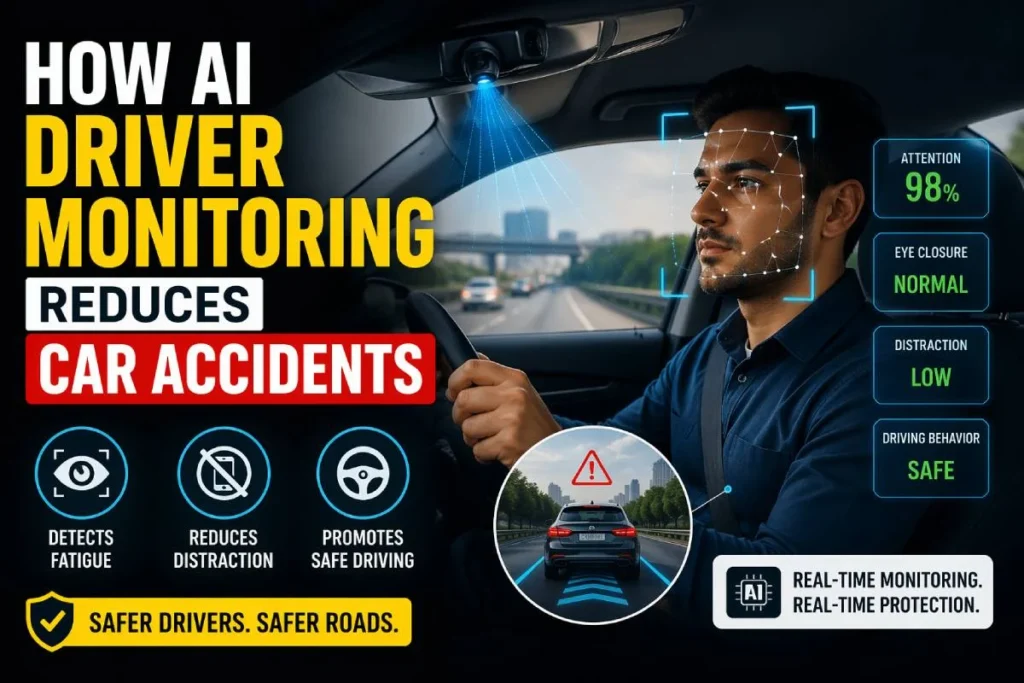
Human factors are estimated to contribute to over 90% of road accidents globally, according to multiple transport safety studies. Within that, distraction and fatigue remain among the most consistent triggers—especially in long-distance and urban stop-start driving conditions.
AI-powered driver monitoring systems (DMS) are designed to address this gap directly. By analyzing driver attention in real time using computer vision and behavioral modeling, these systems intervene before risky situations escalate into collisions. What has changed in recent years is not the concept—but the scale. DMS is rapidly moving from premium vehicles into the mid-range passenger segment, where most volume exists.
From an automotive systems perspective, this marks a shift from vehicle-centric safety (focused on crash mitigation) to human-centric safety (focused on error prevention).
What Are AI-Powered Driver Monitoring Systems?
AI-based driver monitoring systems combine in-cabin cameras, infrared sensors, and edge computing to evaluate driver alertness continuously. Unlike traditional safety features that react to vehicle movement (such as lane departure warnings), DMS focuses on the human operator.
Core parameters tracked include:
– Eye closure duration (PERCLOS) and blink frequency
– Head orientation and gaze tracking
– Facial expressions indicating fatigue or cognitive load
– Steering input patterns and correction delays
These inputs are processed using trained neural networks capable of distinguishing between normal and high-risk behavior. Modern systems operate locally within the vehicle, minimizing latency and avoiding dependence on cloud connectivity.
How AI Driver Monitoring Systems Reduce Accident Rates
1. Early Fatigue Detection Before Critical Impairment
Fatigue builds gradually, often without the driver’s awareness. AI systems detect early-stage indicators such as micro-sleeps, prolonged eyelid closure, and reduced facial responsiveness.
Systems developed by Bosch use infrared cameras to maintain accuracy even in low-light conditions. According to Bosch mobility data (2023), early fatigue detection can occur several minutes before visible driving errors, enabling preventive alerts.
Fleet telematics studies across EU and US logistics networks (2022–2024) indicate that integrating fatigue detection with alert systems can reduce drowsiness-related incidents by 20–30%, particularly in highway environments.
2. Real-Time Distraction Monitoring with Context Awareness
Modern distraction extends beyond phone usage. Infotainment systems, navigation inputs, and prolonged off-road glances contribute to cognitive overload.
AI systems distinguish between safe and unsafe attention shifts by measuring gaze duration. Brief glances are normal, sustained off-road focus beyond 2–3 seconds is flagged as high risk.
Seeing Machines, a global DMS specialist, reports from fleet deployments that active monitoring can reduce distraction-related safety events by up to 30% over 12 months.
3. Behavioral Baseline Modeling and Predictive Alerts
Unlike rule-based systems, AI models adapt to individual driving styles. Over time, they build a behavioral baseline and detect deviations such as slower steering response or inconsistent gaze patterns.
These deviations often occur before visible driving errors. By identifying them early, DMS enables predictive intervention rather than reactive correction.
4. Integration with ADAS for Layered Safety
Driver monitoring becomes more effective when integrated with Advanced Driver Assistance Systems (ADAS), creating a dual-layer safety architecture.
Continental AG has developed systems where DMS data directly influences ADAS responses. For example:
– Lane drift + driver inattention → stronger steering correction
– No driver response → controlled deceleration or emergency braking
According to Euro NCAP safety protocols (2023), combining DMS with ADAS improves crash avoidance effectiveness by 15–20%.
Why Mid-Range Passenger Vehicles Are the Inflection Point
Cost Compression and Hardware Standardization
The cost of in-cabin sensing hardware declined by approximately 30–40% between 2019 and 2024, driven by advances in camera modules and edge AI chips.
Mid-range vehicles (₹10–20 lakh) represent the highest volume segment in India. Deploying DMS at this level creates significantly larger safety impact than limited premium adoption.
Real-World Vehicle Examples in India
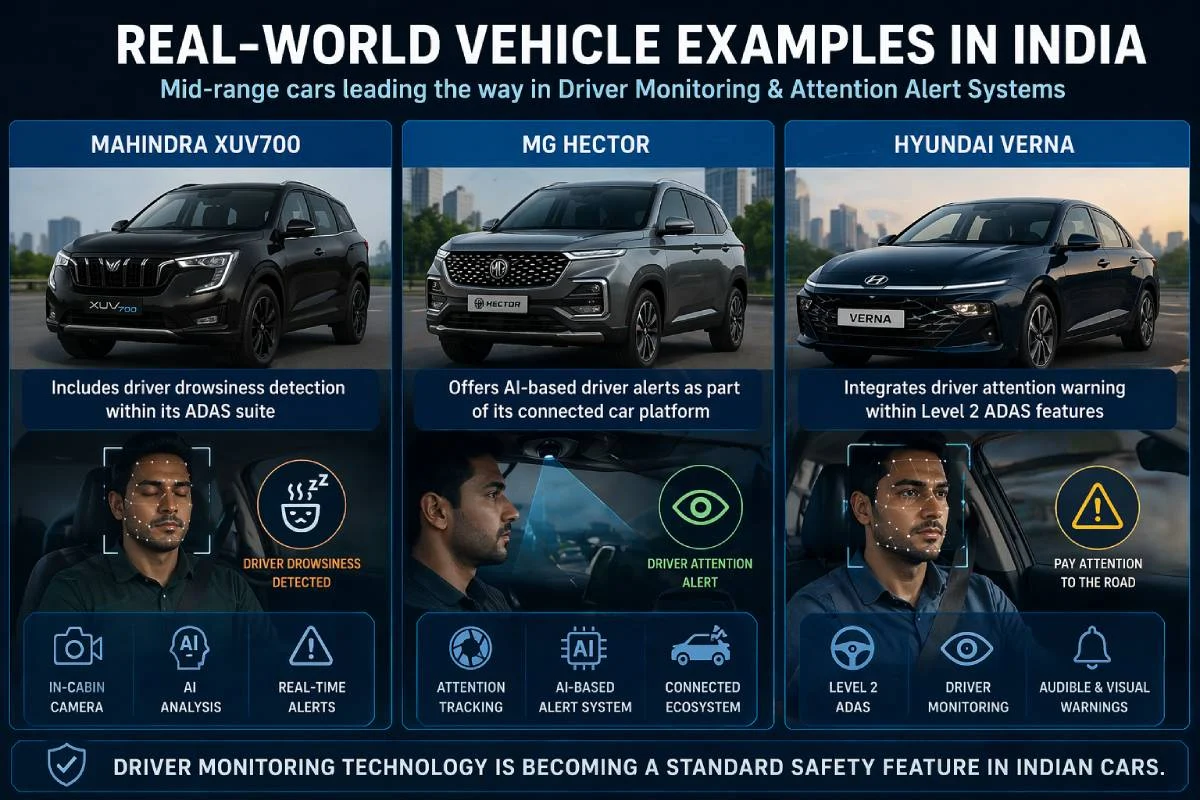
Based on current ADAS deployment trends in India, several mid-range vehicles are beginning to integrate driver monitoring or attention alert systems:
– Mahindra XUV700: Includes driver drowsiness detection within its ADAS suite
– MG Hector: Offers AI-based driver alerts as part of its connected car platform
– Hyundai Verna: Integrates driver attention warning within Level 2 ADAS features
These implementations may vary in sophistication, but they signal a clear transition toward driver-state monitoring as a standard feature.
Regulatory and Safety Rating Pressure
The European Union mandated driver monitoring systems in all new vehicles from July 2024 under its General Safety Regulation. More details are available on the European Commission Road Safety portal.
This regulatory direction ensures that DMS adoption will accelerate across all vehicle segments.
India-Specific Context: Why DMS Matters More Locally
India recorded over 4.6 lakh road accidents in 2022 (MoRTH). Driver fatigue, distraction, and inconsistent road conditions contribute significantly to these incidents.
Factors such as long highway drives, mixed traffic environments, and increased infotainment usage amplify cognitive load, making real-time driver monitoring particularly relevant.
Impact on Insurance and Fleet Economics
DMS data is increasingly being used in insurance risk modeling. Vehicles equipped with driver monitoring can generate behavior-based risk profiles.
Fleet operators report:
– 25–40% reduction in accident frequency over 12–18 months
– Lower claims severity
– Improved driver accountability
Challenges and Limitations
Privacy and Data Governance
Continuous monitoring raises concerns around data usage, storage, and user consent.
Edge Case Accuracy
Performance can be affected by sunglasses or extreme lighting, though newer AI models have improved accuracy significantly.
Driver Over-Reliance
DMS is assistive, not autonomous. Over-reliance can reduce driver vigilance if misunderstood.
Future Direction: From Monitoring to Active Intervention
Next-generation systems will move beyond alerts toward controlled intervention.
Developments include:
– Automatic slowdown if driver is unresponsive
– Emergency lane positioning
– Biometric-based cognitive monitoring
Companies like Smart Eye are developing AI models that predict cognitive overload before visible driving errors occur.
Conclusion
AI-powered driver monitoring systems represent a shift toward human-centric safety in automotive design. By addressing attention, fatigue, and behavioral anomalies, these systems directly target the root cause of most accidents.
As adoption expands into mid-range vehicles, DMS is transitioning from a premium feature to a foundational safety layer with measurable real-world impact.
Key Takeaways
– Human factors contribute to over 90% of road accidents
– AI DMS reduces fatigue-related incidents by 20–30%
– ADAS + DMS improves safety effectiveness by 15–20%
– Mid-range vehicles are driving large-scale adoption
– Regulation and insurance will accelerate deployment
FAQ Section
1. What is an AI driver monitoring system?
An AI driver monitoring system tracks driver attention and behavior to prevent accidents.
2. Which cars in India have driver monitoring systems?
Models like Mahindra XUV700, MG Hector, and Hyundai Verna include driver attention or drowsiness detection features.
3. How effective are these systems?
They can reduce fatigue and distraction-related incidents by 20–30% in real-world conditions.
4. Are they mandatory in India?
Not yet, but future safety regulations may include them.
5. Do these systems record drivers?
Most systems process data locally without storing video.
6. Can they replace driver responsibility?
No, they assist drivers but do not replace active control and attention.
Ankush Kumar is an automotive analyst specializing in electric vehicles, luxury cars, and real-world performance benchmarking. His work focuses on ownership insights, charging behavior analysis, and practical usability to help buyers make informed decisions based on real conditions rather than specifications alone.
He tracks industry data from global agencies, manufacturer reports, and road test benchmarks to deliver high-authority automotive analysis tailored for Indian buyers.
Follow on Facebook: Ankush Kumar