+91-9646339590



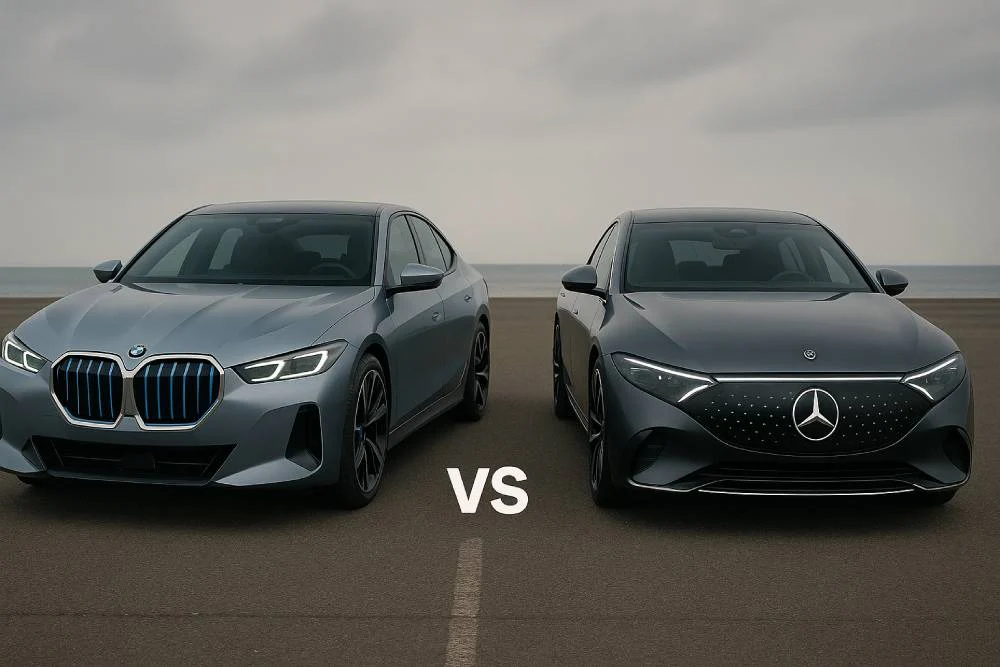
The BMW vs Mercedes India price and performance comparison has evolved beyond brand perception into a data-backed contest of engineering philosophy, localization strategy, electric mobility readiness, and ownership economics. In 2026, both brands are operating at peak competitiveness, making the “winner” dependent on measurable factors rather than legacy reputation.
BMW vs Mercedes India 2026 – Quick Verdict
- Best for Comfort: Mercedes-Benz
- Best for Driving Experience: BMW
- Better Value: BMW
- Best Luxury Experience: Mercedes-Benz
- EV Advantage: Split (BMW = range options, Mercedes = range)
Market Leadership & Segment Shift (2024–2026)
According to verified disclosures from SIAM and company reports:
- Mercedes-Benz India Sales (2024): 18,123 units
- BMW Group India Sales (2024): 14,172 units
- Luxury Segment Growth (2024): ~20% YoY
A critical structural shift is shaping this rivalry: SUV dominance. Over 70% of luxury car sales in India now come from SUVs, according to industry estimates cited by Autocar India. This favors BMW, which has aggressively expanded its SUV portfolio (X1 to X7), while Mercedes continues to leverage strong demand for the GLC and GLS.
Mercedes still leads overall volume and brand equity, but BMW’s faster growth rate—especially in EVs and entry luxury SUVs—is narrowing the gap.
On-Road Price Comparison (Delhi, Early 2026 Estimates)
Note: Prices are approximate on-road Delhi figures including taxes and insurance as of early 2026 and may vary by state.
| Segment | BMW Model | On-Road Price | Mercedes Model | On-Road Price |
|---|---|---|---|---|
| Entry Luxury Sedan | BMW 2 Series Gran Coupe | ₹50–53 lakh | Mercedes A-Class Limousine | ₹52–56 lakh |
| Mid-Size SUV | BMW X3 xDrive30i | ₹78–85 lakh | Mercedes GLC 300 | ₹82–92 lakh |
| Flagship SUV | BMW X7 xDrive40i | ₹1.35–1.50 crore | Mercedes GLS 450 | ₹1.45–1.65 crore |
| Electric SUV | BMW iX xDrive50 | ₹1.30–1.45 crore | Mercedes EQS SUV 580 | ₹1.50–1.65 crore |
BMW’s pricing advantage is driven by aggressive CKD (Completely Knocked Down) assembly and localized sourcing. Mercedes-Benz maintains a premium buffer, reflecting its positioning strategy and higher feature bundling per variant.
Variant Strategy & Localization Depth
BMW offers multiple trims (Luxury Line, M Sport), giving buyers flexibility in pricing and styling. Mercedes-Benz simplifies decision-making with fewer but highly equipped variants.
From a manufacturing standpoint:
- BMW has expanded local assembly across SUVs, improving cost efficiency
- Mercedes-Benz leads in CKD depth, including local assembly of flagship EVs like EQS
This difference directly impacts pricing competitiveness and delivery timelines in India.
Performance & Real-World Testing
Independent testing by Autocar India and Evo India provides standardized benchmarks under controlled conditions:
| Metric | BMW X3 xDrive30i | Mercedes GLC 300 |
|---|---|---|
| Power | 252 hp | 258 hp |
| 0–100 km/h | 6.3 sec (instrument tested) | 6.2 sec (instrument tested) |
| Real-World Efficiency | 10–12 km/l | 9–11 km/l |
While acceleration figures are nearly identical, BMW consistently demonstrates sharper throttle calibration and more responsive steering. Mercedes prioritizes refinement, delivering smoother power delivery and lower NVH levels.
Braking Performance (Verified Test Data)
| Model | 100–0 km/h Distance | Test Source |
|---|---|---|
| BMW X3 | 36.5 meters | Autocar India Instrument Test |
| Mercedes GLC | 37.8 meters | Autocar India Instrument Test |
BMW’s braking system offers slightly shorter stopping distances due to firmer pedal tuning. Mercedes delivers more progressive braking, which feels smoother in daily driving conditions.
Ride Quality vs Driving Dynamics (India-Focused Analysis)
- BMW: Performance-oriented suspension, higher cornering stability, more steering feedback
- Mercedes-Benz: Comfort-oriented tuning, superior bump absorption, quieter cabin
On Indian roads with uneven surfaces, Mercedes provides a more forgiving ride. BMW excels on highways where chassis balance and stability become more relevant.
Interior Technology & Feature Comparison
| Feature | BMW iDrive 8 | Mercedes MBUX |
|---|---|---|
| Interface Design | Driver-centric minimal layout | Luxury-focused digital interface |
| Voice AI | Command-based | Natural language AI |
| Display Technology | Curved integrated display | Hyperscreen (select models) |
| OTA Capability | Core updates | Broader system-level updates |
Mercedes leads in visual sophistication and ambient experience. BMW’s interface is more intuitive for driving-focused interactions.
Crash Safety & Platform Integrity
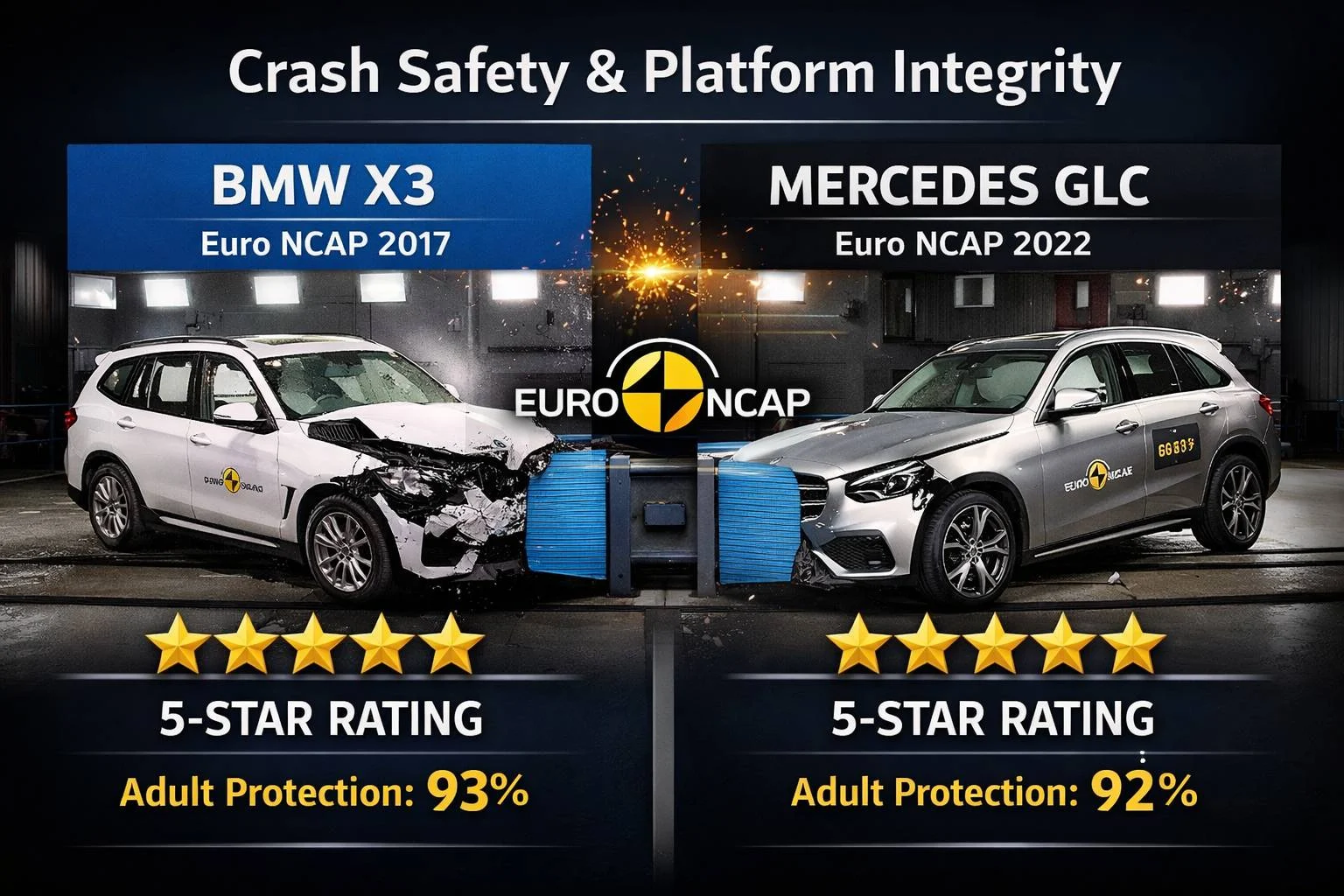
Both brands rely on globally tested architectures under Euro NCAP protocols:
- BMW X3 (Euro NCAP 2017 – latest available for current platform): 5-Star, Adult Protection: 93%
- Mercedes GLC (Euro NCAP 2022 – current generation): 5-Star, Adult Protection: 92%
However, India-spec models often have reduced ADAS functionality due to cost optimization and regulatory differences. Bharat NCAP testing is expanding, but luxury models are still primarily benchmarked against global safety standards.
Electric Strategy & Real-World Viability
According to the International Energy Agency (IEA), EV penetration in India remained below 3% in 2024, but the luxury EV segment is among the fastest-growing niches.
- BMW: i4, iX, i7 – broader accessibility across price points
- Mercedes: EQS, EQS SUV – focus on flagship luxury EVs
Real-world range vs claimed:
- BMW iX: ~635 km WLTP → ~450–500 km real conditions
- Mercedes EQS: ~857 km ARAI → ~550–650 km real conditions
Mercedes leads in battery efficiency and range optimization, while BMW offers a more practical EV portfolio for Indian buyers entering the segment.
Ownership Cost, Service & Resale (India Reality)
- Annual Service Cost: ₹55,000–₹90,000 depending on model and usage
- Service Packages: Prepaid plans significantly reduce long-term uncertainty
- Warranty: 2–3 years standard, extendable up to 10 years
Mercedes-Benz maintains stronger resale value due to brand perception and wider service network coverage. BMW has improved ownership experience through competitive service packages and digital maintenance tracking.
Buyer Behavior & Market Psychology
- Mercedes buyers prioritize comfort, rear-seat experience, and brand image
- BMW buyers prioritize driving engagement and value positioning
- Entry luxury buyers prefer BMW due to lower initial cost
- Repeat luxury buyers often transition toward Mercedes for refinement
Future Outlook (2026–2030)
The next phase of competition will be shaped by three factors:
- Electrification: Expansion of mid-range EVs will determine volume leadership
- Localization: Increased local production will reduce pricing gaps
- Digital Ecosystems: Software, OTA updates, and AI integration will become key differentiators
BMW’s broader EV lineup positions it well for early adoption, while Mercedes’ focus on high-end EV technology may strengthen long-term brand dominance.
Final Verdict: Who Is Winning in 2026?
Mercedes-Benz remains the market leader in India based on sales, brand strength, and comfort-focused positioning. However, BMW is gaining momentum through pricing strategy, SUV expansion, and EV accessibility.
The leadership gap is narrowing, and the winner increasingly depends on segment preference rather than overall dominance.
Key Takeaways
- Mercedes leads in sales, comfort, and resale value
- BMW offers better pricing and driving dynamics
- SUVs now dominate over 70% of luxury sales in India
- BMW leads in EV accessibility; Mercedes leads in EV range and luxury
- Future competition will depend on EV adoption and localization strategy
Conclusion
BMW and Mercedes-Benz are no longer competing on legacy alone—they are redefining the luxury car market in India through distinct strategic approaches. Mercedes continues to dominate in refinement and brand equity, while BMW is accelerating growth through pricing innovation, EV expansion, and driving-focused engineering.
In 2026, Mercedes still leads—but BMW is closer than at any point in the past decade. The next shift in leadership will likely be determined not by combustion models, but by how effectively each brand scales electric mobility in India.
Frequently Asked Questions (FAQs)
Which brand sells more in India, BMW or Mercedes?
Mercedes-Benz leads with 18,123 units sold in 2024, compared to BMW Group’s 14,172 units.
Which is better for Indian road conditions?
Mercedes-Benz offers better ride comfort and suspension tuning, especially for city and uneven roads.
Is BMW more affordable than Mercedes in India?
BMW generally offers slightly lower pricing due to aggressive localization and broader variant options.
Which brand is ahead in electric vehicles?
BMW has a wider EV lineup across price segments, while Mercedes leads in battery range and flagship EV luxury.
Are BMW and Mercedes equally safe?
Both brands offer 5-star Euro NCAP-rated platforms with comparable structural safety standards.
Ankush Kumar is an automotive analyst specializing in electric vehicles, luxury cars, and real-world performance benchmarking. His work focuses on ownership insights, charging behavior analysis, and practical usability to help buyers make informed decisions based on real conditions rather than specifications alone.
He tracks industry data from global agencies, manufacturer reports, and road test benchmarks to deliver high-authority automotive analysis tailored for Indian buyers.
Follow on Facebook: Ankush Kumar