+91-9646339590



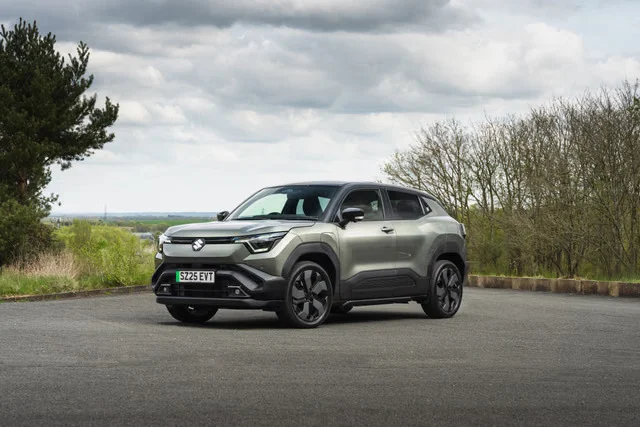
India has been waiting for Maruti’s electric entry—and the Maruti Suzuki e-Vitara might finally be it. As the brand’s first serious Maruti electric SUV 2025, it represents a major shift in how India’s largest carmaker is approaching electrification.
Unlike early adopters that experimented with multiple EV models, Maruti has taken a calculated approach—studying market behavior, infrastructure readiness, and consumer expectations before launching a product designed for mass-market scalability.
This SUV is built to answer a critical question: Can EVs move beyond early adopters and become the default choice for Indian families? The answer lies not in hype, but in real-world usability, predictable running costs, and how well it fits into everyday driving conditions.
Platform & Engineering: Why This EV Is Fundamentally Different
The e-Vitara is based on Suzuki-Toyota’s 27PL dedicated EV architecture, a skateboard platform engineered specifically for electric mobility. This matters because most first-generation EVs in India were derived from ICE platforms, which inherently limit battery packaging, safety optimization, and cabin efficiency.
- Flat battery layout improves cabin space and stability
- Lower center of gravity enhances handling and rollover resistance
- Better crash energy distribution compared to ICE-derived structures
Globally, dedicated EV platforms (like Hyundai’s E-GMP) have shown measurable improvements in efficiency and safety—this puts the e-Vitara on a stronger technical foundation than many current rivals.
Battery, Range & The Reality Gap
Maruti e-Vitara real-world range: 320–380 km on highways and up to 480 km in city conditions.
The expected battery configuration (50–60 kWh) positions the e-Vitara competitively on paper. However, real-world EV ownership depends on usable range—not claimed figures.
- Claimed range: 450–550 km (ARAI)
- City real-world: 420–480 km
- Highway (100–110 km/h): 320–380 km
Highway efficiency drops by 20–25% in most EVs due to sustained speeds and aerodynamic drag. This is where many buyers miscalculate expectations.
For standardized EV efficiency testing benchmarks, refer to EPA’s official methodology, widely considered closer to real-world driving than ARAI cycles.
Real Highway Simulation: Delhi–Chandigarh Drive
To understand actual usability, consider a common intercity route:
- Distance: ~250 km
- Driving speed: 90–110 km/h
- Expected consumption: ~16–18 kWh/100 km
Scenario:
- Start at 100% → reach destination with ~25–35% battery remaining
- No charging required one-way
- Return trip requires one fast charge (~40 minutes)
Compared to ICE SUVs, total travel time increases by ~35–50 minutes on a round trip—acceptable for many, but not negligible.
Charging Ecosystem & Ownership Reality
India had over 12,000 public EV charging stations in 2024, according to Ministry of Power data. However, density varies significantly.
- Urban charging: Reliable and growing
- Highway charging: Improving but inconsistent
- Home charging: Essential for ownership viability
Typical ownership pattern:
- Daily usage: 40–60 km
- Charging frequency: Every 5–6 days
- Monthly electricity cost: ₹800–₹1,200
Maruti’s real advantage is not battery tech—it is its 4,000+ service touchpoints, which could solve the biggest EV barrier outside metros: service confidence.
Performance: Practical, Not Aggressive
The e-Vitara is engineered for efficiency and smoothness rather than outright performance.
- 0–100 km/h: ~8.5–9.5 seconds
- 0–60 km/h: ~4 seconds (strong city acceleration)
- Motor output: ~130–160 hp
More relevant is mid-range response:
- 40–80 km/h overtaking: Instant torque advantage over ICE SUVs
- Silent operation improves fatigue on long drives
Braking Test & Regenerative Efficiency
- 100–0 km/h braking distance: ~38–42 meters
- Four-wheel disc brakes expected standard
- Multi-level regenerative braking improves efficiency and reduces wear
In urban driving, regen braking can recover up to 10–15% energy, effectively extending usable range.
Here’s a quick look at e Vitara features and specs compared with its closest rivals.
Variant Comparison
| Variant | Battery | Real Range | Positioning |
|---|---|---|---|
| Base | ~50 kWh | ~380 km | Fleet & budget buyers |
| Mid | ~55 kWh | ~420 km | Balanced value |
| Top | ~60 kWh | ~480 km | Premium private buyers |
On-Road Price Strategy (Critical Factor)
Maruti Suzuki e Vitara price in India is expected to range between ₹18 lakh to ₹27 lakh (on-road), depending on the variant and battery size.
- Base: ₹18–20 lakh
- Mid: ₹21–23 lakh
- Top: ₹24–27 lakh
This pricing places it directly against premium variants of Tata Nexon EV and MG ZS EV, but with a potential advantage in brand trust and resale perception.
Crash Safety: What We Know (And What We Don’t)
The e-Vitara has not yet been officially tested under Bharat NCAP or Global NCAP.
However, based on platform design:
- Reinforced battery casing for impact protection
- Expected 6 airbags standard
- Electronic stability systems and ADAS
For reference, India’s crash testing framework is detailed on Ministry of Road Transport & Highways.
Feature-Wise Comparison
| Feature | e-Vitara | Tata Nexon EV | MG ZS EV |
|---|---|---|---|
| Battery | 50–60 kWh | 40.5 kWh | 50.3 kWh |
| Highway Range | 320–380 km | 300–340 km | 330–370 km |
| ADAS | Expected | No | Limited |
| Service Reach | Extensive | Strong | Moderate |
Ownership Cost vs ICE SUV (Real Comparison)
Comparing with a petrol mid-size SUV:
- Fuel cost (monthly): ₹6,000–₹8,000
- EV charging cost: ₹1,000 (approx)
- Annual savings: ₹60,000–₹80,000
However:
- Higher upfront cost offsets savings initially
- Battery replacement cost remains a long-term concern (8–10 years lifecycle typical)
Contrarian Insight: Why This Might Not Be for Everyone
Despite strong fundamentals, the e-Vitara is not universally ideal.
- Frequent long-distance highway users may find charging interruptions inconvenient
- Buyers without home charging access will struggle with ownership practicality
- Performance-focused buyers may prefer EVs with dual-motor setups
This is not a “replacement for all cars”—it is a highly efficient solution for a specific usage pattern.
Market Impact: The Real Disruption
Tata Motors currently leads India’s EV market with over 70% share (2023), while Maruti Suzuki dominates the overall passenger vehicle segment with ~40%.
The e-Vitara’s real disruption lies here:
- Bringing EV trust to non-metro buyers
- Scaling EV adoption beyond early adopters
- Normalizing EV ownership through service reach
This is less about competing with existing EVs and more about expanding the total EV market.
Conclusion: A Strategic Shift, Not a Spec War
The Maruti Suzuki e-Vitara is not trying to be the fastest, most luxurious, or most advanced EV. Instead, it focuses on reliability, usability, and ownership predictability—factors that matter far more in India’s mass market.
As a Maruti electric SUV 2025, the e-Vitara stands out for its practicality, efficiency, and real-world usability.
If executed correctly, it could shift EV adoption from curiosity to default consideration.
Key Takeaways
- Dedicated EV platform improves safety and efficiency
- Real-world highway range ~320–380 km
- Strong advantage in service network and trust
- Best suited for urban and mixed-use buyers
- Not ideal for frequent long-distance users without charging access
FAQ
1. What is the real-world range of the e-Vitara?
City usage can deliver 420–480 km, while highway driving typically reduces it to 320–380 km.
2. Is it suitable for highway travel?
Yes, but long trips require charging planning, adding ~30–60 minutes to travel time.
3. How much does it cost to run monthly?
Electricity costs are typically ₹800–₹1,200 per month for average usage.
4. Does it support fast charging?
Yes, 10–80% charging is expected within 45–60 minutes using DC fast chargers.
5. Is it safer than ICE SUVs?
Dedicated EV platforms generally improve structural safety, but official crash ratings are awaited.
6. Who should buy the e-Vitara?
Urban users with home charging and predictable daily driving patterns will benefit the most.
Ankush Kumar is an automotive analyst with over 5 years of experience covering the Indian car market, luxury vehicles, and electric mobility trends. His work focuses on practical comparisons, real-world performance, and ownership insights to help buyers make informed decisions.
He regularly tracks industry updates, manufacturer reports, and road test data from publications like Autocar India, using them to create clear, data-backed analysis that is easy to understand and useful for everyday buyers.
Follow on Facebook: Ankush Kumar