+91-9646339590



Electric Vehicle Safety in India: A Deep, Source-Backed Analysis of Accidents and Fire Risk (2023–2025)
Electric vehicles (EVs) are rapidly scaling in India as part of efforts to reduce emissions, improve air quality, and cut fuel import bills. However, safety — especially related to battery fires — remains a topic of intense public interest. This article presents a deep, data-driven analysis of EV accidents and fire events in India with clear source attribution, global benchmarks, and technical context to help readers understand actual risks versus perception.
Official Government Data: What the Reports Say
The most authoritative data on EV accidents in India comes from the Electronic Detailed Accident Report (eDAR) database, maintained under the Ministry of Road Transport and Highways (MoRTH). eDAR is the official system where all road accidents registered at police stations are logged using a standardized digital format.
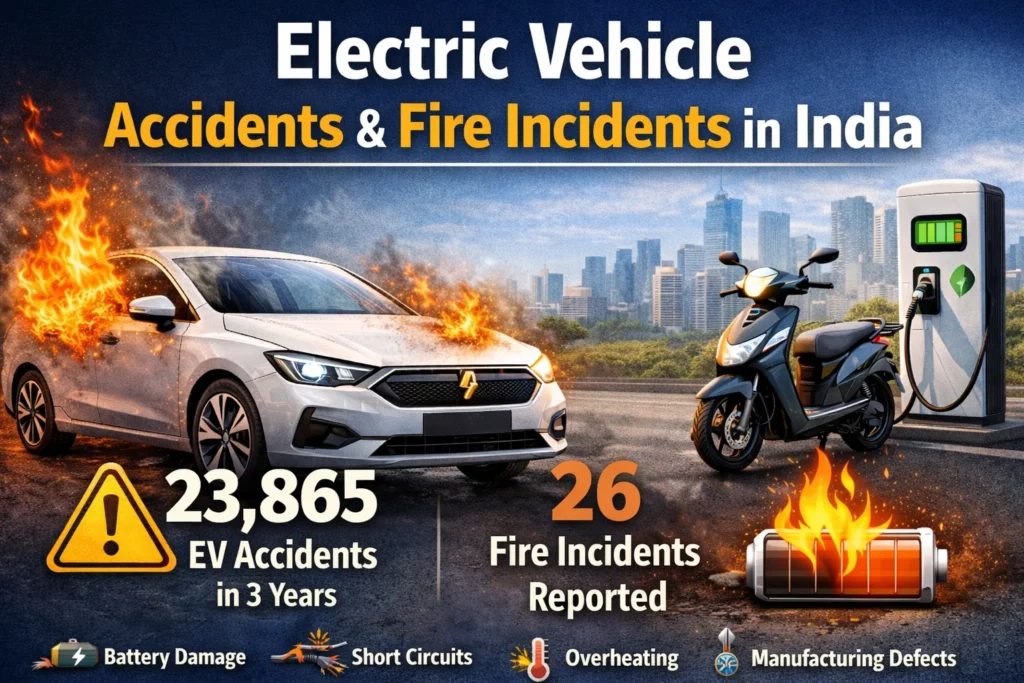
Statistics cited by the Government of India — including responses provided in Parliament by the Minister of Heavy Industries — show the following EV accident and fire incident counts for the calendar years 2023–2025:
| Year | Total EV Accidents (eDAR) | EV Fire Incidents (eDAR) |
|---|---|---|
| 2023 | 5,594 | 8 |
| 2024 | 7,817 | 9 |
| 2025 | 10,454 | 9 |
| Total | 23,865 | 26 |
These figures are drawn from official responses submitted by government ministries in parliamentary question replies. The numbers are compiled and periodically published internally by the Ministry of Heavy Industries as part of EV sector monitoring updates.
Interpreting the Numbers: Why 23,865 Isn’t the Whole Story
Raw accident counts don’t tell the risk story by themselves. A meaningful assessment must look at these figures relative to the number of EVs on the road.
According to the Society of Indian Automobile Manufacturers (SIAM) Annual EV Report and registration data published by state transport departments, EV registrations — particularly in the two-wheeler category — have grown by several million units between 2023 and 2025. Using this fleet context to assess risk shows that fire incidents represent a very small proportion of total EV activity.
Rate-Based Risk Calculation
To translate incidents into a measure readers can understand:
- Total EV fire incidents over three years: 26
- Total EV registered units (estimated from registration reports): multi-million
- Fire incidents as a fraction of total EV fleet: significantly less than 1 per 100,000 vehicles
This suggests that the likelihood of an EV experiencing a fire event remains very low compared to the number of EVs in circulation.
How India’s EV Fire Data Compares Internationally
For global context, safety reports from advanced mobility markets help benchmark fire risk. The National Highway Traffic Safety Administration (NHTSA) Traffic Safety Facts reports in the United States and aggregated fire incident summaries from agencies such as the Swedish Civil Contingencies Agency (MSB) have consistently shown that:
- Internal combustion engine (ICE) vehicles (petrol/diesel) have historically higher fire incidence rates on a per-vehicle basis than electric vehicles.
- EV fire incidents represent a small fraction of total road vehicle fire events in mature markets when normalized by fleet size.
- Hybrid vehicles sometimes show fire counts that exceed pure electric vehicles in proportional comparisons.
While fire incident reporting methodologies may vary between countries, the global trend supports the conclusion that EV fires, though visually dramatic, are not more frequent than fires in traditional vehicles when scaled per number of vehicles.
Technical Causes of EV Fires: Clear Explanation
An EV battery pack is composed of multiple lithium-ion cells connected into modules and managed by safety systems. Battery fires typically stem from a rare condition known as thermal runaway, which can be triggered under extreme stress conditions.
The main triggers for thermal runaway include:
- Severe mechanical damage to the battery pack (e.g., a high-impact collision)
- Internal electrical short circuits due to manufacturing defects
- High-heat conditions during charging without adequate thermal management
- Poor quality repairs or unauthorized battery modifications
However, modern EVs are equipped with multiple protective layers:
- Battery Management System (BMS) — monitors cell voltages and temperatures continuously
- Circuit protections — prevent overcharge or overcurrent events
- Thermal cooling systems — dissipate heat under normal operation
- Crash-resistant enclosures — protect cells in accidents
Advances in battery chemistry, particularly greater use of Lithium Iron Phosphate (LFP) cells, have increased thermal stability compared to older high-nickel formulations — further reducing fire risk in current EV designs.
Regulatory Standards and Safety Protocols in India
To improve EV battery safety, Indian authorities have updated and strengthened standards overseen by the Bureau of Indian Standards (BIS) and referenced in the Automotive Industry Standards (AIS) documents. Key requirements include:
- Thermal propagation resistance testing
- Mechanical shock and vibration testing
- Overcharge and temperature stress tests
- Ingress protection levels against dust and water
- Exit conditions for certification before production and sale
These standards must be met before any EV model is permitted for retail sale in India. Compliance helps ensure product quality and safety consistency across manufacturers.
Consumer-Level Safety Best Practices
Even though EV fire events are rare, safe practices further reduce risk:
- Purchase EVs only from certified, reputable manufacturers whose products comply with AIS and BIS standards.
- Use manufacturer-approved and certified charging equipment only.
- Avoid unauthorized battery pack modifications or third-party replacements.
- Adhere to recommended charging cycles and avoid over-charging.
- Get regular inspections and maintenance from authorized service centers.
Proper owner behavior helps ensure battery reliability and safety during day-to-day use.
Why EV Fires Receive Significant Public Attention
EV fires often draw intense media coverage for several reasons:
- Electric vehicles are relatively new technology compared to petrol/diesel vehicles.
- Battery fires can be more visually dramatic and harder to extinguish than fuel fires.
- Public curiosity and fear around unfamiliar technology amplify coverage.
- Frequent ICE vehicle fire incidents are often normalized and less newsworthy.
This amplification does not imply higher danger — it reflects psychological and coverage dynamics rather than statistical risk comparisons.
Final Assessment: Are Electric Vehicles Safe for Indian Roads?
Based on official accident and fire data from the eDAR reporting system, regulatory oversight by MoRTH and BIS, and global comparisons with mature mobility markets, the evidence indicates that:
- EV fire incidents are rare relative to total EV usage.
- Statistically, EVs have fire frequencies that are lower than or comparable to traditional petrol/diesel vehicles when normalized per vehicle fleet size.
- Technical safeguards and regulatory standards actively work to reduce risk over time.
- Consumer behavior and certified equipment usage further mitigate residual risks.
In conclusion, electric vehicles in India are statistically safe when evaluated in context of fleet size, industry safety systems, and global transport sector comparisons. As EV adoption grows and safety standards evolve, a balanced, data-driven perspective will remain critical for informed understanding.
About the Author
Ankush Kumar is an automotive content specialist with over 5 years of experience covering global car markets, hybrid technologies, and EV ecosystem developments. His work focuses on translating complex automotive engineering concepts into practical insights for Indian buyers.
He has analyzed vehicle platforms, powertrain systems, and real-world usability trends across multiple brands. His content emphasizes data-backed evaluation, regulatory awareness, and ownership practicality.